












What Is Sheikh Mansour's Net Worth?
Sheikh Mansour bin Zayed Al Nahyan is an Emirati royal, politician, and businessman who has a net worth of $30 billion.
Sheikh Mansour bin Zayed Al Nahyan is the Vice President and Deputy Prime Minister of the United Arab Emirates, Chairman of the Presidential Court, and one of the most influential members of Abu Dhabi's ruling family. He is internationally best known as the owner of Manchester City Football Club, which he purchased in 2008 for £200 million and transformed into one of the world's most valuable and successful soccer franchises. In May 2026, Manchester City was valued at $5.5 billion. Mansour also controls the wider City Football Group, a global network of soccer clubs with interests across Europe, the Americas, Asia, and Australia. His influence extends well beyond professional sports. He chairs Mubadala Investment Company and the Emirates Investment Authority, two major government-owned investment organizations, while maintaining substantial private business and real estate interests.
Mansour's ownership of Manchester City has also generated significant controversy. In September 2026, an independent Premier League commission found the club guilty of extensive financial-rule violations involving more than £900 million in improperly presented revenues and costs over nine seasons. The findings centered on sponsorship arrangements that disguised funding from Mansour's ownership company. Manchester City appealed the ruling and continues to deny wrongdoing. The controversy has become one of the biggest financial scandals in soccer history, raising questions about competitive fairness, the influence of wealthy club owners, and the relationship between international politics and professional sports.
Early Life and Education
Sheikh Mansour bin Zayed Al Nahyan was born on November 20, 1970, in Abu Dhabi, then part of the Trucial States. He is a son of Sheikh Zayed bin Sultan Al Nahyan, the founding President of the United Arab Emirates, and Sheikha Fatima bint Mubarak.
Mansour belongs to the powerful Al Nahyan dynasty, which has ruled Abu Dhabi for generations. He is one of six full brothers often referred to as the "Bani Fatima," a group that includes UAE President Sheikh Mohamed bin Zayed Al Nahyan. The brothers have occupied prominent positions across the UAE's government, military, financial institutions, and international investment organizations.
Mansour received his early education in Abu Dhabi before continuing his studies in the United States. He earned a bachelor's degree in international relations in 1993 and subsequently began taking on government responsibilities under his father.
Political Career
Sheikh Mansour began his political career in the 1990s. In 1997, he became Chairman of the Office of Sheikh Zayed bin Sultan Al Nahyan, giving him direct experience in the administration of the UAE presidency. He remained in that position until his father's death in November 2004.
Following Sheikh Zayed's death, Mansour was appointed Minister of Presidential Affairs, overseeing administrative and institutional matters connected to the presidency. He held that portfolio for nearly two decades, serving during the presidencies of his half-brother Sheikh Khalifa and later his full brother Sheikh Mohamed.
In May 2009, Mansour was appointed Deputy Prime Minister of the UAE. His responsibilities included coordinating federal government activities and participating in the country's economic and administrative development. In July 2022, following a government restructuring, he became Minister of the Presidential Court, a position also styled Chairman of the Presidential Court.
On March 29, 2023, UAE President Sheikh Mohamed appointed Mansour Vice President of the United Arab Emirates. He shares the vice presidency with Dubai's ruler, Sheikh Mohammed bin Rashid Al Maktoum, who also serves as Prime Minister.
These appointments placed Mansour among the highest-ranking officials in the UAE government. His responsibilities span presidential administration, federal policymaking, and oversight of major investment and development institutions.
Government Investment Leadership
Beyond his political responsibilities, Mansour has held leadership positions at some of Abu Dhabi's most important financial institutions. He chairs Mubadala Investment Company, the Abu Dhabi government-owned investment organization whose international portfolio includes businesses in technology, energy, financial services, manufacturing, healthcare, and infrastructure.
Mubadala oversees hundreds of billions of dollars in assets, making it one of the world's largest sovereign investment organizations. Its holdings and investments have included semiconductor businesses, renewable-energy companies, private-equity partnerships, and major international corporations.
Mansour also chairs the Emirates Investment Authority, the federal investment institution established in 2007 to manage and develop strategic investments on behalf of the UAE government. Unlike Abu Dhabi's emirate-level sovereign funds, the Emirates Investment Authority operates at the federal level.
Earlier in his career, Mansour served as chairman of First Gulf Bank, one of the UAE's major financial institutions before its merger with National Bank of Abu Dhabi in 2017. He has also held positions involving education, charitable foundations, agricultural development, and government investment policy.
These roles have made Mansour a significant figure in the UAE's efforts to diversify its economy beyond oil. Although the organizations he oversees control enormous investment portfolios, their state-owned assets are separate from his personal fortune.

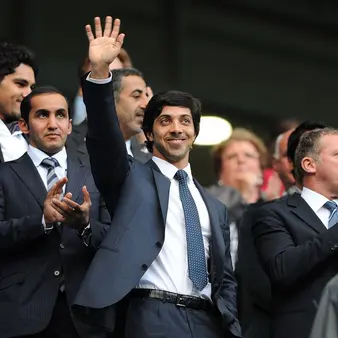
(Photo by Nigel French – PA Images via Getty Images)
Buying Manchester City
In September 2008, Sheikh Mansour transformed the economics of English soccer when his investment vehicle, Abu Dhabi United Group, agreed to purchase Manchester City Football Club for £200 million.
At the time, Manchester City was a historically significant but financially troubled Premier League team. The club had spent much of the previous several decades overshadowed by its wealthier and more successful rival, Manchester United. Its previous owner, former Thai Prime Minister Thaksin Shinawatra, was facing serious legal and financial difficulties, leaving Manchester City in need of new investment.
The Abu Dhabi takeover immediately changed the club's prospects. On the same day the acquisition was announced, City signed Brazilian star Robinho from Real Madrid for £32.5 million, breaking the British transfer record and signaling the ownership group's willingness to spend heavily on elite players.
Over the following years, City invested hundreds of millions of pounds in players, coaching, infrastructure, and commercial development. Major signings included Carlos Tevez, David Silva, Yaya Touré, and Sergio Agüero.
Mansour appointed prominent Abu Dhabi businessman Khaldoon Al Mubarak as Manchester City's chairman. While Mansour remained the club's ultimate owner, Al Mubarak oversaw its day-to-day strategic direction alongside senior executives and football management.
In 2012, City won its first English league championship in 44 years. The title was secured in extraordinary fashion when Agüero scored a stoppage-time goal against Queens Park Rangers on the final day of the season, snatching the championship from Manchester United.
The victory became the defining moment of City's early years under Mansour and demonstrated how dramatically the club's competitive position had changed.
Manchester City's Rise to Global Dominance
Manchester City's success accelerated after the arrival of manager Pep Guardiola in 2016. Supported by major investments in players, facilities, and coaching infrastructure, Guardiola assembled one of the most successful teams in English soccer history.
Under Guardiola, City won six Premier League championships, including four consecutive titles from 2021 through 2024. The squad featured stars such as Kevin De Bruyne, Bernardo Silva, Rodri, and Erling Haaland.
The club's greatest achievement came during the 2022-23 season, when Manchester City won the Premier League, FA Cup, and UEFA Champions League. That historic treble culminated in a 1-0 victory over Inter Milan in the Champions League final in Istanbul.
The club subsequently added the UEFA Super Cup and FIFA Club World Cup, cementing its position among the dominant teams in international soccer. Guardiola departed in 2026 after a decade in charge, with Enzo Maresca succeeding him as manager.
The sporting success was accompanied by enormous commercial growth. Manchester City reported revenue of £694.1 million for the 2024-25 financial year, including £340.4 million in commercial revenue and £278.6 million from broadcasting. The club recorded a £9.9 million loss that year after reporting profits in several preceding seasons.
In May 2026, Manchester City was valued at $5.5 billion, making it one of the most valuable soccer clubs in the world. That represented a dramatic increase from the £200 million Mansour paid to acquire the team in 2008, although significant additional capital had been invested in the business over the intervening years.
City Football Group
Manchester City became the foundation of a much larger international sports business. Under Mansour's ownership, City Football Group expanded into a network of clubs designed to share scouting resources, coaching methods, player development systems, commercial partnerships, and operational expertise.
The group established New York City FC in Major League Soccer and acquired Melbourne City FC in Australia. It also expanded into European and South American soccer through clubs including Girona FC in Spain, Palermo in Italy, and Bahia in Brazil. Other investments and partnerships have involved teams in Belgium, France, Japan, China, Uruguay, and Bolivia.
In November 2019, American investment firm Silver Lake agreed to invest $500 million in City Football Group in exchange for slightly more than 10% of the company. The transaction valued the entire organization at $4.8 billion.
Silver Lake subsequently increased its ownership position to nearly 17%. Mansour retained majority control through Newton Investment and Development LLC, an Abu Dhabi company that he wholly owns.
The global structure has allowed City Football Group to develop players and commercial opportunities across multiple countries. It has also created regulatory challenges when clubs under common ownership qualify for the same international competitions, requiring governance arrangements designed to satisfy UEFA and other governing bodies' rules.
Manchester City's £900 Million Financial Scandal
Mansour's ownership of Manchester City became the subject of one of the most consequential financial investigations in professional soccer history.
In February 2023, the Premier League charged Manchester City with more than 100 alleged violations of its financial regulations. The case became popularly known as the "115 charges," although the allegations covered multiple categories of financial reporting, sponsorship income, managerial compensation, player payments, and cooperation with investigators.
The alleged violations dated from the 2009-10 season through the 2017-18 season, a period in which City was establishing itself as a major force in English soccer.
At the center of the investigation was the question of whether sponsorship agreements with companies based in Abu Dhabi accurately reflected commercial payments, or whether money supplied by Mansour's ownership organization had been disguised as independent sponsorship revenue.
An independent Premier League commission conducted a 42-day hearing that concluded in December 2024. On September 29, 2026, the Premier League announced that the commission had found Manchester City guilty of all the charges relating to serious financial-rule breaches, as well as the majority of allegations concerning its failure to cooperate with the investigation.
The commission concluded that City had entered into sham commercial arrangements that artificially increased the club's reported revenue while reducing its reported expenses. It found that Abu Dhabi United Group, Mansour's ownership vehicle, had supplied substantial sums that were presented in the club's accounts as sponsorship income from other companies.
The commission identified £949.94 million in sponsorship revenue recorded from Abu Dhabi companies over the nine seasons under investigation. According to its findings, only £119.25 million represented genuine base payments from the sponsors, while £830.69 million consisted of additional sums funded by the ownership organization.
Including other arrangements involving operating costs and player image rights, the commission concluded that the schemes had artificially inflated Manchester City's revenue and reduced its reported expenses by more than £900 million.
The findings also addressed compensation arrangements involving former club employees, including payments that had been recorded through consultancy agreements rather than standard employment contracts. A separate arrangement involving the sale of players' image rights to an outside company was also found to have disguised funding from the ownership group.
The commission determined that Manchester City's financial statements had concealed its true financial position from auditors and regulators. It concluded that the club would have substantially exceeded both Premier League and UEFA spending limits had its finances been reported accurately.
The commission also criticized City's conduct during the investigation, finding that the club had obstructed the process and that certain witnesses had provided false evidence.
Manchester City strongly rejected the findings. On October 1, 2026, the club formally appealed, maintaining that the commission's decision contained serious factual and legal errors. City continued to insist that it possessed extensive evidence demonstrating its innocence.
The commission's findings concerned the football club and its financial reporting arrangements. They did not constitute a criminal conviction of Sheikh Mansour personally.
The ruling left Manchester City facing potentially severe sporting and financial penalties. Under Premier League rules, available sanctions include fines, points deductions, and other competitive punishments. More severe possibilities, including relegation, became the subject of considerable public debate.
The commission had not announced a sanction when City filed its appeal, leaving the ultimate consequences to be resolved through the league's disciplinary and appeals processes.
Earlier UEFA Financial Fair Play Controversies
Manchester City's financial practices had attracted scrutiny long before the Premier League's 2026 ruling.
In 2014, UEFA determined that City had failed to comply with its Financial Fair Play regulations, which were designed to restrict the amount clubs could lose while competing in European tournaments.
The club agreed to a settlement that included a conditional £49 million financial penalty, of which £32 million was suspended, along with restrictions on its Champions League squad and transfer spending. City disputed aspects of UEFA's interpretation of the rules but accepted the settlement.
In 2018, German magazine Der Spiegel published leaked documents and internal correspondence raising questions about Manchester City's sponsorship arrangements. The reporting alleged that large portions of certain commercial payments ultimately originated with Abu Dhabi's ownership interests rather than independent sponsors.
In February 2020, UEFA banned Manchester City from European competition for two seasons and imposed a €30 million fine after concluding that the club had improperly overstated sponsorship revenue.
City appealed to the Court of Arbitration for Sport, which overturned the European competition ban in July 2020. The court determined that the alleged disguised funding violations had either not been sufficiently established or were outside UEFA's applicable time limits. However, it upheld a finding that City had failed to cooperate with UEFA's investigation and imposed a reduced €10 million fine.
The decision allowed Manchester City to continue competing in the Champions League.
The subsequent Premier League investigation was a separate proceeding conducted under different rules, ultimately producing the adverse findings announced in September 2026.
Sponsorship Disputes and Sportswashing Criticism
Manchester City's financial controversies have extended beyond its historical accounting practices.
The club became involved in a separate legal dispute with the Premier League over rules governing commercial agreements between teams and businesses connected to their owners. Known as Associated Party Transaction rules, the regulations are intended to prevent clubs from using inflated sponsorship contracts with related companies to circumvent spending restrictions.
Manchester City challenged aspects of those rules, arguing that they were unlawful and unfairly applied. An arbitration tribunal found elements of the previous rules unenforceable, but the Premier League subsequently introduced revised regulations.
In September 2025, Manchester City and the Premier League settled their dispute, with the club accepting that the revised Associated Party Transaction rules were valid and binding.
Mansour's ownership has also prompted criticism from human rights organizations and campaigners who argue that investments in prominent international sporting teams can help improve the public image of governments facing criticism over their human rights records.
Critics have described Manchester City's Abu Dhabi ownership as an example of "sportswashing," a term used when governments or powerful investors are accused of using sporting success and international visibility to enhance their reputations.
Supporters of the ownership have pointed to the club's sporting achievements, development of training facilities, expansion of youth and women's soccer, and investment in surrounding communities as evidence of the takeover's broader benefits.
Business Interests and Wealth
Sheikh Mansour's $30 billion fortune is rooted in his position within Abu Dhabi's ruling family, inherited wealth, and extensive private investments. Although his international reputation is closely associated with Manchester City, his wealth also encompasses interests in real estate, finance, and other businesses.
The Al Nahyan family controls one of the world's wealthiest oil-producing emirates. Abu Dhabi's energy resources have supported the development of an enormous investment industry, with government-owned institutions holding assets across international stock markets, private companies, infrastructure, energy, and real estate.
Mansour operates at the intersection of private investment and government economic leadership. His ownership of City Football Group is a clearly identifiable private commercial interest, while his positions at organizations such as Mubadala and the Emirates Investment Authority give him oversight responsibilities involving much larger state-owned portfolios.
His investment interests have also extended into British property development. In 2014, Abu Dhabi United Group partnered with Manchester City Council to establish Manchester Life, a major residential regeneration initiative.
The project was initially announced as part of a development program that could attract up to £1 billion in investment over ten years and support the construction of thousands of homes. Developments focused on neighborhoods including Ancoats and New Islington, close to Manchester City's Etihad Stadium.
The partnership helped finance residential construction and urban regeneration but also attracted criticism over the treatment of publicly owned land, transparency, affordable housing, and the allocation of development profits.
Mansour's ownership interests in Manchester City and related businesses have consequently become closely intertwined with the wider economic relationship between Abu Dhabi and the United Kingdom.
Personal Life
Sheikh Mansour is married to Sheikha Manal bint Mohammed bin Rashid Al Maktoum, a daughter of Dubai's ruler, Sheikh Mohammed bin Rashid Al Maktoum. The couple married in 2005 and have five children.
Mansour also has a son from an earlier marriage to Sheikha Alia bint Mohammed bin Butti Al Hamed.
His marriage to Sheikha Manal strengthened the family connections between the ruling dynasties of Abu Dhabi and Dubai, the two most economically powerful emirates in the UAE.
Outside politics and business, Mansour has a longstanding interest in equestrian sports, particularly endurance racing and Arabian horses. He has supported horse racing and breeding activities in the UAE and has participated in the development of the country's equestrian sporting institutions.
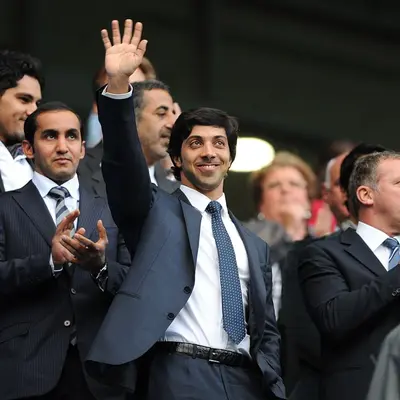
Despite being one of the most recognizable owners in international soccer, Mansour rarely attends Manchester City matches in person. His appearance at the 2023 Champions League final in Istanbul was especially notable, as it was his first appearance at a competitive Manchester City match since 2010.