








What Was Khalifa bin Zayed Al Nahyan's Net Worth?
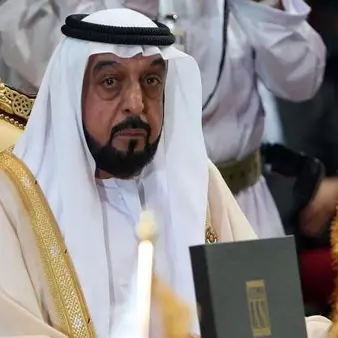
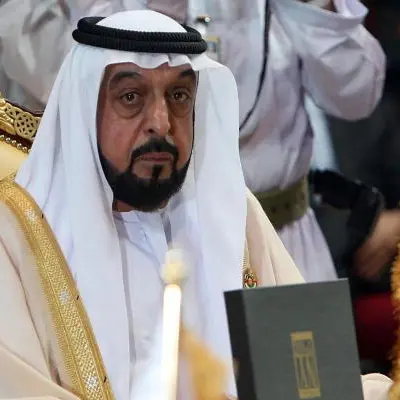
Sheikh Khalifa bin Zayed Al Nahyan was an Emirati royal and political leader who had a net worth of $18 billion at the time of his death in 2022.
Sheikh Khalifa bin Zayed Al Nahyan served as the second President of the United Arab Emirates and ruler of Abu Dhabi from 2004 until his death. The eldest son of UAE founder Sheikh Zayed bin Sultan Al Nahyan, he helped oversee the transformation of Abu Dhabi from an oil-dependent emirate into a global financial powerhouse. He was instrumental in establishing the Abu Dhabi Investment Authority, which grew into one of the world's largest sovereign wealth funds, and presided over the UAE during a period of extraordinary economic development. His personal fortune included one of London's largest privately owned real estate portfolios, valued at £5.5 billion, and the $600 million superyacht "Azzam," which became the world's longest private motor yacht when it launched in 2013. He also played a pivotal role in Dubai's financial rescue during the 2008 financial crisis, an intervention that resulted in the world's tallest building being named Burj Khalifa in his honor.
Sheikh Khalifa suffered a stroke in January 2014 and subsequently withdrew from most public appearances, with his half-brother Sheikh Mohamed bin Zayed Al Nahyan assuming responsibility for much of the country's day-to-day leadership. Khalifa remained president until his death on May 13, 2022, at the age of 73.
Early Life
Khalifa bin Zayed Al Nahyan was born on September 7, 1948, in Al Ain, in the emirate of Abu Dhabi, then part of the British-protected Trucial States. His father, Sheikh Zayed bin Sultan Al Nahyan, would become the founding President of the United Arab Emirates in 1971. His mother was Sheikha Hassa bint Mohammed bin Khalifa Al Nahyan.
Khalifa grew up before the discovery and development of Abu Dhabi's vast oil reserves transformed the region's economy. He attended the Nahyaneia School in Al Ain and received much of his early political education from accompanying his father on official visits and meetings with tribal leaders.
His upbringing exposed him to the traditions of leadership within the Al Nahyan ruling family. When Sheikh Zayed became ruler of Abu Dhabi in August 1966, Khalifa was just 17 years old, but he was already being prepared for significant responsibilities in government.
Early Political Career and Crown Prince
Khalifa's formal political career began in August 1966, when his father appointed him the ruler's representative in Abu Dhabi's Eastern Region. The position gave him responsibility for administrative affairs in Al Ain and the surrounding communities.
In February 1969, Khalifa became Crown Prince of Abu Dhabi and head of the emirate's Department of Defense. He helped develop the Abu Dhabi Defense Force, which later became a central component of the UAE Armed Forces following the country's formation in December 1971.
That same year, Khalifa became Prime Minister of Abu Dhabi and took responsibility for the defense and finance portfolios. In 1974, he was appointed chairman of the Abu Dhabi Executive Council, which replaced the emirate's local cabinet and became its principal administrative authority.
As chairman, Khalifa oversaw major investments in housing, roads, public utilities, hospitals, schools, and other infrastructure. These projects helped transform Abu Dhabi from a relatively small coastal settlement into a modern capital city.
In 1976, he became Deputy Supreme Commander of the UAE Armed Forces, a position he retained until his death. He was also deeply involved in managing Abu Dhabi's growing oil revenues and developing the institutions responsible for investing them.
Abu Dhabi Investment Authority
One of Khalifa's most consequential financial achievements was helping establish the Abu Dhabi Investment Authority, commonly known as ADIA, in 1976.
Working with his father, Khalifa helped create the organization to invest a portion of Abu Dhabi's oil revenues in international financial markets. The objective was to build a permanent source of investment income that could support future generations even as the emirate diversified beyond petroleum.
Khalifa served as chairman of ADIA from its inception and remained closely associated with the institution throughout his political career. Under his leadership, the fund expanded into international equities, bonds, real estate, private equity, infrastructure, and alternative investments.
By the time of Khalifa's death in 2022, ADIA was believed to control $700 billion in global assets. Its investments extended across major international financial markets and made Abu Dhabi one of the world's most influential institutional investors.
Khalifa also chaired the Supreme Petroleum Council, the body historically responsible for setting Abu Dhabi's oil and natural gas policies. Together, his positions at ADIA and the petroleum council placed him at the center of the emirate's economic development and international investment strategy.
President of the United Arab Emirates
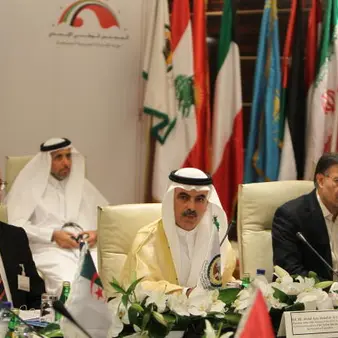
When Sheikh Zayed died on November 2, 2004, Khalifa succeeded him as ruler of Abu Dhabi. The following day, the UAE's Federal Supreme Council elected him President of the United Arab Emirates.
Although his father had remained the country's official leader until his death, Khalifa had already assumed substantial governing responsibilities during the preceding decade because of Sheikh Zayed's declining health.
As president, Khalifa continued the country's infrastructure development and economic diversification programs. His administration expanded investment in education, healthcare, housing, and transportation while encouraging the growth of industries beyond oil production.
He was reelected to additional five-year presidential terms in 2009, 2014, and 2019. Unlike a directly elected presidency, the UAE presidency is chosen by the Federal Supreme Council, which consists of the rulers of the country's seven emirates.
Khalifa also oversaw changes to the Federal National Council, the UAE's advisory parliamentary body. Beginning in 2006, a portion of its membership was selected through limited elections involving an electoral college, while the remaining members continued to be appointed.
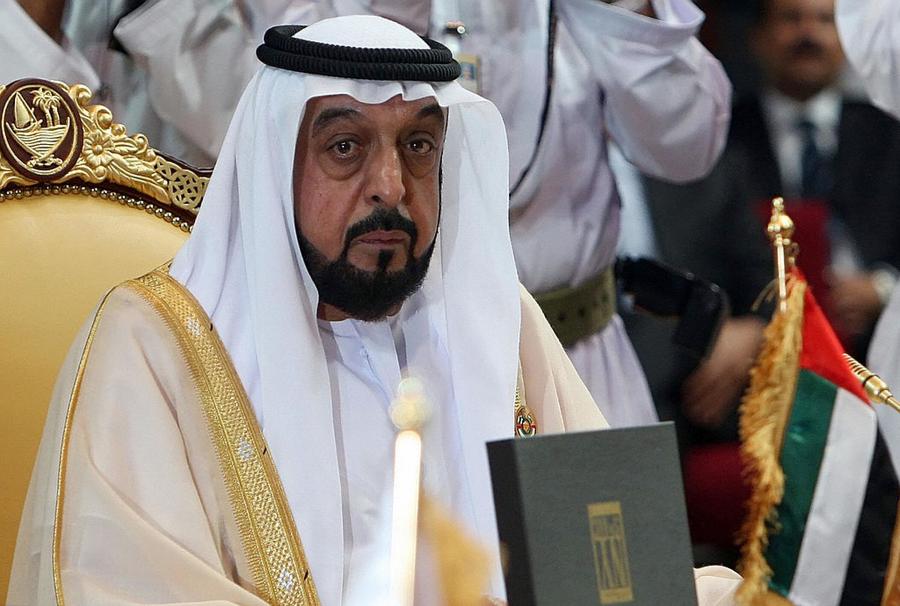
KARIM JAAFAR/AFP via Getty Images
The $20 Billion Dubai Bailout and Burj Khalifa
One of the defining financial episodes of Khalifa's presidency occurred during the global financial crisis of 2008 and 2009, when neighboring Dubai experienced a severe debt crisis.
Dubai had spent years financing enormous real estate, tourism, and infrastructure projects through government-related companies. When global credit markets collapsed, the emirate faced mounting debt obligations and the possibility of major defaults.
Abu Dhabi, under Khalifa's leadership, provided Dubai with $20 billion in financing during 2009. The assistance helped stabilize Dubai's finances and prevented the crisis from escalating into a broader economic emergency.
The intervention also demonstrated the extent of Abu Dhabi's financial resources and its influence within the UAE federation.
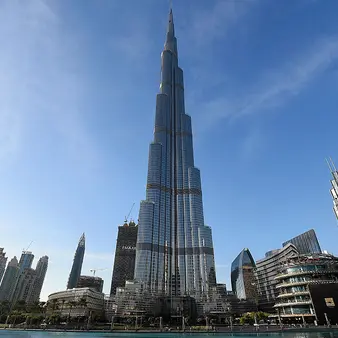
In January 2010, Dubai inaugurated the world's tallest skyscraper. Originally developed under the name Burj Dubai, the 828-meter tower was renamed Burj Khalifa in honor of Sheikh Khalifa and Abu Dhabi's financial support during the crisis.
The building became one of the world's most recognizable architectural landmarks and remains the most famous structure bearing his name.
£5.5 Billion London Real Estate Empire
One of the most revealing insights into Khalifa's personal fortune emerged from investigations into his extensive London property holdings.
In April 2016, the Panama Papers investigation identified Sheikh Khalifa as the beneficial owner of at least 30 companies established in the British Virgin Islands through the offshore law firm Mossack Fonseca.
Those companies were used to hold commercial and residential properties in some of London's most expensive neighborhoods, including Mayfair, Kensington, Knightsbridge, and Westminster.
The International Consortium of Investigative Journalists initially identified at least $1.7 billion in properties connected to the companies. However, a subsequent investigation by The Guardian, published in October 2020, revealed that Khalifa's holdings were considerably larger.
Using court documents, leaked financial records, and British land registry information, The Guardian identified a real estate empire valued at £5.5 billion, encompassing around 170 properties.
The portfolio included major office buildings, luxury apartment complexes, shopping locations, and entire sections of some of central London's most valuable streets.
Among the most prominent holdings were:
- Berkeley Square: Khalifa controlled the freeholds of 95 buildings surrounding one of London's most prestigious squares, including properties occupied by luxury businesses, restaurants, and offices.
- Time Life Building: The landmark building on New Bond Street, purchased in 2005, housed the London flagship store of luxury fashion house Hermès.
- One Kensington Gardens: A luxury apartment development designed by architect David Chipperfield, where individual apartments were marketed for prices between £18 million and £26 million.
- 46 Berkeley Square: The building containing Annabel's, the exclusive London private members' club associated with restaurateur Richard Caring.
- 3 Hans Crescent: A residential building in Knightsbridge, close to Harrods, which contained the Ecuadorian Embassy where WikiLeaks founder Julian Assange lived for seven years.
- De Vere Gardens: A substantial collection of valuable property in Kensington, including a stretch acquired for £160 million.
Court filings revealed that Khalifa spent £1 billion acquiring five properties in 2005 alone. By 2015, the portfolio had reached a value of £5.5 billion and was generating £160 million in annual rental income.
His tenants included major financial institutions, international retailers, luxury fashion companies, and restaurants. At its peak, the portfolio accommodated around 1,000 tenants.
Much of the property empire was managed through a complex network of offshore companies and trusts. A Liechtenstein-based organization called Holbein Anstalt, operating from a Mayfair townhouse near the Dorchester Hotel, handled aspects of the royal family's private financial affairs.
The arrangements allowed Khalifa to accumulate one of London's largest privately controlled property portfolios while keeping much of his ownership out of public view for decades.
London Property Management Dispute
The size and complexity of Khalifa's London holdings also became the subject of litigation in the British courts.
In 2018, companies beneficially owned by Khalifa brought legal proceedings against Lancer Property Asset Management, which had managed a substantial portion of the portfolio between 2004 and 2017.
The companies alleged that more than £26 million in fees had been improperly diverted to offshore entities connected to a former representative of Khalifa's property interests. Lancer disputed the allegations, arguing that the payments had been authorized or approved under agreements involving the property owners.
The dispute produced a series of High Court and Court of Appeal judgments addressing management contracts, financial arrangements, and the admissibility of evidence from earlier settlement negotiations.
The court proceedings also provided public confirmation that Khalifa was the ultimate beneficial owner of a property portfolio valued at £5 billion, strengthening the documentary record of his extraordinary private real estate holdings.
Seychelles Palace and Environmental Controversy
Khalifa also accumulated property in the Seychelles, the Indian Ocean island nation known for its luxury resorts and secluded beaches.
Beginning in the 1990s, he acquired land on Mahé, the country's largest island, eventually assembling a substantial property intended for a private palace complex. The development was located in the elevated La Misère area and included an elaborate mountaintop residence.
The project became controversial because of its scale, environmental impact, and the close financial relationship between the UAE and the Seychelles government.
In February 2010, an accident involving a sewage treatment facility at the palace construction site contaminated local water supplies with raw sewage and diesel fuel. The incident affected around 1,400 residents and workers in La Misère and Petit Barbarons.
Residents complained of health problems and damage to their communities, prompting demands for compensation and investigations into the construction contractor, Associated Contracting and Consulting Limited, known as ASCON.
In March 2011, ASCON agreed to a compensation package totaling 99 million Seychellois rupees, equivalent to $7.2 million at the time. More than 90% of affected households accepted the initial compensation arrangement, which provided payments of 250,000 rupees per household.
Disputes over additional compensation continued for years. In 2019, Seychelles officials announced that the government would fund a further $15 million in compensation, prompting renewed protests from residents who believed the financial responsibility should fall on those connected to the palace development. Additional payments continued after Khalifa's death.
The controversy drew attention to the relationship between Khalifa's private property interests and the substantial development assistance that the UAE provided to the Seychelles.
$600 Million "Azzam" Superyacht
One of Khalifa's most extravagant possessions was "Azzam," a superyacht commissioned for him and completed in 2013 by the German shipbuilder Lürssen.
The vessel cost $600 million to construct and measured 180.6 meters, or 592 feet, in length. When it launched, "Azzam" surpassed Roman Abramovich's "Eclipse" to become the longest private motor yacht in the world.
Despite its extraordinary size, "Azzam" was designed for speed. Its combination of gas turbines and diesel engines allowed it to reach speeds exceeding 30 knots, making it unusually fast for a vessel of its dimensions.
The yacht featured six decks, accommodations for 36 guests, and facilities for a crew of up to 80 people. Its interior was designed by French designer Christophe Leoni, while the exterior was created by Italian yacht design firm Nauta Design.
One of its most impressive features was an expansive main salon measuring 95 feet in length, designed as an open space without supporting columns.
The yacht became one of the most recognizable symbols of the personal wealth accumulated by Abu Dhabi's ruling family.
Foreign Policy and International Relations
During Khalifa's presidency, the UAE strengthened its relationships with the United States and other Western powers while becoming more assertive in regional affairs.
In 2011, the UAE participated in the international military intervention in Libya against the forces of Muammar Gaddafi. The country contributed aircraft to the NATO-led operation and supported international efforts to protect civilians during the conflict.
The UAE later participated in the Saudi-led military intervention in Yemen, beginning in 2015, a campaign that generated significant international criticism because of civilian casualties and the humanitarian crisis associated with the war.
Another major diplomatic development occurred in September 2020, when the UAE formally normalized relations with Israel through the Abraham Accords. The agreement established diplomatic ties and opened new opportunities for trade, tourism, investment, and technological cooperation.
Although Khalifa remained the country's president throughout these developments, his half-brother Sheikh Mohamed bin Zayed Al Nahyan exercised much of the country's executive authority following Khalifa's 2014 stroke.
Philanthropy
Khalifa supported major charitable and development initiatives through the Khalifa bin Zayed Al Nahyan Foundation and other institutions associated with the UAE government.
One of the largest gifts came in 2011, when the Khalifa Foundation donated $150 million to the University of Texas MD Anderson Cancer Center in Houston. At the time, it was the largest philanthropic gift in the cancer center's history.
The funding supported the development of the Sheikh Zayed Bin Sultan Al Nahyan Building for Personalized Cancer Care, which opened in 2016. The building houses the Sheikh Khalifa Bin Zayed Al Nahyan Institute for Personalized Cancer Therapy and the Sheikh Ahmed Bin Zayed Al Nahyan Center for Pancreatic Cancer Research.
In 2018, the UAE also provided $50 million to Johns Hopkins Medicine to establish the Sheikh Khalifa Stroke Institute. The initiative supported advances in stroke prevention, diagnosis, treatment, and rehabilitation.
His philanthropic interests extended to educational development, humanitarian assistance, and housing programs for Emirati citizens. The Khalifa Foundation funded projects in numerous countries, including programs providing food, healthcare, and emergency assistance to communities affected by conflict and natural disasters.
Personal Life
Khalifa was married to Sheikha Shamsa bint Suhail Al Mazrouei. The couple had eight children: Sultan, Mohammed, Shamma, Salama, Osha, Sheikha, Latifa, and Mouza.
His extensive family connections included several of the UAE's most prominent political figures. His half-brother Mohamed bin Zayed succeeded him as President of the UAE, while another half-brother, Sheikh Mansour bin Zayed Al Nahyan, became internationally known for his ownership of Manchester City Football Club and his major business investments.
Khalifa maintained a strong interest in traditional Emirati sports, particularly horse racing and camel racing. He supported local sporting events and organizations that promoted equestrian activities and the preservation of the country's cultural traditions.
He received several international honors during his presidency, including the United Kingdom's Honorary Knight Grand Cross of the Order of the Bath and the Netherlands' Knight Grand Cross of the Order of the Netherlands Lion.
Health and Death
In January 2014, Khalifa suffered a stroke and underwent surgery. Although the UAE government announced that his condition had stabilized, he subsequently made very few public appearances.
His brother Mohamed bin Zayed, then Crown Prince of Abu Dhabi, assumed responsibility for much of the country's governing activity. Khalifa continued to hold the offices of President of the UAE and ruler of Abu Dhabi and was reelected to a fourth presidential term in November 2019.
Sheikh Khalifa died on May 13, 2022, at the age of 73. The UAE announced 40 days of national mourning, with flags lowered to half-staff and government offices and private businesses closed for three days.
He was buried at Al Bateen Cemetery in Abu Dhabi. On May 14, 2022, the Federal Supreme Council unanimously elected his half-brother Sheikh Mohamed bin Zayed Al Nahyan as the country's third president, formally transferring leadership to the man who had already exercised much of the UAE's executive authority for nearly a decade.