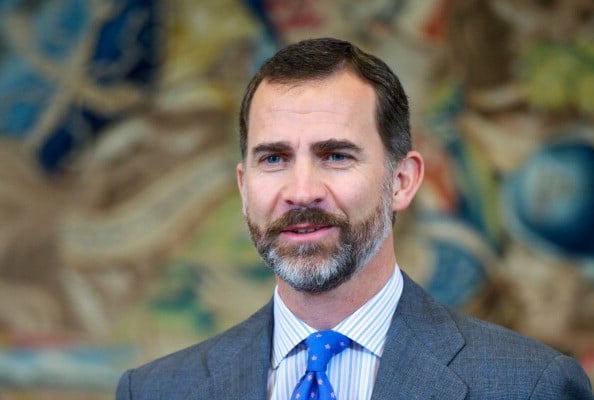
What Is Felipe VI's Net Worth and Salary?
Felipe VI is the King of Spain and has a net worth of $4 million. Felipe became king in June 2014 following the abdication of his father, Juan Carlos I. As Spain's constitutional monarch, he serves as head of state and commander-in-chief of the armed forces, formally appoints the prime minister following parliamentary approval, signs legislation, and represents the country at home and abroad.
Felipe inherited a monarchy whose reputation had been damaged by financial and personal scandals involving members of his family. He responded by reducing the number of working royals, introducing stricter rules governing gifts and private employment, commissioning external audits, and disclosing his personal assets. In 2022, the Royal Household valued Felipe's private property at €2.57 million, providing unusually clear support for his estimated $3 million net worth.
His reign has included repeated parliamentary deadlocks, changes of government, the Catalan independence crisis, the COVID-19 pandemic, and continuing debate about the monarchy's role in Spanish society. Felipe is married to former television journalist Queen Letizia. Their elder daughter, Leonor, Princess of Asturias, is heir to the throne.
Net Worth Analysis
In 2022, Felipe released a detailed official asset disclosure. His decision to publish his assets distinguishes his finances from the much less transparent wealth associated with Juan Carlos. The 2022 disclosure valued his personal assets at the time at exactly €2,573,392.80, roughly $2.9 million. The total consisted of:
- €2,267,942.80 in financial assets: Bank deposits, savings accounts, investment funds, and securities accumulated primarily through his official salary.
- €305,450 in personal property: Artwork, antiques, and jewelry owned privately by Felipe.
The disclosure did not list privately owned real estate. Felipe and his family use residences including Zarzuela Palace, but those properties are administered by the state and are not counted as his personal assets.
Felipe received an official salary of €290,000 in 2026. The Royal Household also receives a larger annual budget covering staff, administration, travel, and official activities, but that institutional funding is not personal income.
Early Life and Education
Felipe Juan Pablo Alfonso de Todos los Santos de Borbón y de Grecia was born on January 30, 1968, in Madrid, Spain. He is the youngest child and only son of Juan Carlos and Queen SofÃa. His older sisters are Infanta Elena and Infanta Cristina.
His father became King of Spain in November 1975 following the death of Francisco Franco. Felipe was formally proclaimed Prince of Asturias, the traditional title of the heir to the Spanish throne, in 1977.
Felipe attended Santa MarÃa de los Rosales School in Madrid and spent a preparatory year at Lakefield College School in Ontario, Canada. He later studied law at the Autonomous University of Madrid, taking additional courses in economics.
He completed a Master of Science in Foreign Service at Georgetown University in Washington, D.C. While studying at Georgetown, he shared a residence with his cousin, Crown Prince Pavlos of Greece.
Military Training
As heir to the throne and future commander-in-chief, Felipe received training in all three branches of Spain's armed forces.
He entered the General Military Academy in Zaragoza in 1985, continued at the Naval Military Academy in MarÃn, and trained aboard the Spanish Navy vessel "Juan Sebastián de Elcano." He then attended the General Air Academy in San Javier and qualified as a military pilot.
Felipe has served in the army, navy, and air force and holds the highest military rank as king. His training was intended to provide familiarity with the institutions he would one day formally command rather than prepare him for a conventional full-time military career.
Olympic Sailing
Like several members of his family, Felipe became a competitive sailor. He represented Spain in the Soling class at the 1992 Summer Olympics in Barcelona and carried the Spanish flag during the opening ceremony.
Felipe and his teammates finished sixth, earning an Olympic diploma. His participation came 32 years after his uncle, King Constantine II of Greece, won an Olympic sailing gold medal, and four years after his sister Cristina competed at the Seoul Games.
Prince of Asturias
On his 18th birthday in 1986, Felipe swore allegiance to the Spanish Constitution and formally accepted his responsibilities as heir.
Over the following decades, he represented Spain at presidential inaugurations, international economic conferences, trade missions, cultural events, and state ceremonies. He traveled extensively throughout Latin America and developed relationships with political leaders across Europe and the wider Spanish-speaking world.
Felipe also became closely associated with the Prince of Asturias Foundation and its annual awards, which recognize achievements in science, culture, international cooperation, literature, sports, and public service. The organization and awards were renamed for the Princess of Asturias after he became king.
Marriage to Letizia Ortiz
Felipe's engagement to television journalist Letizia Ortiz Rocasolano was announced in November 2003. Letizia had worked as a reporter and news anchor and had previously been briefly married in a civil ceremony.
Felipe and Letizia married at Madrid's Almudena Cathedral on May 22, 2004. It was the first royal wedding held at the cathedral.
Their first daughter, Leonor, was born in October 2005. Their second daughter, SofÃa, was born in April 2007. Leonor became Princess of Asturias and heir presumptive when Felipe ascended to the throne.
Becoming King of Spain
Juan Carlos announced his abdication in June 2014 following declining public support, health problems, and scandals involving the royal family. Parliament passed the legislation required to complete the transition.
Felipe was proclaimed king on June 19, 2014. Rather than holding a traditional coronation, he took the constitutional oath before parliament and delivered an address promising a renewed monarchy suited to modern Spain.
He reduced the official Royal Family to himself, Letizia, their daughters, Juan Carlos, and Queen SofÃa. His sisters remained members of the king's extended family but no longer performed regular duties financed by the Royal Household.

Juan Naharro Gimenez/Getty Images
Constitutional Role
Spain is a parliamentary monarchy, meaning Felipe reigns as head of state but does not govern as an elected political leader. His official actions generally require approval or countersignature from the government.
His duties include formally proposing a candidate for prime minister after consulting parliamentary parties, appointing the prime minister following a successful parliamentary vote, signing laws, calling elections under constitutional procedures, receiving ambassadors, and representing Spain during state visits.
Felipe is expected to remain politically neutral. However, he may deliver national addresses during major constitutional or social crises.
Political Deadlock and New Elections
Spain's 2015 general election produced a fragmented parliament in which no party could form a government. Felipe held consultations with party leaders and proposed candidates for prime minister, but parliament was unable to approve a government.
In May 2016, he formally dissolved parliament and called another election. It was the first time a Spanish monarch had dissolved the legislature because the constitutional deadline for forming a government had expired.
Further political deadlock followed later elections, requiring Felipe to conduct repeated rounds of consultations while avoiding involvement in partisan negotiations.
The Catalan Independence Crisis
Felipe faced one of the most significant constitutional challenges of his reign in 2017, when Catalonia's regional government held an independence referendum that Spain's courts had declared illegal.
After the vote and accompanying unrest, Felipe delivered a televised speech condemning the regional government's actions and defending Spain's constitutional order and territorial unity. Supporters viewed the address as a necessary defense of the Constitution, while critics argued that it did not sufficiently acknowledge those injured during police efforts to stop the referendum.
The Spanish government subsequently invoked constitutional powers to remove the Catalan regional administration temporarily and call new elections.
Royal Household Reforms
Felipe introduced a series of financial and ethical reforms after becoming king. Members of the core Royal Family were prohibited from accepting most private-sector employment, and new procedures were established for handling gifts.
The Royal Household began using external auditors and publishing more detailed budget information. Felipe also distanced the institution from relatives involved in legal controversies.
In 2015, he revoked Cristina's title as Duchess of Palma de Mallorca because of the Nóos case. In 2020, he ended Juan Carlos's annual allowance and announced that he would renounce any inheritance connected to offshore foundations associated with his father.
International and Cultural Activities
Felipe represents Spain during state visits, diplomatic ceremonies, economic forums, military events, and international commemorations. He has maintained particularly close connections with Latin American countries and regularly attends inaugurations and regional summits.
He and Letizia also present the annual Princess of Asturias Awards. Recipients have included scientists, writers, athletes, artists, humanitarian organizations, and international leaders.
Felipe speaks Spanish, Catalan, English, and French and has used his international education and diplomatic experience extensively in the role.
Family and Succession
Felipe and Letizia's elder daughter, Leonor, is first in line to the Spanish throne. She formally swore allegiance to the Constitution on her 18th birthday, mirroring the oath Felipe took as heir.
Their younger daughter, Infanta SofÃa, is second in line. Felipe's sister Elena follows them in the order of succession, followed by Elena's children and then Cristina and her children.
Felipe's reign has been defined in large part by his attempt to preserve Spain's constitutional monarchy while separating it from the financial controversies surrounding his father. His future legacy will depend on the durability of those reforms and the eventual transition to the next generation.
/2014/08/GettyImages-475754614.jpg)
/2014/07/Princess-Letizia.jpg)
/2014/07/King-Carl-XVI-Gustaf.png)
/2019/04/william-1.jpg)
/2020/06/taylor.png)
/2020/04/Megan-Fox.jpg)
:strip_exif()/2009/09/P-Diddy.jpg)
:strip_exif()/2015/09/GettyImages-476575299.jpg)
/2009/09/Brad-Pitt.jpg)
/2009/09/Jennifer-Aniston.jpg)
/2018/03/GettyImages-821622848.jpg)
/2019/10/denzel-washington-1.jpg)
/2020/02/Angelina-Jolie.png)
/2017/02/GettyImages-528215436.jpg)
/2019/04/rr.jpg)
/2020/01/lopez3.jpg)
/2014/07/King-Felipe-VI.jpg)
/2014/07/Princess-Letizia.jpg)
/2014/09/Juan-Carlos.jpg)
/2014/08/GettyImages-475754614.jpg)
/2014/07/GettyImages-522816488.jpg)
/2014/07/harald.png)
/2025/02/missing_profile.jpg)
/2014/07/King-Carl-XVI-Gustaf.png)
/2019/11/GettyImages-1094653148.jpg)
/2009/11/George-Clooney.jpg)