What is Teodoro Obiang Nguema Mbasogo's Net Worth?
Teodoro Obiang Nguema Mbasogo is an Equatoguinean politician and former military officer who has a net worth of $800 million. Obiang and his family have accumulated substantial business interests, foreign real estate holdings, and offshore financial assets during his decades in power. U.S. Senate investigations have documented hundreds of millions of dollars moving through accounts connected to his government and relatives, although the distinction between state-controlled money and personally owned assets has complicated efforts to establish the true extent of his wealth.
Teodoro Obiang Nguema Mbasogo has ruled Equatorial Guinea since August 1979, when he overthrew his uncle, Francisco Macías Nguema, in a military coup. His extraordinary tenure has made him one of the longest-serving heads of state in modern history. During his presidency, Equatorial Guinea transformed from an impoverished former Spanish colony into a major oil and natural gas producer, generating billions of dollars in petroleum revenues. However, the country's newfound wealth has been accompanied by widespread allegations of government corruption, political repression, and the concentration of economic resources within the president's family. His eldest son, Teodoro Nguema Obiang, serves as the country's vice president and has become internationally notorious for his lavish lifestyle, expensive real estate purchases, and involvement in multiple foreign money-laundering investigations.
Early Life
Teodoro Obiang Nguema Mbasogo was born on June 5, 1942, in Akoakam-Esangui, a village in what was then Spanish Guinea. He grew up in the Mongomo district, near the border with Gabon, and belonged to the Fang ethnic group. He attended local schools and received part of his early education through Catholic missionary institutions.
In 1963, Obiang entered the Spanish colonial military system and was selected for training at the military academy in Zaragoza, Spain. After completing his training, he returned to Equatorial Guinea and began advancing through the armed forces. His military career developed during the final years of Spanish colonial rule and the country's transition to independence in October 1968.
The 1979 Coup and Rise to Power
Equatorial Guinea's first president was Francisco Macías Nguema, Obiang's uncle, who came to power following independence in 1968. Macías established a highly repressive one-party government, imprisoning political opponents, restricting religious activity, and overseeing policies that contributed to the country's economic collapse. Tens of thousands of Equatoguineans fled into neighboring countries during his presidency.
Obiang rose through the military and security apparatus under his uncle, holding senior positions that included leadership of the National Guard and responsibility for the country's notorious Black Beach prison. He eventually became a senior defense official and one of the most powerful military figures in the government.
On August 3, 1979, Obiang led a military coup that removed Macías from power. The former president was subsequently captured, tried, convicted, and executed in September 1979. Obiang assumed control of the country through the Supreme Military Council, beginning a period of leadership that would extend across nearly five decades.
Initially, Obiang introduced measures intended to reverse some of his uncle's policies, including releasing political prisoners and encouraging refugees to return. A new constitution was adopted in 1982, formally ending military council rule and establishing a civilian presidency. However, political authority remained heavily concentrated in Obiang's hands.
Decades as President of Equatorial Guinea
Obiang founded the Democratic Party of Equatorial Guinea, known by its Spanish initials PDGE, in 1987. The party became the central institution of his government and dominated the country's political system even after opposition parties were formally legalized during the early 1990s.
Obiang won successive presidential elections in 1989, 1996, 2002, 2009, 2016, and 2022, regularly receiving overwhelming percentages of the officially reported vote. International observers and human rights organizations have repeatedly questioned the fairness of these elections, citing restrictions on opposition parties, intimidation, and the ruling party's control over state institutions.
In the November 2022 presidential election, official results credited Obiang with approximately 95% of the vote, giving him another seven-year term. His ruling party and its allies also won every seat in the country's elected national legislature. The government defended the results, while opposition figures disputed the credibility of the election.
His presidency has also included periods of significant international diplomatic activity. Obiang served as chairperson of the African Union from 2011 to 2012 and has maintained relationships with governments and investors in Europe, Asia, the United States, and other African countries.

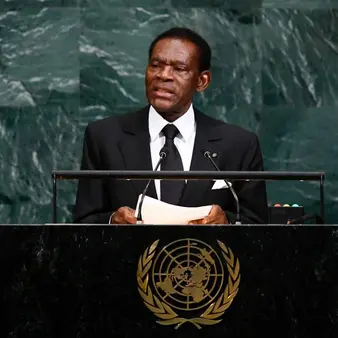
Equatorial Guineas President Teodoro Obiang Nguema Mbasogo (JEWEL SAMAD/AFP/Getty Images)
The Oil Boom That Transformed Equatorial Guinea
For much of Obiang's early presidency, Equatorial Guinea remained a relatively poor country with an economy dependent on agriculture, timber, and limited commercial activity. That changed dramatically during the 1990s, when major offshore petroleum discoveries attracted international energy companies.
American corporations, including ExxonMobil and Marathon Oil, became important participants in the development of Equatorial Guinea's oil and natural gas reserves. Production expanded rapidly, generating billions of dollars in government revenue and turning the country into one of sub-Saharan Africa's significant hydrocarbon producers.
Between 1996 and 2004, the country's annual per-capita economic growth averaged an extraordinary 40%, according to the World Bank. The petroleum boom financed roads, airports, government buildings, hotels, and other major construction projects. Equatorial Guinea attained upper-middle-income status in 2004, a remarkable transformation for a country that had previously suffered economic collapse.
However, this prosperity was distributed unevenly. Much of the population continued to experience poverty, limited access to essential services, and relatively few economic opportunities outside the petroleum industry. Human Rights Watch and other organizations alleged that senior officials and politically connected families benefited disproportionately from the country's natural resources.
The country's dependence on hydrocarbons subsequently became a major economic vulnerability. As production from mature oil fields declined, government revenues weakened and economic growth slowed. World Bank reports have emphasized that Equatorial Guinea has struggled to diversify its economy despite the enormous wealth generated during its petroleum boom.
Business Interests and the Riggs Bank Scandal
One of the most significant investigations into Obiang's financial affairs involved Riggs Bank, a Washington, D.C., financial institution that maintained accounts for foreign governments, diplomats, and wealthy international clients.
In 2004, a U.S. Senate investigation revealed that Riggs had maintained dozens of accounts connected to Equatorial Guinea, its government officials, and members of Obiang's family. By 2003, the combined banking relationship had reached nearly $700 million in deposits and outstanding loans, making Equatorial Guinea one of Riggs Bank's largest clients.
Senate investigators documented unusual transactions, including multimillion-dollar cash deposits and transfers from accounts holding Equatorial Guinea's oil revenues to offshore companies associated with political figures. More than $35 million had been transferred from an account receiving government oil money to suspicious offshore accounts, including entities investigators believed were connected to Obiang.
The investigation also identified personal financial holdings and business interests associated with the president. Contemporary reporting indicated that Obiang maintained personal bank accounts containing more than $10 million, while businesses connected to him and his relatives operated in telecommunications, construction, aviation, real estate, and the petroleum industry.
One particularly important company was Abayak S.A., a business associated with Obiang and administered by his wife, Constancia Mangue. Through Abayak and related entities, the family participated in commercial arrangements involving major international oil companies.
U.S. Senate investigators found that Abayak had acquired a 15% interest in Mobil Oil Guinea Ecuatorial, an oil-trading business, for a total of just $2,300 in 1998 and 1999. The company subsequently received dividends, and the investment was valued at $645,000 by 2004.
Investigators also examined land transactions involving the president's business interests. Marathon Oil paid more than $2 million for land in the Punta Europa area of Bioko Island, with purchases negotiated through Abayak as Obiang's agent.
The Riggs investigation exposed the close financial relationships between multinational energy companies and Equatorial Guinea's political leadership. The bank was criticized for inadequate anti-money-laundering safeguards and ultimately became the subject of regulatory enforcement and criminal proceedings related to its compliance failures.
Real Estate and Personal Assets
Obiang's foreign real estate holdings have also attracted scrutiny. Investigations and property records revealed luxury residences in the United States and reports of property transactions involving Spain, France, and other European countries.
In 1999, Obiang purchased a mansion in Potomac, Maryland, for $2.6 million in cash. The property reportedly featured ten bathrooms, seven fireplaces, and an indoor swimming pool, making it a substantial residence in one of the wealthiest suburbs of Washington, D.C.
The following year, another Maryland property was purchased in the name of his wife, Constancia Mangue, for $1.15 million. Banking records showed that the family received mortgage financing through Riggs Bank, which was subsequently repaid.
Investigators also documented substantial cash movements associated with overseas real estate. Internal Riggs memoranda referred to proceeds of $5 million from property sales in Spain and $3 million from property transactions in France.
These documented transactions revealed a financial position that contrasted sharply with Obiang's publicly reported government salary. In 2003, an official at Equatorial Guinea's embassy in Washington told the Los Angeles Times that the president earned approximately $5,000 per month, equivalent to $60,000 annually.
His Son's $30 Million Malibu Mansion and International Investigations
The international scrutiny surrounding the Obiang family intensified because of the extravagant spending of the president's eldest son, Teodoro Nguema Obiang, commonly known as Teodorín.
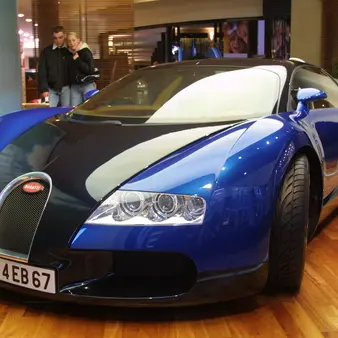
While serving as Equatorial Guinea's agriculture and forestry minister, Teodorín accumulated a collection of luxury cars, private aircraft, expensive artwork, Michael Jackson memorabilia, and residential properties around the world. Among his most famous purchases was a $30 million Malibu mansion acquired in 2006.
The spectacular California estate featured a 15,000-square-foot main residence, a swimming pool, tennis court, landscaped grounds, and a private three-hole golf course. The purchase attracted international attention because Teodorín's official government salary was reportedly only $5,000 per month.
In 2014, the U.S. Department of Justice announced that Teodorín had agreed to relinquish more than $30 million in assets as part of a civil forfeiture settlement. American prosecutors alleged that he had accumulated more than $300 million through corruption and money laundering while holding government office.
The settlement required him to sell the Malibu mansion and surrender other property, with substantial proceeds directed toward programs intended to benefit the people of Equatorial Guinea.
Additional investigations unfolded in Europe. In 2017, a French court convicted Teodorín of money laundering and related financial offenses, resulting in a suspended prison sentence, a substantial fine, and the confiscation of assets, including an enormous Paris mansion. France's highest appeals court upheld the conviction in 2021.
Swiss authorities also investigated his financial activities and seized a collection of exotic cars. Twenty-five vehicles were subsequently auctioned in 2019 for approximately $27 million.
These cases primarily involved the younger Obiang's assets and conduct, rather than personal criminal convictions against his father. Nevertheless, they drew international attention to the family's finances and raised questions about the relationship between political power, government contracting, and private wealth.
Human Rights and International Criticism
Obiang's government has faced sustained criticism from international human rights organizations over political repression, arbitrary detention, restrictions on freedom of expression, and the treatment of opposition figures.
Human Rights Watch has documented allegations of torture, unfair trials, and interference with independent civil society organizations. Freedom House classifies Equatorial Guinea as "Not Free," pointing to the concentration of political authority within the presidency and the ruling party.
The government has rejected many of these accusations and maintains that its policies are intended to preserve national stability, sovereignty, and development. Despite recurring international criticism, Obiang has maintained diplomatic relationships with major foreign governments and continued to participate in international institutions.
Personal Life and Family Succession
Obiang is married to Constancia Mangue Nsue Okomo, Equatorial Guinea's first lady, who has maintained a prominent public role in charitable and social initiatives. He has several children, including prominent political and business figures who have held important positions within the country's government and economy.
His eldest son, Teodorín, became second vice president in 2012 and was elevated to first vice president in June 2016. With responsibilities covering national defense and state security, Teodorín occupies an influential position within the country's leadership and has frequently been identified as a possible successor to his father.
Another son, Gabriel Mbaga Obiang Lima, served as Equatorial Guinea's minister of mines and hydrocarbons and later held responsibilities involving economic planning and finance. He has played a significant role in the country's energy industry and international petroleum relationships.
The family's extensive involvement in government and commercial affairs has made questions of political succession closely connected to the future management of Equatorial Guinea's economic resources. More than four decades after taking power, Obiang remains president of a country whose political institutions, petroleum industry, and ruling family have been shaped by his long tenure.