
/2014/10/GettyImages-482200916.jpg)
/2026/02/Ilham-Aliyev.png)
/2014/08/Evo-Morales-1.jpg)
/2014/08/GettyImages-88576746.jpg)
/2022/03/Alexander-Lukashenko.jpg)
/2021/02/Jair-Bolsonaro.jpg)
:strip_exif()/2009/09/P-Diddy.jpg)
/2019/10/denzel-washington-1.jpg)
/2020/01/lopez3.jpg)
/2009/11/George-Clooney.jpg)
:strip_exif()/2015/09/GettyImages-476575299.jpg)
/2020/02/Angelina-Jolie.png)
/2009/09/Cristiano-Ronaldo.jpg)
/2020/06/taylor.png)
/2020/04/Megan-Fox.jpg)
/2017/02/GettyImages-528215436.jpg)
/2009/09/Jennifer-Aniston.jpg)
What is Nicolás Maduro's Net Worth?
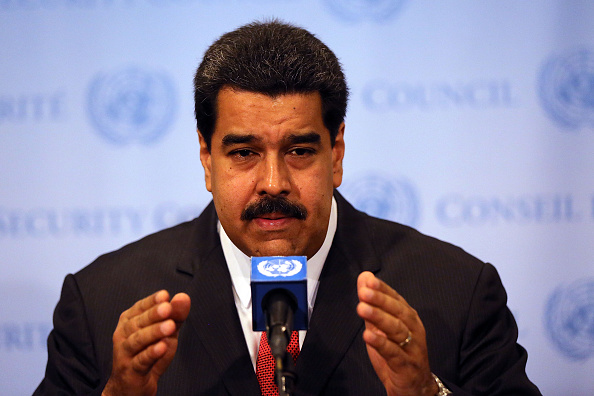
Nicolás Maduro is a Venezuelan politician who has a net worth of $2 million. Nicolás Maduro rose from union activism to become one of the most consequential and polarizing leaders in modern Latin American history. He began his public life as a bus driver in Caracas and a labor organizer, building political credibility through grassroots activism. Maduro entered national politics after the election of Hugo Chávez, winning a seat in the National Assembly in 2000 and quickly emerging as a loyal and dependable figure within Chávez's inner circle. Over the next decade, he held a series of powerful posts, including president of the National Assembly, foreign minister, and vice president, gaining experience in both domestic governance and international diplomacy while reinforcing the ideological foundations of Venezuela's socialist project.
Following Chávez's death in 2013, Maduro narrowly won a special presidential election and assumed control of a country already facing structural economic weaknesses. His presidency soon became defined by severe economic collapse, hyperinflation, widespread shortages of food and medicine, and the mass emigration of millions of Venezuelans. Politically, Maduro consolidated power by weakening independent institutions, sidelining opposition-controlled bodies, and governing increasingly by decree. Elections held under his leadership were widely disputed, and his government faced persistent accusations of human rights abuses, corruption, and repression of dissent.
Internationally, Maduro became a focal point of geopolitical tension, particularly with the United States, which imposed extensive sanctions and accused his government of criminal activity tied to drug trafficking. His rule ended abruptly in early 2026 when he was captured during a U.S. military operation and transported to New York to face federal narcotics and weapons charges. The episode marked an unprecedented collapse for a sitting head of state and closed a dramatic chapter in Venezuela's political history.
Early Life and Education
Nicolás Maduro Moros was born on November 23, 1962, the only boy among four children born to Teresa Moros and Nicolás Maduro García. His father was a prominent trade union leader. Although Maduro has claimed to have been born in Caracas, his birthplace and nationality have been the subject of longstanding dispute. He attended Liceo José Ávalos in the El Valle neighborhood of Caracas, where he was active in the student union, but he did not graduate.
Career Beginnings
Maduro began his professional life as a bus driver for the Caracas Metro, where he organized workers and helped establish an unofficial trade union. In 1983, he worked as a bodyguard for José Vicente Rangel during Rangel's unsuccessful presidential campaign. Later in the decade, Maduro moved to Havana, Cuba, where he lived among South American leftist militants and completed a one-year political training course at the Escuela Nacional de Cuadros Julio Antonio Mella.
In the early 1990s, Maduro joined the Revolutionary Bolivarian Movement-200, campaigning for the release of Hugo Chávez following Chávez's failed coup attempt. He later helped found the Fifth Republic Movement, which became the political vehicle for Chávez's return to power.
Rise in Government
Running on the Fifth Republic Movement ticket, Maduro was elected to Venezuela's Chamber of Deputies in 1998. He subsequently served in the Constituent National Assembly in 1999 and the National Assembly beginning in 2000, representing the Capital District. In 2005, he was elected president of the National Assembly, and in 2006 he was appointed minister of foreign affairs, a post he held for six years. In 2012, Chávez named Maduro vice president and, shortly before his death, publicly designated him as his successor.
Getty Images
President of Venezuela
After Chávez's death in March 2013, Maduro became interim president and was declared the winner of a special presidential election later that year. His first years in office were marked by severe shortages, declining living standards, and mass protests. In 2015, after the opposition won control of the National Assembly, Maduro began ruling by decree and relied increasingly on the Supreme Justice Tribunal and the military to maintain power.
In 2017, the Supreme Justice Tribunal stripped the National Assembly of its authority, triggering a constitutional crisis and widespread demonstrations. Maduro responded by convening a Constituent National Assembly through an election widely regarded as fraudulent. He claimed reelection in 2018 in another disputed vote, and in 2019 the opposition named National Assembly president Juan Guaidó as interim president, igniting a prolonged political standoff.
A new crisis erupted in 2024 after Maduro claimed victory in yet another contested election. Over the course of his rule, Venezuela experienced rampant corruption, repression, and economic devastation. Between 2013 and 2023, the country fell 42 places on the World Press Freedom Index. International organizations have reported widespread extrajudicial killings, systematic due process violations, and the forced displacement of more than seven million Venezuelans. In 2018, an independent panel designated by the Organization of American States concluded that Maduro's government committed crimes against humanity, and the International Criminal Court later opened a formal investigation.
2026 Arrest and Collapse of Power
In early 2026, Nicolás Maduro's grip on power came to a sudden and unprecedented end following a U.S.-led military operation that resulted in his capture inside Venezuela. American forces transported Maduro and his wife to New York, where he was brought before a federal court to face long-standing narcotics and weapons charges that had previously been filed under seal. The operation marked the first time a sitting head of state had been forcibly removed from office and prosecuted in a U.S. courtroom, sending shockwaves through Latin America and the international community. Maduro pleaded not guilty and described himself as the legitimate president of Venezuela, while U.S. officials framed the operation as a law enforcement action rather than a military intervention. In Venezuela, the arrest triggered a chaotic transition period, with competing claims of legitimacy from Maduro loyalists, opposition figures, and an interim governing authority backed by the United States. The episode effectively ended Maduro's presidency and transformed him from an entrenched authoritarian ruler into a criminal defendant, closing one of the most destabilizing chapters in Venezuela's modern history.
Personal Life
Maduro's first wife was Adriana Guerra Angulo, with whom he had his only biological son, Nicolás Maduro Guerra. Following their divorce, he married lawyer and politician Cilia Flores in 2013. The two had previously dated in the 1990s, when Flores served as Hugo Chávez's attorney. Through Flores, Maduro became stepfather to her three children, Walter, Yoswel, and Yosser.
/2014/10/GettyImages-482200916.jpg)
/2014/08/Evo-Morales-1.jpg)
/2009/11/Hugo-Chavez.jpg)
/2026/02/Ilham-Aliyev.png)
/2014/10/GettyImages-464531840.jpg)
/2014/08/GettyImages-88576746.jpg)
/2022/03/Alexander-Lukashenko.jpg)
/2023/03/Alexei-Navalny.jpg)
/2009/09/Brad-Pitt.jpg)
/2018/03/GettyImages-821622848.jpg)
/2019/11/GettyImages-1094653148.jpg)