















What Is Jean-Bertrand Aristide's Net Worth?
Jean-Bertrand Aristide is a Haitian former Salesian priest and politician who has a net worth of $100 million.
Jean-Bertrand Aristide was Haiti's first democratically elected president, rising from a Catholic pulpit in Port-au-Prince to become one of the country's most divisive political figures. He won a landslide election in 1990, was overthrown by the military in 1991, and returned to power in 1994 with American military assistance. Elected again in 2000, he served until a violent rebellion and disputed resignation in February 2004. After seven years in South African exile, he returned to Haiti in 2011.
Aristide championed education, higher wages, and an end to military repression, while opponents accused him of authoritarianism, political violence, and corruption. After 2004, investigators alleged that tens of millions of dollars in public money had been diverted through organizations linked to him. One contemporary newspaper suggested his personal fortune could be as high as $800 million. Aristide denied wrongdoing, and no verified inventory of his personal wealth emerged.
Financial Investigations and Alleged Fortune
The biggest questions about Aristide's fortune emerged after his removal from power in 2004. Haiti's interim government launched investigations into alleged misuse of state funds, suspect bank transfers, government contracts, and the activities of organizations tied to his presidency. In June 2004, the Los Angeles Times quoted interim Justice Minister Bernard Gousse describing checks of $500,000 that investigators believed had moved from Aristide's private secretariat into his personal bank account. Gousse's government suspected that misappropriation extended into the hundreds of millions of dollars, although investigators also acknowledged major gaps in the surviving records.
In August 2005, Le Monde reported on two official Haitian inquiries, including a commission headed by former senator Paul Denis and an investigation by the country's financial intelligence unit, known as UCREF. Together, the inquiries alleged that at least $55 million in public funds had been diverted during Aristide's administration. One commission traced $19.26 million and 123.9 million Haitian gourdes in public-sector checks into private accounts at Banque Populaire Haïtienne associated with the president's private secretariat. Its report also identified $17.49 million in transfers abroad initiated through accounts under examination, including $13.87 million routed through an account associated with Trujillo & Sons in Miami. Investigators said money had passed among private businesses, political organizations, construction projects, and the Aristide Foundation for Democracy. Those movements of funds do not establish how much Aristide personally retained.
Another particularly consequential allegation concerned foreign accounts. A Congressional Research Service report on Haiti, updated in January 2008, summarized UCREF's claim that an estimated $20 million had been transferred into Aristide's personal foreign bank accounts. The report also described allegations that government money went to private institutions created by the former president. On November 2, 2005, Haiti's interim government filed a civil lawsuit in federal court in Miami against Aristide and eight other defendants, alleging that public funds had been moved into personal overseas accounts. Aristide's lawyer called the lawsuit baseless and characterized the investigations as a politically motivated campaign by the administration that replaced him.
The estimates grew even larger in the press. In December 2004, the French newspaper Le Figaro published a report suggesting that Aristide might have accumulated $200 million to $800 million between 1994 and 2004, citing alleged transfers to foreign bank accounts and financial records the newspaper said it had examined. Among the transactions discussed was a $500,000 deposit dated November 29, 2002, into an account described as belonging to Aristide. But the $200 million-to-$800 million range was an allegation, not a completed accounting of cash, investments, real estate, or other assets. In a separate 2004 discussion with Le Monde, Haiti specialist Christophe Wargny said the numbers circulating about Aristide's personal wealth were impossible to verify reliably.
Drug-trafficking allegations raised another possible source of money. Convicted Haitian cocaine trafficker Beaudouin "Jacques" Ketant claimed that he paid Aristide $500,000 per month for protection and access to a roadway used by drug aircraft. He also alleged that he contributed substantial sums to the governing Lavalas movement and the Aristide Foundation. The claims were serious enough to interest American investigators, but reporting by the Miami Herald in 2006 described the absence of corroborating financial records as an obstacle to bringing a case against Aristide. His attorney denied that Aristide had received drug-trafficking payments and said his administration had cooperated with efforts to stop cocaine smuggling. The allegations did not result in a U.S. criminal conviction of Aristide.
One unusually specific account of frozen funds appeared in a June 2006 U.S. Embassy diplomatic cable. Jean-Yves Noël, then head of UCREF, told American officials that roughly $6 million had been frozen across multiple bank accounts belonging to businesses he considered fronts for the Aristide Foundation. The cable recorded Noël's account; it did not independently establish that all those funds were stolen or that the money was Aristide's personal property. The inquiries involved foundations and companies as well as allegedly personal accounts.
The Miami civil lawsuit never went to trial and was dismissed in July 2006. The Los Angeles Times later published a correction emphasizing that the case had been civil, not criminal, and had produced no judicial determination of liability. Haitian investigators continued examining Aristide's finances, and a Haitian judge issued a warrant in 2014 in connection with allegations including corruption, money laundering, and misappropriation of public funds. Aristide was subsequently placed under house arrest; his supporters denounced the proceedings as politically motivated. The existence of these investigations should not be confused with a final court judgment establishing the size of his wealth or proving the sums attributed to him.
Taken together, the investigations reveal allegations involving very substantial sums, but their dollar amounts overlap and cannot simply be added together. Money traced through a foundation, funds alleged to have been diverted from a public institution, and an individual's present-day personal assets are three different things. The allegations help explain the nine-figure fortune attributed to him, but not the value or location of his present holdings.
Early Life and Education
Jean-Bertrand Aristide was born on July 15, 1953, in Port-Salut, Haiti. His father, a farmer, died when Aristide was an infant, and his mother later moved with him to Port-au-Prince. He was educated by Salesian priests and attended Collège Notre-Dame in Cap-Haïtien, graduating in 1974. He undertook religious training in the Dominican Republic, studied philosophy at Haiti's Grand Séminaire Notre Dame and psychology at the State University of Haiti, and continued theological studies abroad. His education prepared him for public life.
Priesthood and Opposition to the Duvaliers
Aristide was ordained a Catholic priest in 1982 and became identified with liberation theology, a movement that emphasized the church's responsibility to the poor and oppressed. From his pulpit in Port-au-Prince, he condemned the dictatorship of the Duvalier family and the violence used to maintain its rule. His sermons attracted fervent support in poor neighborhoods and the hostility of military leaders and church officials.
In 1985, he became associated with St. Jean Bosco church and expanded his work with young people, including programs for homeless children. On September 11, 1988, armed attackers assaulted the church during Mass, killing at least a dozen worshipers and injuring scores more. Aristide survived. Later that year, the Salesian order expelled him after he refused instructions to leave Haiti, accusing him of provoking political conflict. He remained a priest for several more years before leaving the clergy in the 1990s.
1990 Election and the First Military Coup
Aristide entered presidential politics in 1990 and won the December election with more than 67% of the vote, a landmark in a country long ruled by dictatorships and military governments. He took office on February 7, 1991, promising to challenge entrenched wealth and corruption, strengthen public services, and establish civilian control over the state. His rhetoric alienated influential business and military figures.
On September 30, 1991, less than eight months after taking office, Aristide was overthrown in a military coup. He fled Haiti and spent much of the next three years in exile, first in Venezuela and then in the United States. The military persecuted his supporters as pressure mounted for his restoration.
Return to Power and the 1996 Transition
With support from President Bill Clinton, a U.S.-led military intervention paved the way for Aristide's return to the presidency in October 1994. He completed the remainder of his term, disbanded Haiti's military, and helped establish a civilian national police force. His administration also supported prosecutions connected to atrocities committed during the years of military rule.
Haiti's constitution barred him from immediately succeeding himself, so Aristide backed his ally René Préval, who won the 1995 presidential election and took office in February 1996. Later that year, Aristide broke with the Lavalas Political Organization and helped establish Fanmi Lavalas. The original OPL became the Struggling People's Organization and eventually opposed him; the two were separate parties.
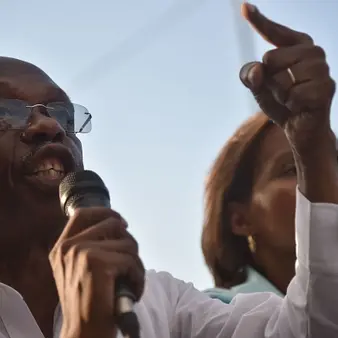
HECTOR RETAMAL/AFP/Getty Images
Second Presidential Term and 2004 Removal
Aristide returned to the presidency after winning the 2000 election, which was boycotted by major opposition parties amid disputes over earlier legislative results. His second term began in February 2001 and was marked by political deadlock, worsening violence, and accusations that pro-government armed groups known as "chimères" intimidated journalists and political opponents. Corruption allegations and strained foreign relations compounded the crisis.
An armed rebellion spread across Haiti in early 2004, and rebel forces took control of major cities as pressure mounted for Aristide to leave office. He departed on February 29 aboard an aircraft arranged with American assistance. Aristide subsequently maintained that he had been forced from power and effectively kidnapped, while the U.S. government insisted that he had resigned voluntarily and requested help leaving the country. He was flown first to the Central African Republic, then spent time in Jamaica before relocating with his family to South Africa.
Education, Health Care, and Political Legacy
Aristide's supporters point to his emphasis on literacy, public education, health care, low-cost housing, and social programs for poorer Haitians. He promoted a higher minimum wage, agricultural assistance, and expanded recognition of Haiti's Creole language and Vodou traditions. His governments also worked with foreign partners on initiatives addressing HIV/AIDS and public health.
Aristide's foundation has credited the governments of Aristide and Préval with constructing or refurbishing 195 primary schools and 104 public secondary schools between 1994 and 2004, along with scholarship and literacy programs. These numbers come from Aristide's own account of the administrations' work. His supporters also cite the development of a university and medical-training programs intended to serve people who had historically been excluded from higher education.
Human Rights Criticism
Aristide's record is sharply contested. Human Rights Watch documented attacks on opposition protesters and journalists by pro-government gangs, while U.S. human rights reporting criticized the politicization of Haiti's police force. Its "zero tolerance" crime policy raised concerns about extrajudicial killings, while critics accused Aristide of tolerating intimidation by loyalists.
At the same time, the armed groups that helped remove him in 2004 included former soldiers and paramilitary figures implicated in grave abuses during earlier periods of military rule. His supporters experienced reprisals after his departure, and rights organizations also documented serious abuses under the interim government. His legacy combines substantial popular support and social reforms with repression and allegations of misconduct.
Exile, Real Estate, and Return to Haiti
Aristide lived in South Africa from 2004 until 2011. His accommodation and lifestyle there generated controversy, but the South African government confirmed in parliamentary responses that it paid for his family's housing, transportation, security, and support staff as guests of the state. Those government-funded arrangements were not personal real estate holdings. In Haiti, Aristide maintained a private residence in the Tabarre area of Port-au-Prince; local reporting described renovations to the property ahead of his return in 2011. No authoritative public valuation of that residence or of a larger personal property portfolio has emerged from the records examined.
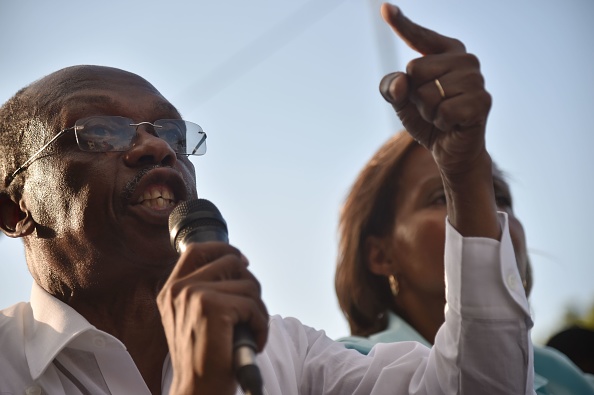
Aristide returned to Haiti on March 18, 2011, following seven years in exile. He initially concentrated on educational and foundation activities rather than seeking elected office. The 2014 financial investigation brought him back into the headlines, and in 2016 he publicly campaigned for Fanmi Lavalas candidates, including presidential contender Maryse Narcisse. His influence endured among supporters who viewed him as a champion of Haiti's poor.
Personal Life
Aristide married Haitian-American lawyer Mildred Trouillot on January 20, 1996. The couple have two daughters, Michaelle and Christine. Mildred had worked with Aristide during his first period of exile and later became a prominent member of his political and legal circle. His family joined him in South Africa and returned to Haiti in 2011.