











What Is Michael Bloomberg's Net Worth and Salary?
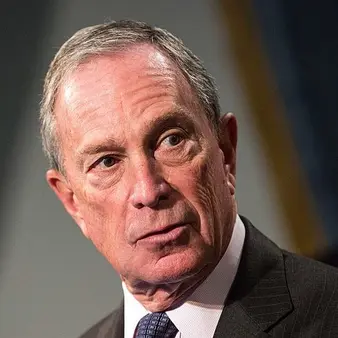
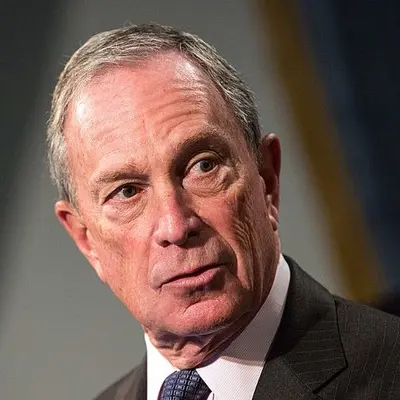
Michael Bloomberg is an American businessman, entrepreneur, philanthropist, and former politician who has a net worth of $95 billion.
Michael Bloomberg is the founder and majority owner of Bloomberg LP, the financial data, technology, and media company that has made him one of the wealthiest people in the world. He owns an estimated 88% of the privately held business, which generates nearly $15 billion in annual revenue and employs 26,000 people worldwide. Bloomberg built his fortune after being fired from Wall Street investment bank Salomon Brothers in 1981, using a $10 million partnership payout to launch the financial information company that bears his name. Its flagship Bloomberg Terminal became an essential tool for banks, investment firms, traders, and financial institutions around the world.
Beyond business, Bloomberg served three consecutive terms as the 108th mayor of New York City, holding office from January 2002 through December 2013. He spent $268 million of his own money on mayoral campaigns, accepted a salary of just $1 per year, and later spent more than $1 billion pursuing the Democratic presidential nomination in 2020. He is also one of history's most prolific philanthropists, having donated $25.4 billion to causes including education, public health, environmental protection, and government innovation. His charitable giving includes a landmark $1.8 billion donation to Johns Hopkins University in 2018 and another $1 billion commitment in 2024.
Early Life and Education
Michael Rubens Bloomberg was born on February 14, 1942, in Boston, Massachusetts. He grew up in a middle-class Jewish family in Medford, a suburb of Boston. His father, William Henry Bloomberg, worked as a bookkeeper for a dairy company, while his mother, Charlotte, managed the household. He has a younger sister, Marjorie.
As a teenager, Bloomberg joined the Boy Scouts and eventually achieved the rank of Eagle Scout. He attended Medford High School before enrolling at Johns Hopkins University, where he earned a bachelor's degree in electrical engineering in 1964.
Bloomberg subsequently attended Harvard Business School, graduating with an MBA in 1966. He entered the financial industry immediately afterward, accepting a position at the Wall Street investment bank Salomon Brothers.
Salomon Brothers and His $10 Million Payout
Bloomberg joined Salomon Brothers in 1966 with a starting salary of $9,000 per year. His early responsibilities included processing securities transactions and performing administrative work, but he quickly demonstrated an aptitude for financial analysis and trading.
In 1972, Bloomberg became a general partner at the firm. He subsequently led its equity trading operations before moving into the development of internal financial information systems. That experience convinced him that computers could transform how investment professionals obtained market data and evaluated securities.
In 1981, Salomon Brothers was acquired by commodities trading company Phibro Corporation. The merger resulted in Bloomberg losing his position after 15 years with the firm.
Because he was a general partner, Bloomberg received a $10 million payout for his ownership interest. Rather than retire or join another Wall Street institution, he decided to use part of that money to establish his own technology business.
The decision would ultimately turn a $10 million exit payment into a personal fortune worth tens of billions of dollars.
Founding Bloomberg LP
In 1981, Bloomberg founded Innovative Market Systems with Thomas Secunda, Duncan MacMillan, and Charles Zegar, three former Salomon Brothers employees. The company developed a computerized system that combined real-time financial data, securities pricing, analytics, and market information in a single terminal.
At the time, financial professionals frequently relied on separate services and manually assembled information from multiple sources. Bloomberg recognized that banks and investment firms would pay substantial subscription fees for a system capable of integrating those functions.
The company's first major customer was Merrill Lynch, which agreed to install the new Market Master terminals in 1982. Merrill Lynch also invested $30 million in exchange for a 30% ownership stake, providing the young business with capital for expansion.
In 1986, the company changed its name to Bloomberg LP. Its financial terminals gradually became an industry standard, with thousands of installations at major banks, securities firms, and investment companies.
Bloomberg expanded beyond financial technology by launching Bloomberg News in 1990. The company subsequently introduced Bloomberg Radio, Bloomberg Television, Bloomberg Businessweek, and digital news services, creating a global financial media operation.
However, the Bloomberg Terminal remained the foundation of the company's extraordinary profitability. Financial institutions pay subscription fees that can exceed $30,000 per terminal annually for access to market information, analytics, communication services, and trading tools.
The company serves more than 300,000 financial professionals globally. Its operations have expanded into artificial intelligence, enterprise data, electronic trading, and other financial technology services.
How Bloomberg LP Became a $100 Billion Business
Bloomberg's ownership of his privately held company has been the primary source of his extraordinary wealth.
In 1996, Bloomberg purchased one-third of Merrill Lynch's 30% ownership stake for $200 million. That transaction valued Bloomberg LP at $2 billion, demonstrating how dramatically the business had grown since its launch 15 years earlier.
An even more significant transaction occurred in July 2008, when Merrill Lynch sold its remaining 20% stake to Bloomberg Inc. for $4.425 billion. That sale established an implied company valuation exceeding $22 billion.
By the time CelebrityNetWorth began tracking Bloomberg's fortune in 2008, we placed his net worth at $12 billion. His fortune grew to $16 billion in 2009, $22 billion in 2012, and more than $43 billion by 2015.
Bloomberg LP continued expanding its revenue and market position during the following decade. By 2026, the company generated nearly $15 billion in annual revenue and employed 26,000 people, including a financial news operation with thousands of journalists.
Bloomberg's ownership stake has consistently been valued at 88%, although some shares have been transferred to philanthropic interests. His fortune reached $109 billion on Forbes' March 2026 billionaires list before its valuation declined to $95 billion later that year.
Unlike publicly traded technology companies, Bloomberg LP does not have a continuously observable stock price. Its value is derived from the financial performance and market position of the privately held business.
Bloomberg LP Leadership and Succession
Bloomberg stepped away from day-to-day management of his company in 2001 to run for mayor of New York City. He returned to an active leadership role in 2014 after completing his third term.
In 2023, Bloomberg reorganized the company's leadership, appointing longtime executive Vlad Kliatchko as CEO and establishing a new board of directors. The changes were designed to provide the company with a more formal management structure beyond its founder.
Bloomberg has repeatedly expressed his intention to direct the company's long-term value toward philanthropy rather than sell it solely for personal profit.
In July 2026, Semafor reported that Bloomberg had transferred some of his personal shares to Bloomberg Philanthropies. The report also described preliminary discussions between company executives and investment bankers about potential ownership transactions, including an initial public offering.
A Bloomberg LP spokesperson responded that Bloomberg remained the company's controlling shareholder and had no plans to sell the business.

Andrew Burton/Getty Images
Mayor of New York City
Bloomberg entered politics in 2001, running for mayor of New York City as a Republican despite having previously been registered as a Democrat. He campaigned as a businessman and political outsider, emphasizing his management experience and financial independence.
The election occurred just weeks after the September 11 terrorist attacks, which profoundly affected the city. Bloomberg defeated Democratic candidate Mark Green and succeeded Rudy Giuliani, taking office on January 1, 2002.
His administration emphasized economic development, public health, education reform, and government accountability. Bloomberg oversaw major redevelopment projects, expanded the city's use of data-driven management, and supported public transportation improvements, including new bicycle lanes and pedestrian plazas.
His public health initiatives included restrictions on indoor smoking, a ban on artificial trans fats in restaurants, and requirements for chain restaurants to display calorie information. A proposed restriction on the sale of large sugary beverages became particularly controversial and was ultimately struck down by New York courts.
Bloomberg's policing policies also attracted substantial criticism. His administration supported aggressive use of stop-and-frisk tactics, which were challenged over their disproportionate impact on Black and Latino residents. In 2013, a federal judge ruled that the NYPD's implementation of stop-and-frisk violated constitutional protections. Bloomberg defended the policy at the time but later apologized for its overuse.
Bloomberg won reelection in 2005. In 2008, he successfully advocated changing New York City's term-limit rules, allowing him to seek a third consecutive term. He won the 2009 election and remained mayor until December 31, 2013, when he was succeeded by Bill de Blasio.
Mayoral Salary and Personal Spending
Bloomberg's enormous personal fortune allowed him to finance his political career without relying on traditional campaign fundraising.
Across his three mayoral elections, Bloomberg spent $268 million of his own money. His 2009 campaign was especially expensive, with spending exceeding $100 million.
Although he was entitled to $2.7 million in mayoral salary over 12 years, Bloomberg accepted just $1 annually. He also personally funded many expenses associated with his administration, including staff meals and official travel.
Among those expenses was $890,000 spent providing breakfast and lunch to City Hall staff during his three terms. Bloomberg also spent more than $6 million on private aviation associated with his mayoral responsibilities.
A 2013 financial analysis concluded that Bloomberg had spent at least $650 million of his personal fortune on activities connected to his mayoralty, including political campaigns, civic donations, travel, and other expenditures.
$1 Billion Presidential Campaign
In November 2019, Bloomberg entered the race for the 2020 Democratic presidential nomination, positioning himself as a candidate with extensive business and government experience.
Unlike most presidential candidates, Bloomberg financed his campaign almost entirely from his personal fortune. He skipped the earliest primary contests and concentrated his resources on Super Tuesday states, building a national operation with thousands of employees.
His campaign spent extraordinary sums on television advertising, digital marketing, polling, staffing, and travel. By the time it ended in March 2020, Bloomberg had contributed $1.05 billion of his own money.
Despite that investment, he won only one contest, the caucus in American Samoa, and accumulated 55 delegates. Bloomberg suspended his campaign on March 4, 2020, and endorsed Joe Biden, who ultimately won the Democratic nomination and defeated Donald Trump in the general election.
The unsuccessful campaign became one of the most expensive self-financed political efforts in American history.

(Photo by Dimitrios Kambouris/Getty Images)
Real Estate
Michael Bloomberg has assembled an extraordinary real estate portfolio encompassing luxury residences in New York, Florida, Colorado, London, and Bermuda.
His primary residence is a five-story Beaux-Arts townhouse at 17 East 79th Street on Manhattan's Upper East Side. He purchased the property in 1986 for $3.5 million and subsequently acquired five of the six apartments in the adjoining building, allowing him to expand the residence horizontally.
One of those additional acquisitions occurred in 2016, when Bloomberg paid $14 million for an adjacent apartment. The combined property is worth tens of millions of dollars.
Bloomberg also purchased another Upper East Side mansion on East 78th Street in 2006 for $45 million. The property has been used for his philanthropic activities.
In Westchester County, Bloomberg owns substantial property in North Salem, where his daughter Georgina Bloomberg pursued her professional equestrian career. He acquired a 20-acre estate in 2001 and expanded the property in 2011 by purchasing an adjoining 33-acre estate for $4.55 million. He also purchased a residence in Armonk, New York, for $375,000 in 1993.
In 2011, Bloomberg purchased Ballyshear, a historic Southampton estate, for $20 million. The property includes a 22,000-square-foot Georgian mansion with 11 bedrooms, extensive gardens, horse facilities, and landscaped grounds. He subsequently acquired neighboring land to expand the estate, bringing the property to 35 acres.
In June 2025, Bloomberg purchased another Southampton residence for $4 million for his daughter Georgina. The waterfront home on Cold Point Road contains 3,000 square feet, four bedrooms, and a private dock.
Outside New York, Bloomberg purchased a home in Wellington, Florida, for $8.9 million in 2006. The property is situated in an equestrian community and includes facilities for horses. He also owns a four-bedroom condominium at Mountain Haus in Vail, Colorado.
In London, Bloomberg purchased a historic Chelsea mansion for $25 million in 2015. The seven-bedroom residence, previously associated with novelist George Eliot, features a large private garden and elaborate period architecture.
Bloomberg has also maintained a residence in Bermuda since the late 1990s. He purchased a waterfront estate, demolished its existing house, and invested $10 million in constructing a new mansion with a pool and private beach.
Financial disclosures released during his final mayoral term identified at least 13 personal properties around the world. The same disclosures showed that he paid more than $500,000 annually in household staff compensation.
Philanthropy and $25.4 Billion in Donations
Michael Bloomberg has become one of the largest charitable donors in American history, committing tens of billions of dollars to education, public health, environmental protection, the arts, and government innovation.
Through Bloomberg Philanthropies, he has supported organizations and initiatives in more than 700 cities across 150 countries. The organization encompasses his personal, foundation, and corporate giving.
Bloomberg donated $3.7 billion in 2024 and $4.3 billion in 2025, bringing his lifetime charitable giving to $25.4 billion.
Education has been one of his most significant priorities. In November 2018, he announced a $1.8 billion donation to Johns Hopkins University, the largest single gift to an American college or university at the time. The money permanently expanded undergraduate financial aid and enabled the school to adopt need-blind admissions.
In July 2024, Bloomberg committed another $1 billion to Johns Hopkins, making medical school tuition-free for students from families earning less than $300,000 annually. The gift also expanded financial support for nursing, public health, and other graduate programs.
That same year, Bloomberg Philanthropies announced a $600 million commitment to bolster the endowments of four historically Black medical schools. The initiative included grants to Howard University, Meharry Medical College, Morehouse School of Medicine, and Charles R. Drew University.
Bloomberg has also devoted enormous resources to environmental initiatives. In 2019, he committed $500 million to the Beyond Carbon campaign, which supports efforts to reduce dependence on coal and natural gas. His philanthropic work has additionally funded programs addressing tobacco use, road safety, opioid addiction, and access to healthcare.
In 2010, Bloomberg joined the Giving Pledge, an initiative founded by Bill Gates and Warren Buffett encouraging billionaires to commit the majority of their wealth to charitable causes. Bloomberg has stated that he intends to give away virtually his entire fortune.
Personal Life
Michael Bloomberg married Susan Brown in 1975. The couple had two daughters, Emma and Georgina, before divorcing in 1993. They remained on amicable terms following their separation.
Emma Bloomberg has worked extensively in philanthropy and nonprofit leadership, while Georgina became a professional equestrian, author, and philanthropist.
Since 2000, Bloomberg has been in a relationship with Diana Taylor, a former New York State superintendent of banks and financial services executive.
Bloomberg is known for maintaining an active lifestyle, including golf, skiing, and travel. Despite his enormous fortune, he has continued working regularly at Bloomberg LP and remains involved in business and philanthropic decision-making.