
/2015/10/Martin-OMalley.jpg)
/2009/11/Joe-Biden.jpg)
/2015/05/marco.jpg)
/2018/11/Beto-ORourke.jpg)
/2013/12/Terry-McAuliffe.jpg)
/2023/08/David-Muir.jpg)
/2018/03/GettyImages-821622848.jpg)
:strip_exif()/2015/09/GettyImages-476575299.jpg)
:strip_exif()/2009/09/P-Diddy.jpg)
/2009/09/Brad-Pitt.jpg)
/2009/09/Jennifer-Aniston.jpg)
/2020/02/Angelina-Jolie.png)
/2019/04/rr.jpg)
/2017/02/GettyImages-528215436.jpg)
/2019/10/denzel-washington-1.jpg)
/2020/01/lopez3.jpg)
/2009/09/Cristiano-Ronaldo.jpg)
What is Martin O'Malley's Net Worth and Salary?
Martin O'Malley is an American politician and musician who has a net worth of $600 thousand. Martin O'Malley served as commissioner of the Social Security Administration from 2023 to 2024, and before that he was the governor of Maryland from 2007 to 2015 and the mayor of Baltimore from 1999 to 2007. In 2016, he ran for the Democratic presidential nomination but dropped out of the race after the Iowa caucuses.
2015 Financial Disclosure
In July 2015, during his campaign for the Democratic presidential nomination, Martin O'Malley voluntarily released five years of tax returns along with a personal financial disclosure form that revealed a relatively modest financial picture compared with many other candidates in the race. The filings showed that O'Malley and his wife, Baltimore judge Catherine Curran O'Malley, reported annual household income of roughly $300,000 to $330,000 during his final years as governor of Maryland, with the bulk coming from his $150,000 gubernatorial salary and his wife's judicial income. The disclosures also highlighted significant debt, largely tied to financing their children's college educations. Key details from the filing included:
- Annual household income: roughly $300,000–$330,000 during his final years as governor
- Effective federal tax rate: about 23%
- Cash and bank accounts: $18,000–$95,000 spread across four accounts
- Education-related debt: more than $300,000 in loans used to help pay for their children's college tuition
- Line of credit: $100,000–$250,000 owed to PNC Bank
- Real estate: a Baltimore home purchased in 2014 for $549,000, financed with a mortgage
The disclosures underscored that the O'Malleys carried significant education-related debt while earning a steady but relatively typical income for two longtime public servants.
Early Life and Education
Martin O'Malley was born on January 18, 1963 in Washington, DC to Barbara and WWII US Army Air Force veteran Thomas. He was educated at Our Lady of Lourdes Catholic School in Bethesda and Gonzaga College High School. At the latter, O'Malley played football and formed an Irish music group with his coach Danny Costello. He went on to attend the Catholic University of America, from which he graduated in 1985. O'Malley then enrolled at the University of Maryland School of Law, where he earned his JD in 1988. That year, he founded the Celtic rock band O'Malley's March, which he has continued to perform with ever since.
Career Beginnings
While still in college, O'Malley worked for Gary Hart's failed presidential campaign and Barbara Mikulski's successful US Senate campaign. He served as a legislative fellow in Mikulski's Senate office before becoming an assistant state's attorney for Baltimore. O'Malley held the latter position until 1990, when he ran for the Maryland Senate and just narrowly lost to incumbent John A. Pica in the Democratic primary.
Baltimore City Council
In 1991, O'Malley was elected to the Baltimore City Council as a representative of the 3rd Councilman District. He served in this role until 1999. As a councilman, O'Malley chaired the Legislative Investigations Committee and the Taxation and Finance Committee, and promoted a number of reforms. By the time his second term came around, he was considered a major player in Baltimore politics.
Mayor of Baltimore
Following incumbent Baltimore mayor Kurt Schmoke's decision to step down in 1999, O'Malley announced his campaign for mayor. He went on to win the Democratic primary and then the general election, handily beating Republican David Tufaro. O'Malley was reelected in 2004. During his mayoralty, he focused heavily on reducing crime through a statistics-based tracking system called CitiStat. His strategies were denounced by many for disproportionately targeting Black communities. However, O'Malley gained praise in other corners, and was named by Esquire as the Best Young Mayor in the Country in 2002.
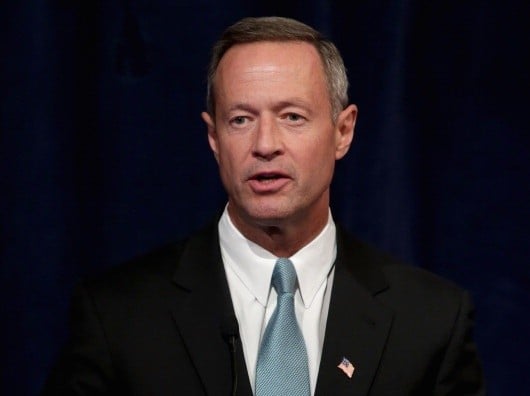
Chip Somodevilla/Getty Images
Governor of Maryland
With no primary opposition, O'Malley ran for governor of Maryland in 2006. In the general election, he defeated Republican incumbent Bob Ehrlich with 53% of the vote. O'Malley was reelected in a rematch with Ehrlich in 2010, this time winning with 56% of the vote. In his first gubernatorial term, he implemented the performance-measurement and management tool Maryland StateStat, and also became the first governor to sign the National Popular Vote Interstate Compact, which advocated for the supremacy of the popular vote in presidential elections.
During O'Malley's second term as governor, he signed a law to make immigrants who were brought to the US as children eligible for in-state college tuition. He also signed a law to legalize same-sex marriage in Maryland, signed a bill to repeal capital punishment in Maryland, and signed a new gun control bill into law. Meanwhile, from 2011 to 2013, O'Malley chaired the Democratic Governors Association. He left office in 2015 and became a visiting professor at the Johns Hopkins Carey Business School.
Presidential Campaign
In the spring of 2015, O'Malley announced his candidacy for president of the United States. He became one of six major candidates for the Democratic nomination, but struggled to build steam and floundered in the polls. Following a third-place finish in the 2016 Iowa Democratic caucuses, O'Malley dropped out of the race.
Post-campaign
After suspending his presidential campaign, O'Malley joined the MetroLab Network, based at Heinz College at Carnegie Mellon University. There, he became chairman of the advisory committee and a senior fellow. O'Malley was then named a fellow of the Georgetown Institute of Politics and Public Service. In the spring of 2017, he was a visiting professor at Boston College Law School's Rappaport Center for Law and Public Policy. At the end of the decade, O'Malley became a fellow of the National Academy of Public Administration.
Commissioner of the Social Security Administration
In July of 2023, O'Malley was nominated by President Joe Biden as commissioner of the Social Security Administration. His nomination was advanced by the Senate Committee on Finance and ultimately confirmed by the US Senate. As commissioner of the SSA, O'Malley used his signature date-driven approach to simplify the agency's forms, eliminate gratuitous requirements, and increase digitization. He left the SSA in late 2024 and ran for chair of the Democratic National Committee, but lost to Ken Martin.
Personal Life
While in law school, O'Malley met fellow student Catherine Curran. The pair married in 1990 and have four children together: Grace, Tara, William, and Jack.
/2015/10/Martin-OMalley.jpg)
/2023/08/David-Muir.jpg)
/2009/11/Joe-Biden.jpg)
/2018/11/Beto-ORourke.jpg)
/2020/02/bob-dole.png)
/2009/09/Mark-Warner.jpg)
/2016/10/Mike-Pence.jpg)
/2016/08/Cory-Booke.jpg)
/2009/11/George-Clooney.jpg)
/2020/06/taylor.png)
/2019/11/GettyImages-1094653148.jpg)