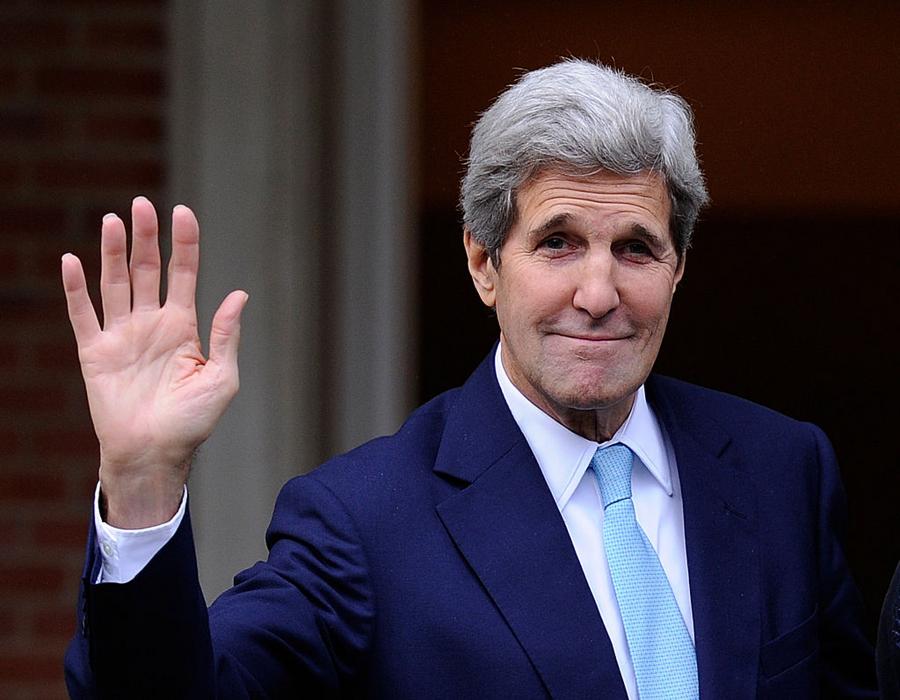
What Is John Kerry's Net Worth?
John Kerry is an American politician and diplomat who has a net worth of $750 million. That is a combined net worth with his wife, Teresa Heinz Kerry, whose wealth comes largely from her inheritance from the Heinz family fortune.
John Kerry is best known for serving as a United States senator from Massachusetts, the Democratic nominee for president in 2004, the 68th United States Secretary of State, and the first U.S. Special Presidential Envoy for Climate. Across more than five decades in public life, Kerry has moved through several distinct phases: decorated Vietnam veteran, anti-war activist, prosecutor, lieutenant governor, senator, presidential nominee, diplomat, and climate negotiator.
Kerry represented Massachusetts in the U.S. Senate from 1985 to 2013, becoming one of the chamber's best-known Democrats and eventually chairman of the Senate Foreign Relations Committee. In 2004, he won the Democratic presidential nomination and lost the general election to incumbent President George W. Bush. He later served as Secretary of State under President Barack Obama from 2013 to 2017, playing a central role in the Iran nuclear deal and the Paris Climate Agreement. He returned to government in 2021 as President Joe Biden's climate envoy, a Cabinet-level diplomatic role focused on global climate negotiations. After leaving that position, Kerry continued working in climate finance and international policy.
Wealth Disclosures
Teresa inherited her fortune as the widow of John Heinz III, an heir to the Heinz food company empire. At the time of his death in 1992, he owned 6% of the Pittsburgh-based company, which made him the firm's largest individual shareholder. When he died in 1991, John Heinz's net worth was $350 million. Other than a brief stint working in the company's marketing department, he was essentially never involved in the business, which was founded by his great-grandfather in 1869.
During the 2004 presidential campaign, the most commonly cited official-disclosure-derived figure was that John Kerry and Teresa Heinz Kerry reported assets somewhere between $165 million and $626 million on Kerry's most recent federal financial disclosure forms. The Center for Public Integrity noted that exact figures were impossible because the forms use ranges, but it also reported that the "top figure" on the form was $688 million. The same analysis said the disclosure listed roughly 950 assets, and that all but three were owned by his wife. It also broke out at least $2.5 million in CDs, money-market funds, and bank accounts; $3.7 million in retirement/mutual-fund-style investments; and at least $151 million in stocks and bonds.
Roll Call's congressional wealth ranking later put the Kerry/Heinz figure even higher, using a 2004 Los Angeles Times estimate of $900 million to $3.2 billion for the couple's combined fortune. But Roll Call was clear about the same issue: relatively little of that money was actually John Kerry's personal fortune, and the vast majority belonged to Teresa Heinz Kerry. Roll Call also noted that Kerry's actual disclosure forms showed at least $165.8 million in assets.
The Washington Post's 2003 profile put the family fortune around $550 million, again emphasizing that most of it traced to Teresa Heinz Kerry's inheritance from the Heinz family. The Post also noted that the disclosure form was unusually opaque because many holdings were placed in the broad "over $1 million" category. Kerry's report listed 101 holdings above that threshold.
The couple purchased an 18-acre property on Martha's Vineyard in April 2017. The seven-bedroom property cost a reported $11.75 million.

Chip Somodevilla/Getty Images
Early Life
John Forbes Kerry was born on December 11, 1943, in Aurora, Colorado. He was the son of Richard John Kerry, a Foreign Service officer and attorney, and Rosemary Forbes Kerry, who came from the wealthy Forbes family of Massachusetts. Although Kerry was born in Colorado while his father was receiving treatment for tuberculosis, he grew up partly in Massachusetts and partly overseas because of his father's diplomatic work.
Kerry was educated at boarding schools in Switzerland and New England before attending Yale University. At Yale, he became involved in debate, politics, and student leadership. He graduated in 1966 with a degree in political science and soon entered military service during the Vietnam War.
Vietnam War and Anti-War Activism
Kerry served in the United States Navy during the Vietnam War. He commanded a Swift Boat in Vietnam and was awarded the Silver Star, Bronze Star, and three Purple Hearts. His combat record became a major part of his public identity, and decades later it also became a central issue in the 2004 presidential campaign.
After returning from Vietnam, Kerry became one of the most visible veterans in the anti-war movement. He helped lead Vietnam Veterans Against the War and gained national attention in 1971 when he testified before the Senate Foreign Relations Committee. His question, "How do you ask a man to be the last man to die for a mistake?" became one of the most famous lines of the Vietnam-era anti-war movement.
Kerry's military service and anti-war activism gave him a complicated but powerful political profile. To supporters, he was a decorated veteran willing to challenge U.S. policy from a position of personal experience. To critics, his postwar activism was controversial, especially among some veterans and conservatives.
Early Political Career
After the war, Kerry attended Boston College Law School and earned his law degree in 1976. He worked as a prosecutor in Middlesex County, Massachusetts, where he became known for handling organized crime and public corruption cases. His legal work helped him build a base for a future career in elected office.
Kerry first ran for Congress in 1972 but lost. A decade later, he was elected lieutenant governor of Massachusetts, serving under Governor Michael Dukakis from 1983 to 1985. His time as lieutenant governor was brief, but it positioned him for a successful U.S. Senate campaign after Senator Paul Tsongas announced he would not seek reelection.
United States Senate
John Kerry was elected to the United States Senate in 1984 and took office in January 1985. He went on to represent Massachusetts for nearly three decades. In the Senate, Kerry focused heavily on foreign policy, national security, veterans' issues, environmental policy, and investigations.
One of his most prominent early roles came through his work investigating the Iran-Contra affair and issues related to drug trafficking and U.S. foreign policy in Latin America. He also worked on matters involving prisoners of war and missing service members from the Vietnam War, including efforts that helped normalize relations between the United States and Vietnam.
Over time, Kerry became one of the Senate's leading foreign policy voices. He served on the Senate Foreign Relations Committee for many years and later became its chairman. His Senate career also gave him a national profile that made him a natural contender for the presidency.
(Photo by Denis Doyle/Getty Images)
2004 Presidential Campaign
Kerry entered the 2004 Democratic presidential race as one of several major candidates seeking to challenge President George W. Bush. After a slow start, he surged in the Iowa caucuses and New Hampshire primary, overtaking rivals such as Howard Dean, John Edwards, and Wesley Clark. Kerry's campaign emphasized his Vietnam service, foreign policy experience, and criticism of the Iraq War, even though he had voted in 2002 to authorize the use of force in Iraq.
Kerry selected North Carolina Senator John Edwards as his running mate. The general election was closely fought and heavily shaped by the Iraq War, national security, terrorism, and the aftermath of the September 11 attacks. Kerry lost to Bush in the Electoral College and popular vote. The campaign was also marked by the "Swift Boat" attacks, in which a conservative group challenged Kerry's Vietnam record and anti-war activism. Kerry and his supporters strongly disputed those attacks, but the controversy became one of the defining media stories of the race.
After the election, Kerry returned to the Senate and remained a prominent Democratic figure. He won reelection in Massachusetts in 2008 and continued to play a major role in foreign policy debates.
Secretary of State
In 2013, President Barack Obama nominated Kerry to succeed Hillary Clinton as Secretary of State. Kerry resigned from the Senate and was confirmed as the 68th U.S. Secretary of State.
As Secretary of State, Kerry was deeply involved in some of the Obama administration's most important foreign policy initiatives. He played a key role in negotiating the Joint Comprehensive Plan of Action, better known as the Iran nuclear deal. The agreement was designed to limit Iran's nuclear program in exchange for sanctions relief and became one of the most consequential and controversial diplomatic achievements of the Obama years.
Kerry also helped negotiate the Paris Climate Agreement, a global accord aimed at reducing greenhouse gas emissions and coordinating international climate action. In addition, his tenure included work on the Syrian civil war, relations with Russia, the Israeli-Palestinian peace process, and the fight against ISIS.
Kerry left the State Department in January 2017 at the end of the Obama administration. He later wrote a memoir, "Every Day Is Extra," and remained active in foreign policy, climate issues, and Democratic politics.
Climate Envoy and Later Career
In 2021, President Joe Biden appointed Kerry as the first U.S. Special Presidential Envoy for Climate. The role was created to elevate climate diplomacy within American foreign policy, and Kerry became the administration's lead international negotiator on climate issues.
As climate envoy, Kerry worked with foreign governments, international organizations, and private-sector leaders to encourage emissions reductions and climate-finance commitments. He represented the United States at major global climate conferences and helped push climate change back toward the center of U.S. diplomatic strategy after the Trump administration had withdrawn from the Paris Agreement.
Kerry stepped down from the climate envoy role in 2024. After leaving government, he continued working in the climate sector, including through climate-finance and policy-focused initiatives.
Personal Life
Kerry married Julia Thorne in 1970, and the couple had two daughters, Alexandra and Vanessa. Alexandra Kerry is a filmmaker, and Vanessa is a physician and public health expert. They separated in the 1980s and later divorced.
In 1995, Kerry married Teresa Heinz, the widow of Pennsylvania Republican Senator John Heinz, who died in a plane crash in 1991. Teresa inherited a large fortune tied to the H.J. Heinz Company, the food company founded by the Heinz family. Her wealth made Kerry one of the richest members of the Senate by household assets, though much of that money was separate from his personal holdings. Through his marriage to Teresa Heinz Kerry, he also became stepfather to her three sons from her marriage to John Heinz.
Teresa Heinz Kerry has also been active in philanthropy, environmental causes, women's issues, and public policy through the Heinz family philanthropies. Her wealth and public profile became major points of interest during Kerry's 2004 presidential campaign.
Real Estate
John Kerry and Teresa Heinz Kerry have been associated with an impressive portfolio of homes over the years. Their properties have included residences in Massachusetts, Pennsylvania, Washington, D.C., Idaho, and Nantucket. During Kerry's presidential campaign, the couple's homes became a regular subject of media coverage because they highlighted the scale of the family's wealth.
One of their best-known properties is a waterfront estate on Nantucket. They have also owned a townhouse in Boston's Beacon Hill neighborhood and a home in Georgetown in Washington, D.C. Teresa Heinz Kerry has also been connected to longstanding Heinz family properties in Pennsylvania.
The couple's real estate holdings are another reason their net worth has been difficult to pin down precisely. Some properties are personally owned, while others have been tied to family entities, trusts, or long-held inherited assets.
/2012/10/thk.jpg)
/2026/06/JohnHeinz.png)
/2009/11/Joe-Biden.jpg)
/2013/02/Lindsey-Graham-e1739237814248.jpg)
/2009/10/Al-Gore-1.jpg)
/2009/09/Cristiano-Ronaldo.jpg)
/2019/04/rr.jpg)
/2009/09/Brad-Pitt.jpg)
/2020/01/lopez3.jpg)
/2019/10/denzel-washington-1.jpg)
/2020/04/Megan-Fox.jpg)
/2019/11/GettyImages-1094653148.jpg)
:strip_exif()/2009/09/P-Diddy.jpg)
/2017/02/GettyImages-528215436.jpg)
:strip_exif()/2015/09/GettyImages-476575299.jpg)
/2009/09/Jennifer-Aniston.jpg)
/2009/09/John-Kerry.jpg)
/2012/10/thk.jpg)
/2026/06/JohnHeinz.png)
/2013/02/Lindsey-Graham-e1739237814248.jpg)
/2015/08/mitt.jpg)
/2015/10/Martin-OMalley.jpg)
/2019/09/GettyImages-492426041.jpg)
/2020/06/taylor.png)
/2020/02/Angelina-Jolie.png)
/2009/11/George-Clooney.jpg)