













What Is Yolandi Visser's Net Worth?
Yolandi Visser is a South African rapper, singer, songwriter, and actress who has a net worth of $10 million.
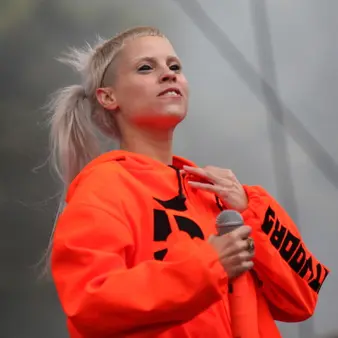
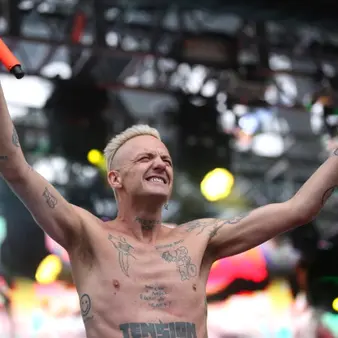
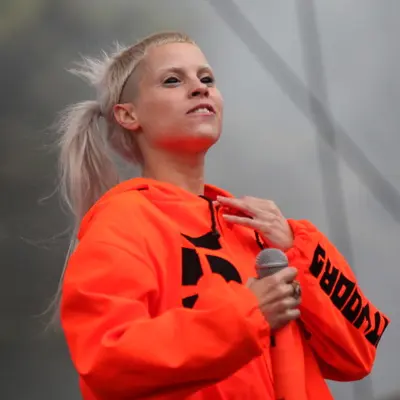
Yolandi Visser is best known as a founding member of Die Antwoord, the South African group that brought its abrasive mixture of hip-hop, electronic dance music, and "zef" style to an international audience. Performing alongside Watkin Tudor Jones, better known as Ninja, she became recognizable for her high-pitched vocals, bleached hair, dark contact lenses, and confrontational stage persona. Their breakthrough video, "Enter the Ninja," became an internet phenomenon in 2010 and helped turn a local experimental act into an international touring group.
Die Antwoord's albums include "$O$," "Ten$ion," "Donker Mag," "Mount Ninji and da Nice Time Kid," "House of Zef," and "Zama Zama." Songs such as "I Fink U Freeky," "Baby's on Fire," "Ugly Boy," and "Banana Brain" paired dance-oriented production with elaborate, frequently unsettling videos. Before Die Antwoord, Visser worked with the Constructus Corporation and MaxNormal.TV. She also starred in the 2015 science-fiction film "Chappie." The group's later career has included festival cancellations amid controversies, a return to international touring, and the documentary "ZEF: The Story of Die Antwoord."
Early Life
Yolandi Visser was born Anri du Toit on March 3, 1984, in Port Alfred, South Africa. She was adopted as a baby and raised in an Afrikaans-speaking household by a minister and his wife. Visser has described feeling out of place during her childhood and finding an outlet in music and alternative youth culture.
At 16, she attended boarding school in Pretoria, where she encountered other students interested in the arts. Her musical interests included punk, alternative rock, hip-hop, and experimental electronic music. She later moved to Cape Town, where her collaboration with Ninja developed.
Early Music Projects
Visser's early recording work included the Constructus Corporation, an experimental project involving Ninja, Markus Wormstorm, and other South African musicians. She contributed vocals under the name Anica to "The Ziggurat," a concept album accompanied by an illustrated story. The project combined music, fictional characters, and visual art, elements that also became central to her later work.
She subsequently joined MaxNormal.TV, a multimedia hip-hop act in which Ninja performed as the suit-wearing Max Normal. Visser adopted the Yolandi Visser name during this period and participated in the group's theatrical presentation. MaxNormal.TV released "Good Morning South Africa" in 2008, shortly before Die Antwoord became the collaborators' primary project.

Trixie Textor/Getty Images
Die Antwoord and International Breakthrough
Die Antwoord formed in 2008 around Visser, Ninja, and producer DJ Hi-Tek. The group's name means "the answer" in Afrikaans. Its music combined Afrikaans and English lyrics with electronic beats, while its presentation drew on "zef," a South African style associated with working-class culture, conspicuous accessories, customized cars, and deliberately unfashionable clothing.
The group initially made "$O$" available online in 2009. Videos for "Zef Side" and "Enter the Ninja" attracted international attention in early 2010, introducing audiences to Visser's sharp vocal delivery and the pair's exaggerated characters. Their distinctive appearance, surreal imagery, and unusual sound prompted debate about how much of the act was autobiography and how much was performance.
The attention led to an Interscope Records deal and a commercially released version of "$O$" in 2010. Die Antwoord began performing internationally, including at Coachella, and built a following through videos and energetic live shows. Visser's melodic hooks contrasted with Ninja's harsher rapping, giving the group a recognizable vocal dynamic.
Record Deal and Independent Releases
Die Antwoord left Interscope in 2011 following disagreements about the direction of their music. In a 2015 interview with Dazed, Visser said the label wanted additional songs and a more commercial collaboration. She said the group returned $1 million that Interscope had paid them so they could retain creative control.
The group released "Ten$ion" through its own Zef Recordz label in 2012. The album included "I Fink U Freeky," "Baby's on Fire," and "Fatty Boom Boom." Photographer Roger Ballen collaborated on the stark black-and-white video for "I Fink U Freeky," which became one of the band's best-known visual works.
"Donker Mag" followed in 2014, featuring "Pitbull Terrier" and "Ugly Boy." The latter's video included appearances by Jack Black, Flea, Marilyn Manson, Cara Delevingne, and Dita Von Teese. In 2016, Die Antwoord released the mixtape "Suck on This" and the studio album "Mount Ninji and da Nice Time Kid," which included "Banana Brain."
Later Albums and Touring
Die Antwoord released "House of Zef" in 2020. The album incorporated collaborations with South African performers and followed singles including "Baita Jou Sabela." Subsequent releases included "Reanimated" in 2023 and "Everything Is Perfect" and "Pokémon" in 2024.
The group resumed international touring in 2024 with its "Reanimated" dates in Europe and the United Kingdom. A North American run followed later that year, including a performance at Brooklyn Steel. These shows marked a return to sustained overseas touring after several years away from that circuit.
In June 2026, Die Antwoord released its sixth studio album, "Zama Zama," through Zef Records, with distribution by Stem. The 10-track album included "Stiek Uit," "What Do They Know?," "Tigers Don't Cry," and the title track. The group also created a "Zama Zama" short film built around its fictional characters.
Acting and Documentary Work
Visser appeared alongside Ninja in Harmony Korine's 2011 short film "Umshini Wam." She made her major feature-film debut in Neill Blomkamp's "Chappie" in 2015. She and Ninja played fictionalized versions of their stage personas, members of a criminal group who become involved with a robot capable of independent thought and emotion. The cast also included Hugh Jackman, Sigourney Weaver, and Dev Patel.
Her character develops a maternal bond with Chappie, giving Visser a role that extended beyond a musical cameo. The film incorporated the pair's existing appearance and performance style into its fictional Johannesburg setting.
In 2024, director Jon Day released "ZEF: The Story of Die Antwoord." Filmed over several years and narrated by Visser and Ninja's daughter, Sixteen Jones, the documentary traces the group's origins, creative partnership, and international rise. It also presents the band's response to allegations that had damaged its public reputation.
Controversies
Die Antwoord's imagery and public conduct have attracted criticism throughout its career. Commentators have challenged the group's use of racial stereotypes and blackface imagery, while later allegations and a widely circulated backstage video affected its festival bookings.
In 2019, footage from Australia's 2012 Future Music Festival circulated showing a confrontation involving Visser, Ninja, and Hercules and Love Affair musician Andy Butler, during which homophobic slurs were used. Die Antwoord was removed from festival lineups, including Louder Than Life and Life Is Beautiful. Ninja disputed the video's presentation, said it had been misleadingly edited, and denied that the confrontation was a hate crime.
Separately, Australian musician Zheani Sparkes filed a police report in 2019 alleging that Ninja had sexually assaulted her during a 2013 visit to South Africa. Ninja denied her allegations. The accusations added to the scrutiny surrounding the group.
In 2022, Gabriel "Tokkie" du Preez, who had been in Visser and Ninja's foster care, publicly accused the pair of abuse and exploitation. His allegations included exposure to sexual material and encouragement of violent behavior. Through their representative, Die Antwoord disputed his account. The band subsequently addressed the allegations in "ZEF: The Story of Die Antwoord," maintaining its denial.
Personal Life
Visser and Ninja have a daughter, Sixteen Jones, who has participated in their creative projects and narrated their documentary. Their relationship has included both a romantic partnership and a long-running professional collaboration. Visser explained in a 2015 interview that they were no longer a couple at that time, although they continued raising their daughter and making music together.