
/2021/11/luciano.jpg)
/2019/01/Jose-Carreras.jpg)
/2017/05/Adelmo-Fornaciari.jpg)
/2018/07/tito.jpg)
/2016/07/Tarkan.png)
/2014/08/Plácido-Domingo-1.jpg)
/2019/11/GettyImages-1094653148.jpg)
/2009/11/George-Clooney.jpg)
:strip_exif()/2009/09/P-Diddy.jpg)
/2009/09/Jennifer-Aniston.jpg)
/2009/09/Brad-Pitt.jpg)
/2018/03/GettyImages-821622848.jpg)
/2020/06/taylor.png)
/2009/09/Cristiano-Ronaldo.jpg)
/2019/10/denzel-washington-1.jpg)
:strip_exif()/2015/09/GettyImages-476575299.jpg)
/2020/01/lopez3.jpg)
What was Luciano Pavarotti's Net Worth?
Luciano Pavarotti was an Italian opera and popular music singer with a net worth of $275 million at the time of his death in 2007.
Widely regarded as the most famous operatic tenor of the postwar era, Luciano Pavarotti achieved a level of global recognition and commercial success unmatched by any classical singer before or since.
Blessed with an unmistakable voice, effortless high notes, and an outsized public persona, Pavarotti became both a serious musical figure and a mass-market celebrity. He extended opera far beyond traditional theaters through televised performances, stadium concerts, crossover recordings, and high-profile collaborations. His work with the Three Tenors alongside Plácido Domingo and José Carreras turned classical music into a global pop phenomenon, selling millions of albums and drawing audiences of tens of millions worldwide.
By the final decades of his career, Pavarotti had become a cultural institution, performing at events such as the 1990 FIFA World Cup and the 2006 Winter Olympics, the latter marking his final public appearance. Few artists in any genre managed to combine artistic legitimacy, popular appeal, and financial success on the scale that Pavarotti achieved.
Estate And Legal Battles
Despite being Italian-born, Luciano long claimed tax haven Monte Carlo as his primary residence. In 1999, the Italian government sued Pavarotti and eventually won $7.6 million in back taxes and penalties. At the time of his death, Luciano's estate was valued at $250 – $300 million. Pavarotti had already given his first wife a generous settlement during their 1996 divorce. By 2007, his estate included a large property in Modena, Italy, a villa in Pesaro, Italy, a Monte Carlo flat, and three New York City flats.
His first three daughters fought bitterly with his second wife over the estate. A will that Pavarotti signed late in life, potentially with not a sound mind, left 50% of his estate to his second wife and divided the remainder among his four children. And a second will leave 100% of his American-based assets exclusively to the second wife. The battle was ultimately resolved with the first three daughters being given a share of the American assets and his villa in Pesaro.
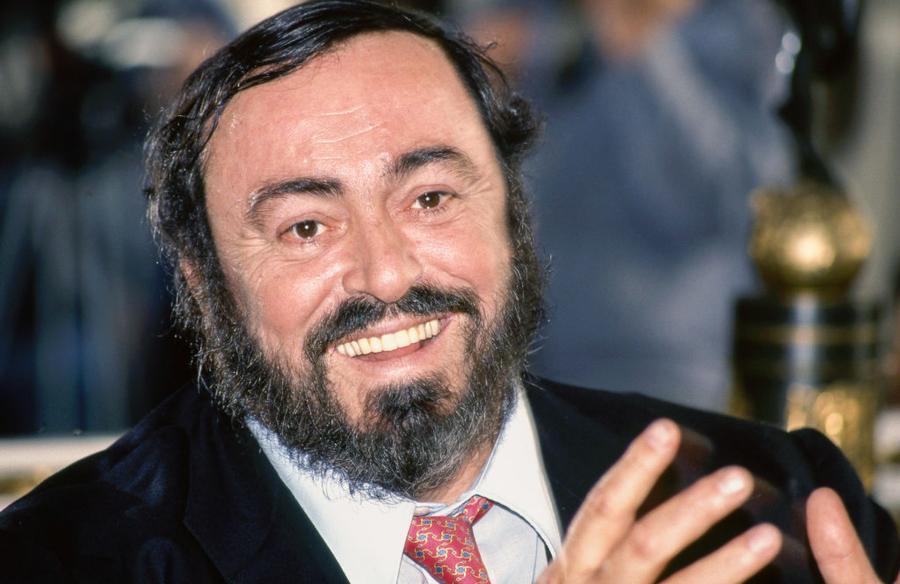
Portrait of Italian tenor Luciano Pavarotti (1935 – 2007), Madrid, Spain, 1993. (Photo by Gianni Ferrari/Cover/Getty Images)
Early Life
Luciano Pavarotti was born on October 12, 1935, in Modena, Italy. His father, Fernando, was a baker and an amateur tenor, while his mother, Adele Venturi, worked at a cigar factory. The family lived modestly, and their financial situation was further strained during World War II. Music entered Pavarotti's life early through his father, who filled their home with recordings by legendary tenors such as Beniamino Gigli and Tito Schipa.
As a child, Pavarotti initially dreamed of becoming a professional soccer goalkeeper before committing himself to singing. After finishing school, he trained as a teacher and worked in an elementary classroom for two years. In 1954, at age 19, he decided to pursue music seriously and began studying under Arrigo Pola, later continuing his training with Ettore Campogalliani. During this period, he supported himself through various jobs, including teaching and selling insurance.
His first notable success came as a member of the Corale Rossini male choir, which won first prize at the International Eisteddfod in Llangollen, Wales. The victory confirmed his potential and encouraged him to pursue a solo career.
Early Operatic Career
After seven years of intensive vocal training, Pavarotti made his professional operatic debut in April 1961 as Rodolfo in Puccini's "La Bohème." National and international appearances soon followed, including performances in "La Traviata" and early engagements in Vienna, Amsterdam, Zurich, and Dublin.
A major turning point came in the mid-1960s through his association with soprano Joan Sutherland. In 1965, Pavarotti joined the Sutherland-Williamson company on an Australian tour, singing Edgardo in Donizetti's "Lucia di Lammermoor." Pavarotti later credited Sutherland's mentorship as crucial to the development of his technique, confidence, and vocal discipline.
By the late 1960s, he had made important debuts at La Scala in Milan and the Metropolitan Opera in New York, where he sang alongside his childhood friend Mirella Freni in "La Bohème." His voice, noted for its power, clarity, and natural projection, quickly distinguished him from his contemporaries.
International Breakthrough and Metropolitan Opera Stardom
Pavarotti's defining breakthrough in the United States came in 1972 at the Metropolitan Opera, when he delivered nine perfectly executed high Cs in Donizetti's "La Fille du Régiment." The performance earned him a record-breaking 17 curtain calls and instantly transformed him into a household name.
From that moment forward, Pavarotti became a central figure at the Met, where he ultimately sang 379 performances, most in fully staged productions. He remained a favorite of Met audiences well into the 1990s, admired for his natural stage presence, expressive Italian diction, and seemingly effortless vocal production.
Televised broadcasts such as "Live from the Met," which debuted in 1977, further expanded his reach, introducing opera to millions of viewers who had never attended a performance in person.
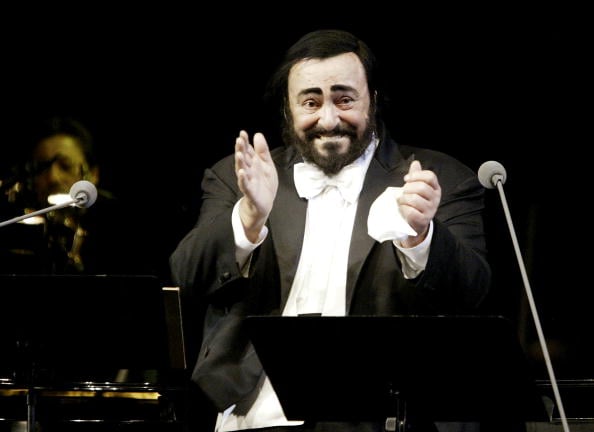
Oleg Nikishin / Getty Images
The Three Tenors and Global Pop Stardom
In the late 1980s and early 1990s, Pavarotti entered an entirely new phase of his career through the creation of the Three Tenors with Plácido Domingo and José Carreras. First staged in conjunction with the 1990 FIFA World Cup, the concerts became one of the most successful musical collaborations in history.
The Three Tenors recordings and tours sold millions of copies and filled stadiums worldwide. While some critics dismissed the project as overly commercial, there was widespread agreement that Pavarotti's charisma and vocal immediacy were the driving forces behind its success. The collaboration transformed opera singers into international superstars and generated enormous financial returns.
During the same period, Pavarotti's recording of "Nessun Dorma" from "Turandot" became a global anthem, achieving rare crossover success on pop charts and cementing his status as a cultural icon.
Later Career, Criticism, and Health Issues
As Pavarotti's fame expanded, so did criticism. By the 1980s and 1990s, he became increasingly selective with repertoire and was sometimes accused of artistic complacency, reliance on cue cards, and reluctance to learn new roles. He also faced criticism for frequent performance cancellations, leading to strained relationships with opera houses, including a temporary ban at the Lyric Opera of Chicago.
Despite physical ailments that limited his mobility and stamina, Pavarotti's voice remained remarkably intact well into middle age. He completed roughly half of a planned worldwide farewell tour beginning in 2004, though health problems increasingly forced cancellations.
Personal Life and Philanthropy
Pavarotti married his first wife, Adua Veroni, in 1961. The couple had three daughters before divorcing in 2000 after nearly four decades together. In 2003, he married Nicoletta Mantovani, his former assistant, with whom he had a daughter earlier that year.
He was deeply involved in humanitarian efforts, hosting the "Pavarotti and Friends" charity concerts in Modena, collaborating with artists such as Elton John, Sting, Bono, and Andrea Bocelli to raise funds for UN causes. He worked closely with Princess Diana on land mine awareness and was named a United Nations Messenger of Peace in 1998. His honors included the Kennedy Center Honors, the Freedom of the City of London, and the Nansen Medal from the UN High Commission for Refugees.
Death and Legacy
While on his farewell tour, Pavarotti was diagnosed with pancreatic cancer in July 2006. After surgery and months of declining health, he died at his home near Modena on September 6, 2007, at age 71.
His funeral at Modena Cathedral was attended by world leaders and broadcast internationally. Tributes poured in from opera houses, musicians, and public figures worldwide. More than any other classical singer, Pavarotti reshaped the public perception of opera, proving that a powerful, unmistakable voice could transcend genre, language, and tradition while remaining instantly recognizable.
As he once observed with characteristic simplicity, his greatest strength was that if someone heard him on the radio, they knew immediately who it was.
/2021/11/luciano.jpg)
/2014/08/Plácido-Domingo-1.jpg)
/2019/01/Jose-Carreras.jpg)
/2014/12/GettyImages-145733131.jpg)
/2020/12/Selena-Quintanilla-Perez2.png)
/2009/12/GettyImages-168378637.jpg)
/2016/07/Tarkan.png)
/2019/04/rr.jpg)
/2020/02/Angelina-Jolie.png)
/2020/04/Megan-Fox.jpg)