
/2015/06/Chris-Squire1.jpg)
/2010/12/Jon-Anderson.jpg)
/2015/03/GettyImages-665960406.jpg)
/2019/01/Alan-White.png)
/2016/09/Rick-Wakeman-1.jpg)
/2018/03/Bill-Bruford.png)
/2019/10/denzel-washington-1.jpg)
/2017/02/GettyImages-528215436.jpg)
/2020/02/Angelina-Jolie.png)
/2020/06/taylor.png)
/2019/11/GettyImages-1094653148.jpg)
/2009/09/Brad-Pitt.jpg)
/2009/11/George-Clooney.jpg)
/2020/04/Megan-Fox.jpg)
:strip_exif()/2015/09/GettyImages-476575299.jpg)
/2018/03/GettyImages-821622848.jpg)
/2019/04/rr.jpg)
What was Chris Squire's net worth?
Chris Squire was an English musician and singer-songwriter who had a net worth of $10 million.
Chris Squire was best known as the co-founder and musical backbone of the progressive rock band "Yes." As the only member to appear on every studio album released during the band's lifetime, Squire's influence on Yes was both foundational and enduring. His aggressive, melodic bass style redefined the role of the instrument in rock music, elevating it from rhythmic support to a lead voice capable of driving harmony, counterpoint, and momentum within complex arrangements.
Squire's sound was instantly recognizable. Using a Rickenbacker bass played with a pick and pushed through bright, cutting amplification, he created a tone that sliced through dense mixes while remaining musical and expressive. Beyond his technical approach, Squire was a principal architect of Yes's harmonic language, vocal arrangements, and overall sonic ambition. His backing vocals, often stacked in intricate harmonies with Jon Anderson, became a signature element of the band's sound. Over nearly five decades, Squire helped guide Yes through multiple eras, lineup changes, and stylistic evolutions, securing his reputation as one of the most influential bassists in rock history.
Early Life
Christopher Russell Edward Squire was born on March 4, 1948, in London, England. He grew up in a musical household and sang in church choirs as a child, where he developed a strong sense of harmony and pitch. Squire attended St. Andrew's Primary School and later Chislehurst and Sidcup Grammar School, continuing to perform vocally while discovering rock and roll and rhythm and blues.
He took up the bass guitar as a teenager, drawn to the instrument's power and role within a band. Influenced by players such as Paul McCartney and Jack Bruce, Squire quickly developed a style that emphasized melody and attack, setting him apart from many of his contemporaries.
Formation of Yes
In 1968, Squire co-founded Yes with vocalist Jon Anderson in London. The original lineup included guitarist Peter Banks, keyboardist Tony Kaye, and drummer Bill Bruford. From the outset, Squire envisioned a band that combined technical virtuosity with strong melodies and layered vocal harmonies.
Yes released its self-titled debut album in 1969, followed by "Time and a Word" in 1970. While these early records showed promise, the band's defining sound began to crystallize after key lineup changes in the early 1970s.
Classic Yes Era
The arrival of guitarist Steve Howe in 1970 and keyboardist Rick Wakeman in 1971 marked the beginning of Yes's most influential period. Alongside Anderson and Squire, and later drummer Alan White, the band produced a series of landmark albums including "The Yes Album," "Fragile," "Close to the Edge," and "Tales from Topographic Oceans."
Squire's bass lines were central to these recordings. On songs such as "Roundabout," "Heart of the Sunrise," and "Close to the Edge," his playing functioned as both rhythmic engine and melodic counterpoint. He frequently used chordal bass techniques, harmonics, and overdubs to create orchestral textures that expanded the band's sonic range.
During this era, Yes became one of the world's premier progressive rock acts, selling millions of albums and headlining major international tours.
Songwriting and Vocal Contributions
In addition to his instrumental work, Squire was a key songwriter within Yes. He often collaborated closely with Anderson, contributing musical frameworks and harmonic ideas that shaped the band's compositions. His high harmony vocals were essential to Yes's layered vocal sound, adding brightness and depth to Anderson's lead melodies.
Squire also sang lead vocals on select tracks, most notably "Tempus Fugit," showcasing a commanding voice that complemented his instrumental authority.
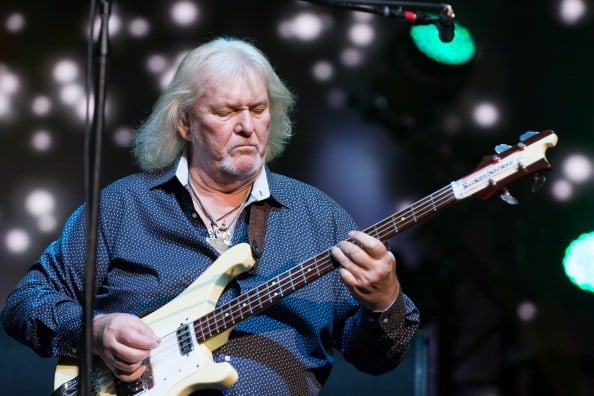
(Photo by Dave Kotinsky/Getty Images)
Solo Work and Side Projects
Squire released his first solo album, "Fish Out of Water," in 1975. The record, featuring orchestral arrangements and guest musicians including Bill Bruford and Patrick Moraz, was well received and remains a favorite among progressive rock fans. It highlighted Squire's compositional ambitions and confirmed his abilities outside the Yes framework.
He later participated in various side projects and collaborations, including work with bands such as The Syn and Conspiracy, often alongside guitarist Billy Sherwood.
Later Years with Yes
Squire remained the constant presence in Yes through decades of lineup changes, reunions, and stylistic shifts. He continued recording and touring with the band into the 2010s, helping preserve its legacy while introducing the music to new audiences.
Even as progressive rock fell in and out of mainstream favor, Squire's commitment to the band never wavered. His bass playing remained the anchor of Yes's sound until the end of his life.
Illness and Legacy
Chris Squire died on June 27, 2015, at the age of 67, after a brief battle with leukemia. His death marked the end of an era for Yes and for progressive rock as a whole.
Squire's legacy is defined by innovation, consistency, and influence. He reshaped expectations for the bass guitar in rock music and helped create one of the most ambitious catalogs in the genre's history. As the heartbeat of Yes, his impact continues to resonate with musicians and fans around the world.
/2015/06/Chris-Squire1.jpg)
/2015/03/GettyImages-665960406.jpg)
/2016/11/John-Wetton.jpg)
/2016/09/Rick-Wakeman-1.jpg)
/2018/03/Bill-Bruford.png)
/2019/09/Geoff-Downes.jpg)
/2014/08/tony-banks.png)
/2011/01/Steve-Harris-1.jpg)
/2009/09/Jennifer-Aniston.jpg)
/2020/01/lopez3.jpg)
:strip_exif()/2009/09/P-Diddy.jpg)