













What Is Keith Richards' Net Worth?
Keith Richards is an English guitarist, singer, songwriter, and record producer who has a net worth of $600 million.
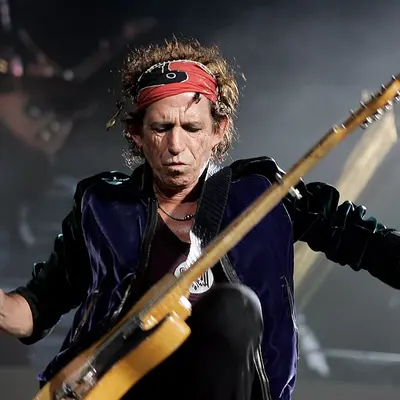
Keith Richards is best known as a founding member of the Rolling Stones and one half of the songwriting partnership responsible for much of the band's original music. Working with Mick Jagger, he helped create "(I Can't Get No) Satisfaction," "Jumpin' Jack Flash," "Gimme Shelter," "Angie," and "Start Me Up." His distinctive rhythm playing, often built around open tunings and a five-string guitar, gave the Stones a sound that remained recognizable across blues, country, soul, and hard rock.
The Stones have sold more than 200 million records worldwide and sustained a touring business for more than six decades. Richards participates in that business as a performer, recording artist, and songwriter, while also maintaining a solo catalog with his band the X-Pensive Winos. His other projects include the bestselling memoir "Life," production work, and appearances as Captain Teague in the "Pirates of the Caribbean" films.
Richards' career has continued well beyond the period that produced the Stones' most famous recordings. He toured with the group behind "Hackney Diamonds" in 2024 and recorded its 2026 follow-up, "Foreign Tongues." Alongside his music interests, he has owned homes in England, Connecticut, New York, and the Caribbean, as well as a collection numbering thousands of guitars.

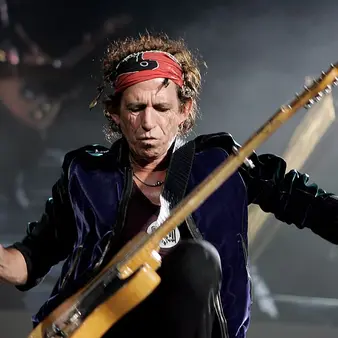
Ilya S. Savenok / Getty Images
Early Life
Keith Richards was born on December 18, 1943, in Dartford, Kent, England. He was the only child of Doris and Herbert Richards. His maternal grandfather, Augustus Theodore "Gus" Dupree, was a musician who encouraged his interest in the guitar and helped introduce him to the instrument.
Richards and Jagger knew each other as children at Wentworth Primary School before their families moved apart. They reconnected in 1961 at Dartford railway station, where Jagger's American blues records revealed a shared enthusiasm for artists such as Chuck Berry and Muddy Waters. Richards was attending Sidcup Art College, while Jagger was studying at the London School of Economics.
Through fellow musician Dick Taylor, Richards became involved with Little Boy Blue and the Blue Boys, a group that already included Jagger. London's blues scene brought them into contact with guitarist Brian Jones and pianist Ian Stewart. Those connections led to the formation of the Rolling Stones in 1962.
The Rolling Stones
The Stones initially built their following by performing American blues and rhythm-and-blues songs in London clubs. The familiar early lineup took shape around Richards, Jagger, Jones, Stewart, bassist Bill Wyman, and drummer Charlie Watts. They signed with Decca Records in 1963, while manager Andrew Loog Oldham encouraged Jagger and Richards to develop original material.
Their songwriting quickly became central to the group's identity. "The Last Time" and "(I Can't Get No) Satisfaction" helped establish the Stones as major international hitmakers in 1965. Songs such as "Paint It Black," "Ruby Tuesday," and "Jumpin' Jack Flash" followed, with Richards' guitar riffs supplying some of the most recognizable openings in rock music.
The run of albums from "Beggars Banquet" through "Let It Bleed," "Sticky Fingers," and "Exile on Main St." became a defining period in the band's career. The recordings expanded beyond electric blues to include country, gospel, acoustic ballads, and dense ensemble arrangements. Richards sometimes played bass as well as guitar, and he began taking occasional lead vocals, including on "You Got the Silver."
Jones left the band in 1969 and died shortly afterward. Mick Taylor joined for the next phase, bringing a different lead-guitar style to the Stones' recordings and concerts. Ronnie Wood eventually replaced Taylor, developing an interlocking approach with Richards in which the two players traded rhythm and lead parts rather than keeping those jobs rigidly separate.
The making of "Exile on Main St." brought the band's financial difficulties directly into its creative history. In 1971, the Stones left Britain amid tax problems, and Richards rented Villa Nellcôte in the south of France. The villa's basement became a recording space, connected to the band's mobile studio outside. Richards lived there with Anita Pallenberg and their young son, Marlon, while musicians, friends, and visitors circulated through the house.
The sessions produced much of the material for the 1972 double album, although other recordings came from earlier work and subsequent sessions in Los Angeles. Songs such as "Tumbling Dice," "Happy," and "Rocks Off" reflected the band's increasingly loose blend of rock, country, gospel, and blues. "Happy," sung by Richards, became one of his signature concert numbers. The album's reputation grew over time, making the rented French villa one of the most famous recording locations in rock history.
Richards and Jagger also became an established production team under the name the Glimmer Twins. The Stones continued generating hits through albums such as "Some Girls" and "Tattoo You," even as punk, disco, and newer forms of pop changed the market around them. Their songs remained staples of radio, film soundtracks, and live performance.
Tensions between Jagger and Richards became particularly public during the 1980s, when both pursued solo recordings. Their disagreements involved musical direction and the balance between individual careers and the band, with Richards particularly frustrated by Jagger's emphasis on his solo work. The dispute did not end their songwriting partnership, but it interrupted the touring routine that had helped sustain the Stones for decades. They resumed large-scale touring together with "Steel Wheels" in 1989. Later releases included "Voodoo Lounge," "Bridges to Babylon," "A Bigger Bang," and the blues collection "Blue & Lonesome."
Watts died in 2021, and longtime Richards collaborator Steve Jordan took over the touring drum chair. "Hackney Diamonds," released in 2023, was the band's first album of new original material since "A Bigger Bang." It won the Grammy for Best Rock Album and supplied the name for the band's 2024 tour.
In July 2026, the Stones released "Foreign Tongues," recorded with producer Andrew Watt in London. The album included contributions from Paul McCartney, Steve Winwood, Robert Smith, and Chad Smith, along with a previously recorded Watts performance. It reunited the core trio of Jagger, Richards, and Wood for another studio project after "Hackney Diamonds."

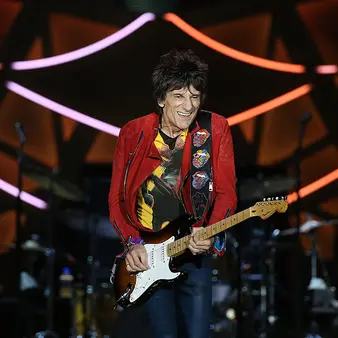
Photo by MJ Kim/Getty Images
Songwriting and Guitar Style
Richards' most famous contribution to a song may be the opening riff of "(I Can't Get No) Satisfaction." He recalled recording the idea on a bedside tape recorder and falling asleep, leaving the machine running. The finished record paired that insistent guitar figure with Jagger's lyrics and became the Stones' first American number-one single. It also demonstrated how a brief instrumental phrase could be as identifiable as a song's chorus.
His playing developed around rhythm, space, and the interaction between instruments. Open tunings allowed him to create ringing chords and shift between chord shapes with small movements of his fretting hand. His five-string, open-G setup became especially closely associated with the Stones' sound, while his work with Watts gave the songs a rhythmic flexibility that continued into live performance. With Wood, he developed a conversational two-guitar style in which either musician could carry the rhythm or add a melodic response.
Richards' songwriting also extended well beyond electric-guitar riffs. Acoustic textures, country influences, and quieter songs became important parts of the band's records. His occasional lead vocals offered a different character from Jagger's, particularly on "You Got the Silver," "Happy," and later ballads. As a producer and arranger, he helped shape the overall performances as well as the guitar parts listeners most readily associated with him.
Touring, Royalties, and Music Rights
Touring has been one of the Stones' largest businesses. The 1994–1995 "Voodoo Lounge" tour grossed $320 million and sold 6.4 million tickets. The 2005–2007 "A Bigger Bang" tour surpassed that revenue with $558 million from 4.7 million tickets, setting a touring record at the time. The tours helped establish the Stones as a stadium attraction whose commercial reach extended far beyond the original release dates of their biggest albums. In 2018, the band generated $117 million from 14 shows. Pollstar counted $235 million in gross ticket revenue from 18 reported North American concerts on the 2024 "Hackney Diamonds" tour, with 847,800 tickets sold. These figures describe the band's concert business rather than Richards' individual compensation.
Richards also receives income from the use of songs he wrote with Jagger. The partnership's catalog has continued to circulate through streaming, physical releases, radio, cover versions, and licensing. Its commercial history is more complicated than a single company owning every Stones recording and composition.
ABKCO owns and controls the original 1963–71 Jagger-Richards publishing catalog. Later material falls under different arrangements, while the writers retain interests administered on their behalf. In 2020, BMG announced an expansion of its relationship with the Stones that included collecting neighboring-rights royalties for Richards and the other principal band members when their recordings were broadcast.
BMG also administers Jagger and Richards' publishing interests across their songwriting history, including their shares in earlier songs represented by other publishers. Separately, the band's 2018 agreement with Universal Music Group covered recorded music, audiovisual releases, merchandising, brand management, and archive support. The combination of touring, continuing record sales, licensing, and songwriting royalties gives Richards several distinct sources of music income.
The Jagger-Richards credits also figured in the long-running dispute over the Verve's "Bitter Sweet Symphony." The 1997 song sampled an orchestral recording of "The Last Time," and the ensuing rights dispute resulted in Jagger and Richards receiving songwriting credits and royalties. In 2019, the pair agreed to give Richard Ashcroft their shares of the song and remove their names from its writing credits. The agreement redirected the future royalties associated with their interests to Ashcroft.
Solo Music and Other Projects
Richards released his first solo single, a version of "Run Rudolph Run," in 1978. During the Stones' strained period in the late 1980s, he assembled the X-Pensive Winos with drummer, songwriter, and producer Steve Jordan. Guitarist Waddy Wachtel, keyboardist Ivan Neville, bassist Charley Drayton, and saxophonist Bobby Keys were among the musicians associated with the project.
"Talk Is Cheap," released in 1988 under Richards' name, went gold in the United States and supported a solo American tour. "Main Offender" followed in 1992, with another round of concerts. His third solo studio album, "Crosseyed Heart," arrived in 2015 and mixed rock, blues, country, and reggae influences.
Beyond his own records, Richards has produced or co-produced work involving Aretha Franklin, Johnnie Johnson, and Ronnie Spector. His Mindless Records label released "Wingless Angels" in 1997, an album rooted in Jamaican spiritual music that he helped produce. His collaborations have repeatedly brought him back to the musicians and traditions that shaped his playing before the Stones became famous.
Richards' memoir "Life," written with James Fox, was published in 2010. Little, Brown paid a $7 million advance for the book, which became a major bestseller. Its subjects ranged from childhood and guitar technique to addiction, family life, and his complicated relationship with Jagger.
He followed "Life" with the 2014 children's book "Gus & Me: The Story of My Granddad and My First Guitar." Illustrated by his daughter Theodora, it revisited the grandfather who encouraged his earliest interest in music. The collaboration presented a family story that had also appeared in his memoir, with a very different audience and format.
Actor Johnny Depp cited Richards as an inspiration for Captain Jack Sparrow's mannerisms. Richards subsequently appeared as Sparrow's father, Captain Teague, in "Pirates of the Caribbean: At World's End" in 2007 and returned in "On Stranger Tides" in 2011. He also remained involved in guitar-related commercial projects, including a limited Gibson release modeled on his 1960 ES-355 in 2026.

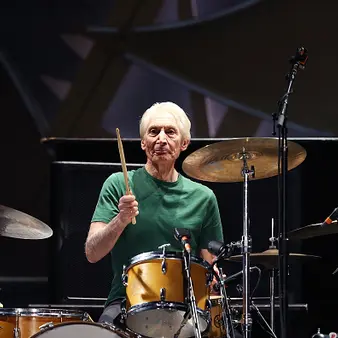
Ian Gavan/Getty Images
Personal Life
Richards' drug use and encounters with police were major parts of his public image during the Stones' early decades. The 1967 raid on his Redlands home became a defining episode in the band's relationship with the British establishment. Another serious drug case followed his arrest in Toronto in 1977, during a period when heroin addiction threatened both his freedom and his ability to continue working. He ultimately received a suspended sentence and was required to perform a benefit concert. The episode became a major turning point in his efforts to overcome heroin addiction.
His relationship with actress Anita Pallenberg lasted from 1967 to 1979. They had three children: Marlon, Angela, and Tara. Tara died of sudden infant death syndrome in 1976, when he was just over two months old.
Richards met model Patti Hansen in 1979. They married on his 40th birthday in December 1983 and had two daughters, Theodora and Alexandra. The couple established their principal family home in Connecticut while maintaining connections to England and the Caribbean.
Real Estate and Guitar Collection
Richards bought Redlands, his country estate in West Wittering, West Sussex, in 1966 for £20,000. The thatched historic house became closely associated with him after the 1967 police raid. It remained a long-term holding rather than a house he sold after the Stones' first burst of success.
His other residences have included his main home in Weston, Connecticut, and a beachfront property on Parrot Cay in the Turks and Caicos Islands. The Caribbean home has also been offered as a luxury vacation rental. Its amenities have included an infinity pool and butler service.
In 2014, Richards and Hansen paid $10.5 million for a duplex at One Fifth Avenue in Manhattan's Greenwich Village. The four-bedroom, four-bathroom apartment occupied portions of the building's 18th and 19th floors. They listed it in 2016 for $12.23 million and later reduced the asking price before selling it for $9 million in 2018, below their purchase price.
Richards has amassed a collection of around 3,000 guitars. In a 2026 interview, he confirmed that scale but explained that many instruments had been gifts and that his regular working rack contained only about 15 guitars. His best-known instruments include the Fender Telecaster nicknamed Micawber, associated with his open-G tuning and five-string technique. Although the collection is extensive, individual working guitars have remained closely tied to particular songs, recording sounds, and stage performances throughout his career.