
/2018/03/Bill-Bruford.png)
/2016/11/John-Wetton.jpg)
/2019/01/Alan-White.png)
/2015/03/GettyImages-665960406.jpg)
/2010/12/Jon-Anderson.jpg)
/2015/06/Chris-Squire1.jpg)
/2019/04/rr.jpg)
/2020/01/lopez3.jpg)
/2009/09/Jennifer-Aniston.jpg)
/2009/09/Brad-Pitt.jpg)
/2020/04/Megan-Fox.jpg)
:strip_exif()/2009/09/P-Diddy.jpg)
/2019/11/GettyImages-1094653148.jpg)
/2009/09/Cristiano-Ronaldo.jpg)
/2020/06/taylor.png)
:strip_exif()/2015/09/GettyImages-476575299.jpg)
/2009/11/George-Clooney.jpg)
What is Bill Bruford's net worth?
Bill Bruford is an English drummer, songwriter, producer, and record label owner who has a net worth of $10 million.
Bill Bruford's career redefined the role of percussion in progressive rock and jazz fusion. Widely regarded as one of the most inventive and intellectually rigorous drummers of his generation, Bruford brought a distinctive sense of precision, restraint, and rhythmic sophistication to every project he touched. He first achieved international prominence as the original drummer of "Yes," helping shape the band's early sound before departing at the height of its success. He then entered a more experimental phase with King Crimson, where his angular, unpredictable approach became central to some of the band's most influential recordings.
Unlike many rock drummers who emphasized power and volume, Bruford prioritized texture, dynamics, and compositional awareness. His playing treated rhythm as an interactive, melodic force rather than a purely supportive function. Over the decades, he moved fluidly between progressive rock, jazz fusion, and improvised music, eventually stepping away from full-time performance to pursue academic work. Bruford's career is defined by artistic independence, constant reinvention, and a refusal to compromise musical curiosity for commercial comfort.
Early Life
William Scott Bruford was born on May 17, 1949, in Sevenoaks, Kent, England. He discovered the drums as a teenager and was largely self-taught, developing his technique through close listening rather than formal instruction. Influenced by jazz drummers as much as rock players, Bruford quickly gravitated toward subtlety, timing, and tonal variation.
He attended University College London, where he studied psychology, balancing academic life with an increasingly serious commitment to music. His intellectual background would later inform both his musical philosophy and his post-performance career.
Yes and Early Breakthrough
Bruford co-founded Yes in 1968 alongside Jon Anderson, Chris Squire, Peter Banks, and Tony Kaye. As the band developed its identity, Bruford's crisp, economical drumming became a key component of its sound. He appeared on the band's first five studio albums, including "The Yes Album," "Fragile," and "Close to the Edge."
His work on tracks such as "Roundabout" and "Heart of the Sunrise" demonstrated his ability to balance complex time signatures with forward momentum. Despite Yes's growing commercial success, Bruford felt increasingly constrained by the band's direction. In 1972, he made the controversial decision to leave Yes at the peak of its popularity. Bill was replaced by Alan White.
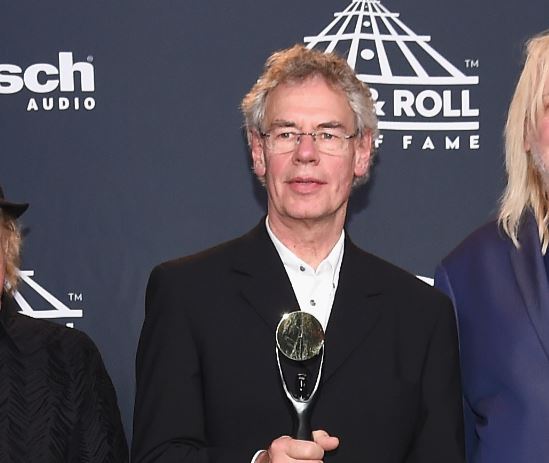
Getty
King Crimson Era
Immediately after leaving Yes, Bruford joined King Crimson, led by guitarist Robert Fripp. This move marked a decisive shift toward more experimental and improvisational music. Bruford became a central figure in King Crimson's 1970s lineup, contributing to albums such as "Larks' Tongues in Aspic," "Starless and Bible Black," and "Red."
In King Crimson, Bruford abandoned conventional rock drumming in favor of fractured rhythms, unconventional accents, and interactive improvisation. His playing on "Starless" is often cited as one of the most emotionally powerful drum performances in progressive rock history.
U.K. and Progressive Supergroups
After King Crimson disbanded in the mid-1970s, Bruford co-founded the progressive rock supergroup U.K. with John Wetton, Eddie Jobson, and Allan Holdsworth. The band blended virtuosic musicianship with more structured songwriting, though internal tensions limited its lifespan.
Bruford later formed his own group, Bruford, which allowed him to explore jazz fusion more fully. Albums released under his name emphasized compositional complexity and collective improvisation, reflecting his growing interest in jazz as a primary musical language.
Earthworks and Jazz Focus
In the late 1980s, Bruford shifted his focus almost entirely to jazz with the formation of Earthworks. The group incorporated electronic percussion and emphasized subtle interaction over virtuoso display. Earthworks became Bruford's longest-running and most personally fulfilling project, aligning closely with his musical philosophy.
Through Earthworks, Bruford established himself as a serious jazz composer and bandleader, earning respect beyond the rock world.
Technology and Innovation
Bruford was an early adopter of electronic drums, using them not as gimmicks but as tools for expanding tonal possibilities. His thoughtful integration of technology influenced later generations of drummers interested in hybrid acoustic and electronic setups.
He also became a prolific writer, authoring books and essays that examined the psychology, economics, and philosophy of being a professional musician.
Retirement and Academic Career
In 2009, Bruford retired from public performance, citing physical demands and a desire to leave the stage on his own terms. He went on to earn a PhD in music and joined the academic world, lecturing and writing on music theory, performance, and creativity.
His transition from performer to scholar was a natural extension of a career always driven by reflection and analysis.
Legacy
Bill Bruford's legacy rests on innovation, integrity, and intellectual independence. From Yes to King Crimson to Earthworks, he consistently challenged assumptions about rhythm and musicianship. His influence spans genres, inspiring rock, jazz, and fusion drummers to think more deeply about their role in the music. Bruford stands as one of the most original and respected drummers in modern music history.
/2018/03/Bill-Bruford.png)
/2016/11/John-Wetton.jpg)
/2015/03/GettyImages-665960406.jpg)
/2015/06/Chris-Squire1.jpg)
/2010/12/Jon-Anderson.jpg)
/2016/11/greg-lake.jpg)
/2016/09/Rick-Wakeman-1.jpg)
/2017/02/GettyImages-528215436.jpg)
/2019/10/denzel-washington-1.jpg)
/2020/02/Angelina-Jolie.png)
/2018/03/GettyImages-821622848.jpg)