















What Is Tego Calderón's Net Worth?
Tego Calderón is a Puerto Rican rapper, singer, songwriter, actor, and record executive who has a net worth of $8 million.
Tego Calderón is one of the most influential figures in the history of reggaeton and Latin hip-hop. Nicknamed "El Abayarde," he broke through internationally with the 2002 album "El Abayarde," combining reggaeton and hip-hop with salsa, bomba, plena, dancehall, and other Afro-Caribbean traditions. At a time when reggaeton was rapidly becoming commercialized, Calderón distinguished himself with songs addressing racism, poverty, Black identity, Puerto Rican culture, and social inequality. His early success helped move the genre from Puerto Rico's underground into the Latin mainstream, and in 2005 he signed a long-term worldwide agreement between Atlantic Records and his own Jiggiri Records. Calderón later said he had turned down multimillion-dollar offers when they threatened his creative control.
His albums include "The Underdog/El Subestimado," "El Abayarde Contraataca," and "El Que Sabe, Sabe," the latter of which won the 2015 Latin Grammy for Best Urban Music Album. Eight years later, Calderón won another Latin Grammy for Best Reggaeton Performance with "La Receta." He has also appeared in several installments of the "Fast & Furious" franchise alongside Vin Diesel, Paul Walker, and Ludacris. Despite his enormous influence, Calderón has never pursued the constant-release strategy common among many commercial reggaeton stars. He has said that live performances, rather than record royalties, have historically been his primary source of income.
Early Life
Tegui Calderón Rosario was born on February 1, 1972, in Santurce, Puerto Rico. He grew up in areas including Río Grande and Carolina, where Afro-Caribbean culture and music were major influences on his development.
His parents exposed him to traditional Puerto Rican music and salsa, particularly the work of Ismael Rivera, while Calderón developed interests ranging from jazz and African music to American hip-hop and heavy metal. He studied percussion at Puerto Rico's Escuela Libre de Música and spent part of his youth in Miami, where he attended Miami Beach Senior High School.
Before becoming a rapper, Calderón played drums in rock and heavy metal bands. His background as a percussionist later became important to his approach to reggaeton, which frequently uses live instrumentation and rhythms drawn from bomba, plena, rumba, salsa, and other forms rather than relying exclusively on the genre's standard electronic production.
Breaking Into Reggaeton
Calderón spent years trying to establish himself within Puerto Rico's underground rap and reggaeton scenes. He competed in hip-hop contests, performed wherever opportunities arose, and developed relationships with artists and producers including Eddie Dee.
His appearances on compilations and other artists' recordings gradually built a following. Calderón stood apart both visually and lyrically from many contemporaries. He openly embraced his Afro-Puerto Rican identity, frequently discussed racism and class inequality, and generally avoided building his image around luxury cars, jewelry, and other conventional symbols of rap success.
That approach initially made him an unusual figure in the emerging commercial reggaeton world, but it ultimately became one of the reasons his work proved so influential.
"El Abayarde"
Calderón's breakthrough came with the release of "El Abayarde" in 2002.
The album included songs such as "Pa' Que Retozen," "Guasa Guasa," and "Al Natural" and became a major independent success despite reggaeton still having limited access to mainstream American distribution. "Pa' Que Retozen" became one of Calderón's signature recordings and remains one of the defining tracks of early-2000s reggaeton.
The album's importance went beyond commercial success. Calderón incorporated traditional Puerto Rican and Afro-Caribbean sounds into a genre that was becoming increasingly dominated by electronic production, while his lyrics addressed racial identity, life in poor communities, politics, and social inequality alongside more conventional party records.
His popularity exploded across Puerto Rico, the Dominican Republic, New York, Miami, and other major Latin markets. In 2003, he performed at Madison Square Garden, and by the middle of the decade he had become one of the artists most closely associated with reggaeton's transition into the American mainstream.
Jiggiri Records and Atlantic Deal
Calderón also approached his career as a businessman.
He established his own label, Jiggiri Records, giving him a degree of ownership and creative control that was unusual for an artist emerging from reggaeton's underground scene. Jiggiri became involved with music from artists including Zion & Lennox and Julio Voltio while serving as Calderón's own recording vehicle.
In 2005, Atlantic Records announced a long-term worldwide deal with Calderón through Jiggiri Records. Atlantic described him as the first artist from the rapidly expanding reggaeton movement to sign a global agreement with a major non-Latin record label.
The structure was important to Calderón because he retained his own imprint rather than simply becoming another artist signed directly to a major label. He said at the time that the agreement finally allowed him to feel as though he was "captain" rather than a passenger in his career.
The deal came after Calderón had already demonstrated that he was willing to sacrifice money for control. The Los Angeles Times reported in 2005 that he had previously rejected multimillion-dollar offers from major labels rather than surrender the level of control he wanted over his music.
Turning Down Endorsement Money
Calderón's willingness to walk away from money extended beyond record contracts.
During the height of his early fame, he rejected an offer to participate in an advertising campaign for Sean "Diddy" Combs' Sean John clothing company. Calderón cited reports concerning labor conditions associated with clothing manufacturing and said the campaign conflicted with his values.
He also gradually stopped embracing the expensive jewelry commonly associated with hip-hop and reggaeton. Calderón later explained that learning about working conditions surrounding the diamond trade made him uncomfortable promoting what he called "bling bling."
Those decisions became part of a broader pattern throughout his career. Although Calderón clearly benefited financially from reggaeton's explosive growth, he frequently prioritized independence and personal beliefs over maximizing endorsements or fitting the image expected of a commercial rap star.
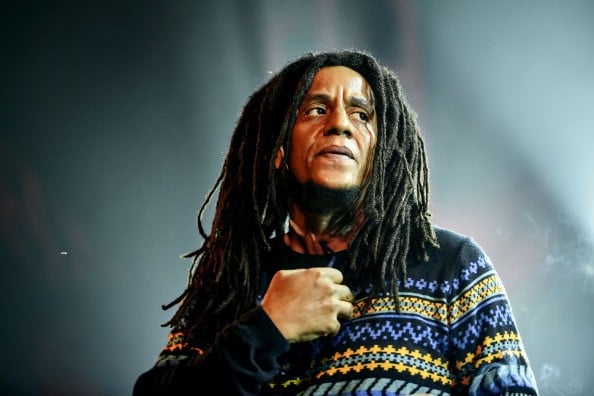
AFP / Getty Images
"Bandoleros"
One of Calderón's most enduring collaborations arrived in 2005 when he appeared with Don Omar on "Bandoleros."
The song became an international reggaeton classic and received additional exposure after being included in "The Fast and the Furious: Tokyo Drift." Calderón and Don Omar subsequently developed an onscreen partnership within the movie franchise itself.
Calderón also collaborated with numerous prominent artists during the period, including Fat Joe, Wyclef Jean, 50 Cent, Cypress Hill, and other American and Latin performers. His verses appeared on remixes and compilation records that helped connect the Spanish-language urban movement to mainstream American hip-hop.
"The Underdog/El Subestimado"
Calderón released "The Underdog/El Subestimado" through Jiggiri and Atlantic in 2006.
Rather than simply repeating the sound of "El Abayarde," he broadened the musical palette considerably. The album incorporated hip-hop, reggae, salsa, Cuban rumba, Puerto Rican bomba, and other Afro-Caribbean sounds and included collaborations with artists such as Don Omar, Zion, Yandel, Julio Voltio, Buju Banton, and salsa legend Oscar D'León.
The album reached #2 on Billboard's Top Latin Albums chart and earned Calderón a Grammy nomination for Best Latin Rock, Alternative or Urban Album. Its success demonstrated that he could experiment beyond conventional reggaeton without abandoning the audience that had made him famous.
Calderón followed it in 2007 with "El Abayarde Contraataca." That album earned another Grammy nomination, this time for Best Latin Urban Album.
How Tego Calderón Made His Money
Although record sales, publishing, acting, and his record label have all contributed to Calderón's wealth, he has said that touring historically generated the bulk of his income.
In a 2015 interview, Calderón was unusually direct about his finances, explaining that he did not live from record royalties. Instead, he said he made his living primarily through personal appearances and concerts, adding that he was fortunate to have a large volume of live work.
That business model was especially valuable during the 2000s, when Calderón became a major touring attraction throughout the United States, Puerto Rico, Latin America, and Europe. His peak coincided with reggaeton's first international explosion, giving pioneering artists significant demand for concerts even before streaming transformed the economics of Latin music.
His ownership of Jiggiri Records also gave Calderón more control over his recorded work than an artist functioning entirely under a conventional major-label contract. At the same time, his insistence on artistic independence and his relatively selective release schedule likely limited the maximum commercial earnings he could have generated during reggaeton's boom years.
Acting Career
Calderón expanded into acting during the 2000s.
He played Choco in the 2007 crime drama "Illegal Tender," which was produced by John Singleton. Two years later, he entered the "Fast & Furious" universe alongside Don Omar.
Calderón first appeared as Leo Tego in the 2009 short film "Los Bandoleros," directed by Vin Diesel, before appearing in "Fast & Furious" later that year. Leo and Don Omar's Rico Santos became members of Dominic Toretto's extended crew.
The pair returned for 2011's "Fast Five," one of the franchise's most successful and important installments. Leo and Santos participate in the elaborate Rio de Janeiro vault heist alongside Dom, Brian, Roman, Tej, Han, and Gisele.
Calderón subsequently reprised Leo in 2017's "The Fate of the Furious." His work in the movies gave him a recognizable acting résumé without ever becoming his primary profession.
"El Que Sabe, Sabe"
Calderón became increasingly selective about releasing full-length albums during the 2010s.
In 2015, eight years after his previous studio album, he released "El Que Sabe, Sabe." The title honored his late father, Esteban Calderón, who frequently used the expression.
The album continued Calderón's mixture of reggaeton, Latin hip-hop, and Afro-Caribbean music while addressing subjects including social injustice and abuse. It was nominated for multiple Latin Grammy Awards and won Best Urban Music Album at the 2015 ceremony.
The victory was an important validation for an artist who had helped shape Latin urban music more than a decade earlier but had never depended on the volume of releases or pop collaborations pursued by many younger artists.
"La Receta" and Second Latin Grammy
Calderón largely disappeared from the conventional album cycle after "El Que Sabe, Sabe," surfacing periodically for collaborations and individual singles.
He appeared on Cosculluela's "Chambean" in 2022 and returned more prominently in 2023 with "La Receta." The song immediately reminded listeners of the conversational flow, percussion-heavy production, and lyrical personality that had made him distinctive two decades earlier.
"La Receta" won the 2023 Latin Grammy for Best Reggaeton Performance, beating a field that included Karol G, Feid, Ozuna, María Becerra, and Maldy. The victory gave Calderón his second Latin Grammy nearly eight years after "El Que Sabe, Sabe."
His continuing relevance was reinforced in 2025 when "Reggaeton Malandro" earned another Latin Grammy nomination for Best Reggaeton Performance.
Influence on Reggaeton
Calderón occupies an unusual position in reggaeton history.
Artists such as Daddy Yankee and Don Omar ultimately became larger commercial stars, but Calderón became one of the genre's most influential artistic figures. His music demonstrated that reggaeton could incorporate traditional Black Caribbean music, politically conscious lyrics, and serious discussions of race and poverty without losing its connection to clubs and the street.
His pride in his Afro-Puerto Rican identity was particularly important. Calderón openly described himself as a Black artist at a time when colorism and anti-Black prejudice were often minimized within Latin entertainment. His music and visual presentation deliberately foregrounded that identity.
As reggaeton later became one of the dominant forms of global pop music, younger stars repeatedly cited the generation represented by Calderón as foundational. His influence became particularly apparent as artists such as Bad Bunny embraced Puerto Rican musical history, social commentary, and Afro-Caribbean sounds alongside mainstream reggaeton.
Personal Life
Calderón married Michelle Peterbauer in January 2006 after the two had already been together for several years. Peterbauer had previously worked as his assistant. Calderón has children from his relationships and has repeatedly described fatherhood as more important to him than his entertainment career.
The marriage later deteriorated. By 2015, Calderón publicly acknowledged that he and Peterbauer were living separately, and subsequent Puerto Rican media reports described domestic disputes between them.
In June 2019, Calderón was taken into custody in Puerto Rico after an ex-partner alleged that he had violated a protective order by contacting her through telephone calls and text messages. The arrest concerned the alleged violation of the order rather than a finding that the underlying accusations were true.
Despite periods of personal turmoil and lengthy stretches away from recording, Calderón has retained an unusually respected position within Latin music. More than two decades after "El Abayarde" helped introduce a wider audience to reggaeton, his occasional releases continue to compete for the genre's most prestigious awards.