











What Was Chris Farley's Net Worth?
Chris Farley was an American comedian and actor who had a net worth of $5 million at the time of his death in 1997. That is the equivalent of around $10 million in today's dollars after adjusting for inflation.
Chris Farley became one of the most popular performers of the early-1990s "Saturday Night Live" cast before starring in the hit comedies "Tommy Boy," "Black Sheep," and "Beverly Hills Ninja." His physical comedy, immense energy, and vulnerability made him a singular presence on television and in movie theaters. His best-known "SNL" characters included motivational speaker Matt Foley, a Chippendales dancer competing against Patrick Swayze, and one of the Chicago sports fans known as Bill Swerski's Superfans. After leaving "SNL," Farley emerged as a leading film comedian with strong box-office potential. "Tommy Boy" grossed about $32 million worldwide, "Black Sheep" about $34 million, and "Beverly Hills Ninja" about $31 million, at the box office. Farley died at only 33, cutting short a film career that had already opened new possibilities, including plans to voice the title character in "Shrek." His reputation has continued to grow through repeats, home video, streaming, and tributes by comedians who worked alongside him.
Early Life
Christopher Crosby Farley was born on February 15, 1964, in Madison, Wisconsin, and grew up in nearby Maple Bluff. His father, Thomas Farley Sr., ran an oil business, while his mother, Mary Anne, raised Chris and his four siblings, Tom Jr., Kevin, John, and Barbara. He attended Catholic schools including Edgewood High School and spent summers at Red Arrow Camp in northern Wisconsin.
Farley grew up in an outgoing and competitive family and played football and rugby. His physical athleticism became part of his comedic technique, allowing him to throw his body into elaborate falls and sudden movements while maintaining the precision required for live performance. He attended Marquette University and graduated in 1986 with degrees in communications and theater.
Madison Improv and Chicago's Second City
After college, Farley worked briefly in his father's oil business but found himself increasingly drawn toward performing. He studied improvisational comedy at the Ark Improv Theatre in Madison, where Joan Cusack was among the future performers associated with the local scene. Farley subsequently moved to Chicago and performed at ImprovOlympic, a training ground for many comedians who went on to national fame.
He joined the Second City touring company and eventually the main stage. His colleagues included future television writer and actor Bob Odenkirk, who would later create Farley's most famous "Saturday Night Live" character. Farley's stage credits included "The Gods Must Be Lazy," "It Was Thirty Years Ago Today," and "Flag Smoking Permitted in Lobby Only or Censorama." Live improvisation suited him because it rewarded risk, instinct, and the ability to turn physical excess into a coherent joke.
Joining "Saturday Night Live"
Farley joined "Saturday Night Live" in 1990, alongside performers including Chris Rock. He became part of a tight-knit cast associated with David Spade, Adam Sandler, Rob Schneider, and Tim Meadows, sometimes nicknamed the "Bad Boys of SNL." His performances were frequently the emotional and physical center of a sketch even when he was not playing the most powerful character.
Farley's strength lay in making absurd people strangely sympathetic. He could appear frighteningly intense for a moment and then unexpectedly embarrassed or insecure. Other performers often had to control their laughter as Farley committed to extreme physical bits, from smashing furniture to demonstrating a ridiculous dance routine.
Matt Foley and Other Famous Sketches
Matt Foley, the motivational speaker who warned teenagers about ending up "living in a van down by the river," became Farley's best-known character. Bob Odenkirk devised the sketch with Farley during their Chicago years, and the character's name came from a real friend of Farley's who later became a priest. Foley's furious lectures, broken furniture, and self-pity gave Farley an ideal vehicle for improvisational fury.
Another enduring sketch placed Farley in an audition against guest host Patrick Swayze for a Chippendales dancing job. Farley performed with fearless conviction, using the obvious disparity between their conventional appearances as part of the joke. He also appeared as Todd O'Connor among the Chicago Superfans, one of the Gap Girls, and the inarticulate television interviewer in "The Chris Farley Show." His impressions included Jerry Garcia, Rush Limbaugh, and Meat Loaf.
The grueling rhythm of weekly live television and the cast's off-screen antics became part of Farley's legend. After the 1994–95 season, Farley and several colleagues left "SNL," and he shifted his primary focus to film.
"Wayne's World" and Early Film Roles
Farley made his film debut in "Wayne's World" in 1992, playing a security guard, and appeared in "Coneheads," "Airheads," and "Billy Madison." He also featured in the Red Hot Chili Peppers music video for "Soul to Squeeze," which appeared on the "Coneheads" soundtrack. These projects introduced him to movie audiences while he was still a major part of "SNL."
His early screen appearances often used the same explosive physicality that had become his trademark. The challenge was sustaining that energy across a feature-length story rather than a brief sketch, and "Tommy Boy" gave him the most successful answer.
"Tommy Boy"
"Tommy Boy" was released in 1995 and paired Farley with David Spade in a road comedy about an immature heir trying to save his late father's auto-parts business. Spade's deadpan exasperation played beautifully against Farley's huge emotions and physical disasters. The movie grossed about $32 million in theaters and later found an even larger audience through video and television.
The film's financial performance showed that Farley could headline a commercial movie rather than merely provide comic relief. Although its original reviews were mixed, "Tommy Boy" became one of the most beloved comedies associated with the "SNL" generation. Its lasting popularity is one reason Farley's influence far exceeds the relatively short length of his film career.
"Black Sheep" and "Beverly Hills Ninja"
Farley and Spade reunited for "Black Sheep" in 1996, a political comedy intended to capitalize on their chemistry. The film earned about $34 million but did not receive the same affection as "Tommy Boy." Farley was unhappy with its direction, and accounts of that period describe his ongoing struggle with addiction and repeated attempts at treatment.
He next starred in "Beverly Hills Ninja," which arrived in theaters in 1997. The movie grossed around $31 million and gave Farley another recognizable starring role, built around a well-meaning but inept martial-arts student. Its comedy again depended on demanding physical work, something Farley performed with unusual commitment.
"Almost Heroes," "Dirty Work," and "Shrek"
Farley completed roles in "Almost Heroes" and "Dirty Work," both released in 1998 after his death. He was also the original choice to voice the ogre in DreamWorks' animated film "Shrek." Accounts of the production indicate that he had recorded most of his dialogue before he died. The filmmakers ultimately reworked the character and cast Mike Myers in the title role.
He had also been associated with the proposed film "A Confederacy of Dunces" and other projects that never came to fruition. His early death left a much larger list of potential future roles than the filmography he actually completed. The "Shrek" casting history is especially poignant because the finished franchise became a massive commercial success with another "SNL" veteran voicing the character.

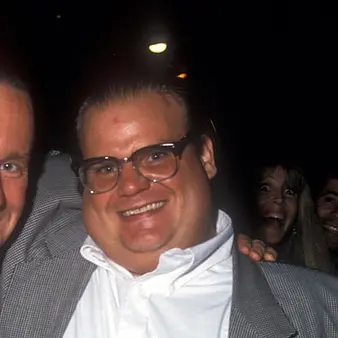
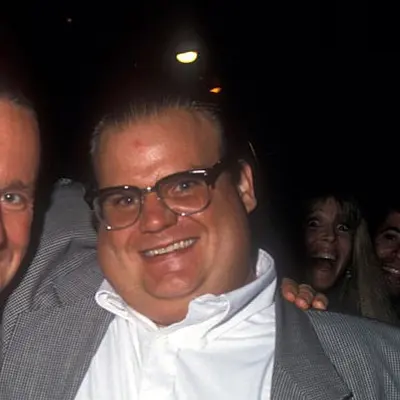
Phil Hartman and Chris Farley (Photo by Barry King/WireImage)
Working with David Spade and the "SNL" Generation
Farley's pairing with David Spade was central to his transition from television sketch player to film star. The two performers had contrasting comic personalities: Spade specialized in dry sarcasm and controlled embarrassment, while Farley was emotionally transparent and willing to throw his entire body into a scene. Their chemistry gave "Tommy Boy" more emotional weight than its mismatched-partners premise might suggest. The road-trip story depended on the audience caring about Farley's character despite his mistakes and lack of self-confidence.
The performers came from an unusually productive "Saturday Night Live" period that also included Adam Sandler, Chris Rock, and other comedians who would become film or television stars. Farley did not live long enough to establish an enduring production company or a second phase as a senior comedic actor, but his peers repeatedly described the distinctiveness of his screen presence. His best performances worked because the loudest, most chaotic physical moments were often followed by genuine tenderness.
Original Voice of "Shrek"
Among Farley's unfinished assignments, "Shrek" is the one with the most extraordinary commercial afterlife. He recorded the voice of the central character while DreamWorks was developing the animated film, and accounts differ about whether he had completed roughly 85% or as much as 95% of the dialogue. After his death, the filmmakers changed the story and brought in Mike Myers, another "SNL" alumnus, whose Scottish-accented performance became inseparable from the finished character. Footage of an early story reel using Farley's recorded dialogue later circulated publicly and showed how different the original conception had been.
Farley's association with "Shrek" does not mean that he earned a share of the sequels or the eventual franchise's enormous box-office receipts. His recorded performance was not used in the released film, and the relevant contractual terms are not public. It does, however, demonstrate the level of Hollywood opportunity already available to him when his life ended: he was working on projects that might have moved him far beyond the films and roles for which he is remembered today.
Farley's unrealized work on "Shrek" became especially poignant after the animated film transformed into a hit with Mike Myers voicing the title character. Farley had recorded substantial dialogue for an earlier version of the project and had approached the ogre as a different, more vulnerable personality. After his death, the filmmakers redeveloped the story and recast the lead. The released film was not merely a production with an actor replaced: its tone and central character evolved in the process. For fans, those early recordings have offered a glimpse of a career that might have moved into a new creative phase.

Chris Farley (Photo by Steve Granitz Archive 1/WireImage)
Tributes and Documentary Portraits
Farley's family, friends, and colleagues have repeatedly tried to tell a fuller story of his life than the familiar account of a brilliant comedian who died young. The 2015 documentary "I Am Chris Farley" brought together relatives and former colleagues to discuss his childhood, professional success, and vulnerabilities. Sandler later performed a musical tribute in his own comedy specials, returning to Farley's generosity, stage energy, and their shared early careers.
Those recollections are important because Farley was sometimes reduced to the repeated spectacle of falls, shouting, and pratfalls. His colleagues emphasized meticulous preparation, strong improvisational instincts, and an ability to make audiences sympathize with awkward outsiders. That combination explains why fans continue to return to his sketches and films decades after his death.
Box Office and Estate
Farley's three major starring comedies produced theatrical grosses in the low-to-mid $30 million range each.
Farley had a net worth of $5 million when he died in 1997, equivalent to around $10 million in 2026 purchasing power. His films continued earning money through home video, television licensing, and streaming long after his death, but the distribution of those later receipts to his estate is not public.
Personal Life and Death
Farley's life was marked by recurring problems with substance use and by repeated efforts to recover. Colleagues remembered both his generosity and his vulnerability, qualities that were visible beneath his enormous stage persona. He died on December 18, 1997, in Chicago from a drug overdose at the age of 33.
He has been remembered in tributes by former "SNL" colleagues including Adam Sandler and David Spade. Sandler later performed a moving musical tribute, and Farley's family has continued to discuss his work and influence. The enduring attachment to "Tommy Boy," Matt Foley, and his other characters reflects an exceptional talent whose most promising years were cut short.