













What Was John Hughes' Net Worth?
John Hughes was an American filmmaker, screenwriter, producer, and director who had a net worth of $150 million at the time of his death in 2009.
John Hughes created an extraordinary collection of films that helped define American comedy in the 1980s and 1990s. After starting as an advertising copywriter and "National Lampoon" contributor, he wrote "National Lampoon's Vacation" and "Mr. Mom" before becoming a director with "Sixteen Candles." Over the next several years, Hughes wrote and often directed an astonishing run that included "The Breakfast Club," "Weird Science," "Pretty in Pink," "Ferris Bueller's Day Off," "Some Kind of Wonderful," "Planes, Trains and Automobiles," "Uncle Buck," and "National Lampoon's Christmas Vacation."
Although Hughes became synonymous with teenage movies, his greatest financial success came from a family comedy he wrote and produced but did not direct. Made for $18 million, 1990's "Home Alone" earned more than $476 million worldwide and remained the #1 movie in America for 12 consecutive weekends. Its sequel earned another $359 million. The first two "Home Alone" movies therefore generated more than $835 million in worldwide theatrical revenue, transforming Hughes from an enormously successful writer-director into one of Hollywood's most powerful producers.
After "Home Alone," Fox prepared a seven-picture arrangement involving more than $200 million in production and marketing commitments. A competing offer from Columbia reportedly included $18.5 million in fees for five films even before accounting for "Home Alone 2." Hughes gradually withdrew from directing after 1991's "Curly Sue" but continued writing and producing films including "Beethoven," "Dennis the Menace," "Miracle on 34th Street," "101 Dalmatians," "Flubber," and "Maid in Manhattan." Movies written by Hughes generated well over $1 billion at the worldwide box office during his lifetime, while many of his characters and franchises continued generating revenue long after his death.
Early Life
John Wilden Hughes Jr. was born on February 18, 1950, in Lansing, Michigan. His father, John Hughes Sr., worked in sales, while his mother, Marion, was active in community volunteer work. John was the only boy among four children.
Hughes spent part of his childhood in Grosse Pointe, Michigan, and later described himself as a lonely child who spent considerable time listening to music, drawing, and imagining stories. He developed strong interests in artists including Bob Dylan, John Lennon, and Pablo Picasso.
When John was 13, his family moved to Northbrook, Illinois, on Chicago's North Shore. The relocation would eventually become one of the most important events in his creative life. Hughes attended Glenbrook North High School, and the suburbs surrounding Northbrook later supplied the geography, architecture, schools, homes, social divisions, and emotional atmosphere found throughout his movies.
After graduating, Hughes enrolled at the University of Arizona but left without earning a degree.
Advertising and "National Lampoon"
Before Hollywood, Hughes made his living by writing advertising copy and jokes. He began selling freelance jokes to established comedians, including Joan Rivers and Rodney Dangerfield, then used copies of the jokes and the checks he had received as samples when approaching advertising agencies.
In 1970, Hughes joined Needham, Harper & Steers in Chicago before moving to Leo Burnett, one of the world's largest advertising agencies. His accounts included major consumer brands, and he became a successful copywriter while continuing to write humor on the side.
Frequent business trips to New York gave Hughes opportunities to visit the offices of "National Lampoon." He became a regular contributor to the magazine, writing articles, short stories, and parodies.
One of those pieces became pivotal to his film career. Hughes wrote a story called "Vacation '58," chronicling a family's disastrous road trip from the Midwest to Disneyland. Warner Bros. acquired the rights, and Hughes was hired to adapt it into a screenplay.
"National Lampoon's Vacation" and "Mr. Mom"
After contributing to the short-lived "Animal House" television spinoff "Delta House," Hughes received his first major feature-screenwriting opportunities. His early credits included 1982's "National Lampoon's Class Reunion," but his real breakthrough arrived the following year.
"National Lampoon's Vacation," directed by Harold Ramis and starring Chevy Chase as Clark Griswold, was released in 1983 and became a major hit. The movie transformed Hughes' autobiographical magazine story into the beginning of one of Hollywood's most durable comedy franchises.
That same summer, another Hughes screenplay reached theaters. "Mr. Mom," starring Michael Keaton, became another box-office success.
Despite the success of both movies, Hughes was frustrated by the limited authority a screenwriter held once a project entered production. He wanted to control casting, performances, dialogue, music, editing, and the overall tone of his work. The solution was to begin directing his own scripts.
"Sixteen Candles"
Hughes made his directing debut with 1984's "Sixteen Candles," starring Molly Ringwald as Samantha Baker and Anthony Michael Hall as the Geek.
The screenplay itself demonstrated Hughes' remarkable writing speed. He reportedly wrote the initial version in a burst of roughly two days while preparing another project, "The Breakfast Club." Universal was sufficiently impressed that "Sixteen Candles" moved ahead first and became his directorial debut.
The film established several trademarks that would recur throughout Hughes' work: Chicago's affluent northern suburbs, teenagers who felt unseen by adults, music used as an essential storytelling tool, and an ability to move suddenly between broad comedy and emotional vulnerability.
Ringwald became one of Hughes' most important collaborators and would star in three movies he wrote during the decade.
"The Breakfast Club"
Hughes followed with 1985's "The Breakfast Club," set almost entirely inside the fictional Shermer High School during a Saturday detention.
The movie brought together five high-school archetypes—a brain, an athlete, a basket case, a princess, and a criminal—and gradually dismantled the stereotypes separating them. Ringwald and Hall starred alongside Judd Nelson, Ally Sheedy, and Emilio Estevez.
Produced for a relatively small budget, "The Breakfast Club" became a commercial hit and one of the defining high-school films in American cinema. The image of its five students gathered in a school library and Simple Minds' "Don't You (Forget About Me)" became permanently associated with 1980s youth culture.
Hughes followed it later in 1985 with "Weird Science," again starring Anthony Michael Hall.

(Photo by Paul Natkin/WireImage)
"Pretty in Pink" and "Some Kind of Wonderful"
Not every Hughes movie was directed by Hughes. He wrote and produced 1986's "Pretty in Pink," starring Ringwald as working-class teenager Andie Walsh. Howard Deutch directed the film, while Jon Cryer and Andrew McCarthy co-starred.
Hughes originally conceived a different ending in which Andie chose Cryer's character, Duckie. After test audiences reacted poorly, the ending was reshot so that she reunited with McCarthy's Blane.
Hughes continued exploring similar themes in 1987's "Some Kind of Wonderful," another Howard Deutch-directed film about class, romance, and friendship among teenagers. Eric Stoltz, Mary Stuart Masterson, and Lea Thompson starred.
Those films, along with "Sixteen Candles," "The Breakfast Club," and "Ferris Bueller's Day Off," became central to the group of 1980s youth movies associated with the so-called Brat Pack era.
"Ferris Bueller's Day Off"
Hughes reached another creative peak with 1986's "Ferris Bueller's Day Off," starring Matthew Broderick as a suburban Chicago teenager who skips school and spends the day exploring the city with his best friend Cameron and girlfriend Sloane.
The screenplay was another example of Hughes' astonishing productivity. His notes indicate that he developed the basic story in late February 1985 and completed the screenplay in less than a week.
"Ferris Bueller's Day Off" earned more than $70 million domestically and became one of Hughes' most enduring movies. Locations including the Art Institute of Chicago, Wrigley Field, downtown Chicago, and the North Shore suburbs helped turn the city itself into a major character.
In 2014, the Library of Congress selected the film for preservation in the National Film Registry because of its cultural, historical, or aesthetic significance.
"Planes, Trains and Automobiles"
By 1987, Hughes was eager to move beyond being categorized exclusively as a filmmaker for teenagers. He wrote, produced, and directed "Planes, Trains and Automobiles," starring Steve Martin and John Candy.
Martin played tightly wound advertising executive Neal Page, while Candy portrayed relentlessly friendly shower-curtain-ring salesman Del Griffith. What begins as an escalating collection of travel disasters gradually becomes a much more emotional story about loneliness and companionship.
The film began one of Hughes' most important creative relationships. Candy subsequently appeared in Hughes projects including "The Great Outdoors," "Uncle Buck," "Home Alone," and "Only the Lonely," which Hughes produced.
Hughes was deeply affected by Candy's sudden death from a heart attack in 1994. Friends later suggested that losing Candy contributed to Hughes' increasing withdrawal from Hollywood.
An Extraordinary 1980s Run
The speed at which Hughes produced movies during his peak remains extraordinary. Between 1983 and 1990, he wrote or co-wrote "National Lampoon's Vacation," "Mr. Mom," "Sixteen Candles," "The Breakfast Club," "European Vacation," "Weird Science," "Pretty in Pink," "Ferris Bueller's Day Off," "Some Kind of Wonderful," "Planes, Trains and Automobiles," "She's Having a Baby," "The Great Outdoors," "Uncle Buck," and "National Lampoon's Christmas Vacation," among other projects.
For several of those films, he was simultaneously serving as director and producer. Hughes worked quickly, frequently producing complete screenplays in days rather than months, and kept extensive notebooks filled with dialogue, plot ideas, character sketches, music, and production plans.
His fictional town of Shermer, Illinois, became a stand-in for Chicago's North Shore. Northbrook, Northfield, Highland Park, Winnetka, Glencoe, and other surrounding communities repeatedly appeared on screen, giving Hughes' films a visual continuity that made them feel as though many of his characters occupied the same universe.
"Uncle Buck" and Macaulay Culkin
One of the most consequential films of Hughes' career was 1989's "Uncle Buck." John Candy starred as an irresponsible bachelor unexpectedly placed in charge of his brother's children.
Among the child actors was nine-year-old Macaulay Culkin, who played Miles. Hughes was sufficiently impressed that he began developing another movie around Culkin.
That project became "Home Alone."
"Home Alone"
Hughes wrote and produced "Home Alone," while Chris Columbus directed. The story followed eight-year-old Kevin McCallister, accidentally left behind when his large suburban Chicago family travels to Europe for Christmas.
The film nearly collapsed immediately before production. Warner Bros. had been developing the project but became concerned as its budget increased. When the studio refused to continue, Hughes took the project to 20th Century Fox, which quickly stepped in and financed it.
The final production cost $18 million.
Released in November 1990, "Home Alone" stunned Hollywood. It opened at #1 and remained the highest-grossing movie in America for 12 consecutive weekends. The film eventually earned more than $285 million domestically and $476 million worldwide, making it one of the most successful comedies ever produced at the time.
For Hughes, the magnitude of the success was unlike anything he had previously experienced. His teen comedies had been highly profitable, but none had approached the hundreds of millions generated by "Home Alone."
"Home Alone 2" and the $200 Million Fox Deal
The success of "Home Alone" dramatically increased Hughes' financial leverage in Hollywood. Studios began competing for a long-term relationship with the writer-producer.
In early 1991, 20th Century Fox began putting together a seven-film arrangement involving more than $200 million in total production and marketing commitments. Six films were expected to carry production budgets of roughly $20 million to $25 million apiece, with the package also including "Home Alone 2."
A competing Columbia proposal was prepared to pay Hughes $18.5 million in fees for five films other than the "Home Alone" sequel. That figure represented Hughes' personal fees, rather than the production budgets themselves, illustrating how valuable his services had become after producing one of the most profitable movies in Hollywood history.
"Home Alone 2: Lost in New York" reunited Hughes, Columbus, and Culkin and was released in 1992. It earned $359 million worldwide, bringing the first two movies to more than $835 million in combined global theatrical revenue.
Hughes later wrote and produced 1997's "Home Alone 3," which introduced an entirely new family and starred Alex D. Linz rather than Culkin.
"Curly Sue" and the End of His Directing Career
Hughes directed only eight feature films, with his final effort arriving in 1991.
"Curly Sue" starred Jim Belushi, Kelly Lynch, and young Alisan Porter. The movie also featured the film debut of Steve Carell in a small role.
After "Curly Sue," Hughes stopped directing altogether at only 41 years old. He did not leave the film business immediately, but his role changed dramatically. Instead of spending months on sets, he increasingly worked from Illinois as a writer and producer.
"Beethoven," "Dennis the Menace," and Family Films
During the 1990s, Hughes shifted decisively toward family entertainment. He wrote the story and screenplay for the 1992 hit "Beethoven," although he used the pseudonym Edmond Dantès rather than his own name on the finished film.
He subsequently wrote and produced "Dennis the Menace," released in 1993, and wrote 1994's remake of "Miracle on 34th Street." Other credits included "Baby's Day Out," "101 Dalmatians," and "Flubber."
His 1990s work was generally less personal than the teen movies that established his reputation, but these projects extended his commercial success and created additional franchises and character rights with long afterlives on television, home video, streaming, and sequels.
Edmond Dantès and Withdrawal From Hollywood
As Hughes became increasingly private, he occasionally distanced himself even from his own screenwriting credits. He used "Edmond Dantès," the protagonist of Alexandre Dumas' "The Count of Monte Cristo," as a pseudonym when he did not want his real name attached prominently to a finished movie.
The name appeared on "Beethoven" and later on 2002's "Maid in Manhattan," starring Jennifer Lopez and Ralph Fiennes. Hughes received story credit under the pseudonym after the finished movie differed substantially from his original screenplay.
His final released story credit came on 2008's "Drillbit Taylor," starring Owen Wilson. Once again, Hughes was credited as Edmond Dantès. Seth Rogen and Kristofor Brown developed the final screenplay from the story.
By then, Hughes had spent years almost completely outside Hollywood's public culture. He rarely gave interviews, stopped attending industry events, and largely avoided the publicity machine that surrounded his earlier career.
Redwing Farms
As Hughes pulled away from Hollywood, he devoted increasing energy to an ambitious property project in northern Illinois.
In 1989, he began assembling land for Redwing Farms near the Wisconsin border. The property eventually expanded to more than 1,000 acres. Much of the land had been heavily cultivated, and Hughes became fascinated with restoring portions of it to something resembling its pre-agricultural landscape.
He researched native plants and trees, planted extensive hedgerows, reforested sections of the property, raised Devon cattle, grew crops, and worked with farmers and landscapers on the estate. The meticulous planning echoed the notebooks and obsessive detail he had once devoted to movies.
Hughes maintained Redwing Farms as both a working agricultural property and a private refuge from Hollywood.
Lake Forest Estate
John and Nancy Hughes also owned an impressive residence in Lake Forest, Illinois, only a block from Lake Michigan.
The English-style mansion was originally built in 1929 and sat on a little more than two acres. After an extensive expansion, the residence measured more than 11,000 square feet and contained six bedrooms, numerous bathrooms, six fireplaces, a three-car heated garage, a swimming pool, extensive gardens, and multiple stone terraces.
The most significant room for Hughes was the library. Surrounded by leaded windows, dark wood, and a large fireplace, it became one of his primary writing spaces. Hughes wrote material for projects including "Home Alone 2," "Beethoven," and "Dennis the Menace" there.
After John's death, Nancy eventually placed the property on the market for $5.89 million. The estate later became the site of a charitable designer showhouse and ultimately sold for $4 million.
Personal Life
Hughes married his high-school sweetheart, Nancy Ludwig, in 1970. They had two sons and remained married for 39 years, until John's death.
Unlike many successful Hollywood filmmakers, Hughes never permanently embraced Los Angeles. By the end of the 1980s, he had returned to the Chicago area and relocated Hughes Entertainment to Northfield, allowing him to remain close to the suburbs that had inspired so much of his work.
His retreat from Hollywood became increasingly pronounced during the 1990s. Hughes continued writing, farming, spending time with his family, and occasionally communicating privately with fans, but he largely disappeared from interviews, premieres, and industry social life.
Nancy Hughes died in 2019.
Kevin Winter/Getty Images
Death
John Hughes died on August 6, 2009, at the age of 59. He suffered a heart attack while taking a morning walk in Manhattan, where he was visiting family, and was transported to Roosevelt Hospital.
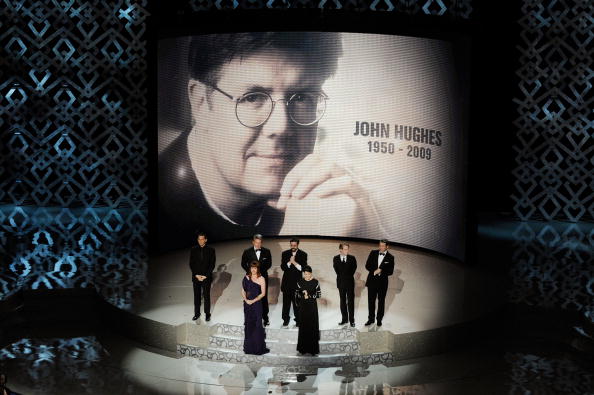
His death prompted an enormous outpouring from the actors whose careers he had helped shape. At the 2010 Academy Awards, Molly Ringwald, Matthew Broderick, Macaulay Culkin, Anthony Michael Hall, Judd Nelson, Ally Sheedy, and Jon Cryer appeared together onstage during a special tribute to Hughes.
The first episode of the NBC comedy "Community" was also dedicated to him.