
/2014/10/Federico-Fellini.jpg)
/2013/10/Alfonso-Cuaron-1.jpg)
/2014/08/Anouk-Aimee.jpg)
/2011/06/Ang-Lee.jpg)
/2010/11/dino.jpg)
/2023/05/anita.png)
/2009/09/Jennifer-Aniston.jpg)
/2020/06/taylor.png)
/2020/01/lopez3.jpg)
:strip_exif()/2015/09/GettyImages-476575299.jpg)
/2009/11/George-Clooney.jpg)
/2009/09/Brad-Pitt.jpg)
/2019/10/denzel-washington-1.jpg)
/2020/04/Megan-Fox.jpg)
/2018/03/GettyImages-821622848.jpg)
/2020/02/Angelina-Jolie.png)
/2009/09/Cristiano-Ronaldo.jpg)
What was Federico Fellini's Net Worth?
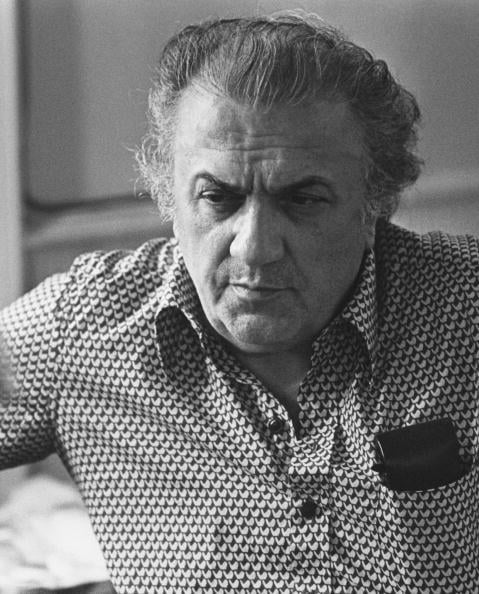
Federico Fellini was an Italian film director and screenwriter who had a net worth of $10 million.
Widely considered one of the greatest filmmakers of all time, Federico Fellini directed such films as "La Strada," "Nights of Cabiria," "La Dolce Vita," "8½," and "Amarcord." Four of his films won the Academy Award for Best Foreign Language Film, and "La Dolce Vita" won the Palme d'Or at Cannes in 1960.
Early Life and Education
Federico Fellini was born on January 20, 1920 in Rimini, Italy to Ida and Urbano. His mother hailed from a bourgeois Catholic family of Roman merchants and his father came from a family of Romagnol peasants. Fellini had two younger siblings named Riccardo and Maria. He was educated at a primary school run by nuns before attending the Carlo Tonini public school for two years. Growing up, Fellini drew, staged puppet shows, and went to the circus and the movies. In 1929, he entered the Ginnasio Giulio Cesare. Later, as an adolescent in the late 1930s, he opened a portrait shop in his hometown and embarked on a career as a caricaturist and gag writer. After graduating from high school in 1939, Fellini moved to Rome and enrolled in law school at the Sapienza University of Rome. However, he never attended any classes.
Career Beginnings
Starting out as a caricaturist and comedy writer, Fellini wrote for the satirical magazine Marc'Aurelio and eventually joined its editorial board. He had a regular column in the magazine from 1939 to 1942, and during his tenure met such future collaborators as Ettore Scola, Cesare Zavattini, and Bernardino Zapponi. Meanwhile, Fellini wrote radio sketches as well as gags for films. In late 1942, he was sent to Fascist Italy-occupied Libya to co-write the screenplay to the film "Knights of the Desert" with Vittorio Mussolini. The next year, Fellini co-wrote the comedies "The Peddler and the Lady" and "The Last Wagon." Following the Allied liberation of Rome in 1944, Fellini opened the Funny Face Shop with Enrico De Seta. There, they drew caricatures of American soldiers.
Joining Neorealism
After the war, Fellini became involved in the burgeoning Italian Neorealist movement, and co-wrote Roberto Rossellini's seminal 1945 neorealist film "Rome, Open City." For the script, he received his first Academy Award nomination. Fellini went on to co-write and serve as an assistant director on Rossellini's 1946 follow-up film "Paisan," for which he received another Academy Award nomination. After that, he co-wrote Alberto Lattuada's films "Flesh Will Surrender" (1947), "Without Pity" (1948), and "The Mill on the Po" (1949), and both co-wrote and acted in Rossellini's 1948 anthology film "L'amore."
AFP/AFP/Getty Images
Films as Director
In 1950, after co-writing Rossellini's "The Flowers of St. Francis" and Pietro Germi's "Path of Hope," Fellini had his first film directing credit on the 1950 romantic dramedy "Variety Lights," which he co-directed with Alberto Lattuada. It featured both men's wives, Giulietta Masina and Carla Del Poggio, respectively. "Variety Lights" performed poorly with critics and audiences, leaving Fellini with severe debt. He went on to make his solo directorial debut in 1952 with the satirical comedy "The White Sheik," which received a similarly sour response from critics at the time. However, the film established Fellini's prolific professional partnership with composer Nino Rota. Fellini had his breakthrough with his next film, "I Vitelloni," which won the Silver Lion at the 1953 Venice Film Festival and became a critical and commercial success. It also earned Fellini his third Academy Award nomination. "I Vitelloni" secured Fellini international distribution for the first time, making him a name overseas. He continued his global acclaim with "La Strada" (1954), starring Giulietta Masina and Anthony Quinn. The film garnered Fellini another Academy Award nomination for writing and won the trophy for Best Foreign Language Film. He followed that in 1955 with "Il Bidone," starring Broderick Crawford; it was a critical and commercial flop.
After the disappointment of "Il Bidone," Fellini bounced back with "Nights of Cabiria" (1957), starring Masina as a down-on-her-luck prostitute striving desperately for happiness. The film earned Masina Best Actress at Cannes and won the Academy Award for Best Foreign Language Film. Fellini reached a new artistic pinnacle in 1960 with his epic satire of modern life, "La Dolce Vita." His first film starring Marcello Mastroianni, it won the Palme d'Or at the Cannes Film Festival and broke all box-office records in Italy, although it was denounced and eventually banned by the Italian censors for its subversiveness. The film received four Academy Award nominations, including Fellini's first for Best Director. After "La Dolce Vita," Fellini moved increasingly toward a dreamlike cinema influenced by the work of psychologist Carl Jung. His next solo film, "8½" (1963), was a surrealistic metafictional film about a famous director, played by Mastroianni, suffering from a creative block. It earned five Academy Award nominations, including Fellini's second for Best Director, and won Best Foreign Language Film.
Fellini continued to explore dream states with his 1965 fantasy psychodrama "Juliet of the Spirits," starring Masina. His first feature-length color film, it earned two Academy Award nominations. Fellini followed that in 1968 with the short "Toby Dammit," which was included in the horror anthology film "Spirits of the Dead." The following year, he released the phantasmagorical Imperial Rome-set "Fellini Satyricon," which garnered him his third Academy Award nomination for Best Director. Next came "I Clowns" (1970) and "Roma" (1972), both of which include documentary elements. Fellini went on to release one of his most beloved films, the semi-autobiographical "Amarcord," in 1973; it brought Fellini his fourth Academy Award nomination for Best Director and his fourth trophy for Best Foreign Language Film. His subsequent films were "Fellini's Casanova" (1976), "Orchestra Rehearsal" (1978), "City of Women" (1980), "And the Ship Sails On" (1983), and "Ginger and Fred" (1986). Fellini's final two films were "Intervista" (1987) and "The Voice of the Moon" (1990). In 1992, he received an Academy Honorary Award for his esteemed career.
Personal Life and Death
During his early career as a radio sketch writer in 1942, Fellini met Giulietta Masina at the public service broadcast station EIAR, where she also worked. The pair dated for nine months and got married in 1943. Masina suffered a miscarriage with the couple's first child after falling down the stairs, and the couple's second child, Pierfederico, died from encephalitis 11 days after his birth in 1945. Fellini and Masina had no other children.
On October 31, 1993, Fellini died in Rome after having suffered a heart attack a few weeks prior. About five months later, Masina passed away from lung cancer. The two are buried together with their son Pierfederico in the Monumental Cemetery of Rimini.
/2014/10/Federico-Fellini.jpg)
/2023/05/anita.png)
/2013/10/Alfonso-Cuaron-1.jpg)
/2014/08/Jane-Campion.jpg)
/2023/10/Robert-Altman.jpg)
/2014/02/Milos-Forman-1.jpg)
/2010/11/sophia.jpg)
/2010/02/Paul-Thomas-Anderson.jpg)
/2019/11/GettyImages-1094653148.jpg)
:strip_exif()/2009/09/P-Diddy.jpg)