
/2015/09/philip-roth-1.jpg)
/2025/07/Anne-Tyler.jpg)
/2022/11/toni.jpg)
/2017/07/GettyImages-76654381.jpg)
/2010/12/Jonathan-Franzen.jpg)
/2014/12/Rod-Steiger.jpg)
/2019/11/GettyImages-1094653148.jpg)
:strip_exif()/2015/09/GettyImages-476575299.jpg)
:strip_exif()/2009/09/P-Diddy.jpg)
/2020/06/taylor.png)
/2009/11/George-Clooney.jpg)
/2019/10/denzel-washington-1.jpg)
/2019/04/rr.jpg)
/2009/09/Brad-Pitt.jpg)
/2009/09/Cristiano-Ronaldo.jpg)
/2017/02/GettyImages-528215436.jpg)
/2009/09/Jennifer-Aniston.jpg)
What was Philip Roth's Net Worth?
Philip Roth was an American author who had a net worth of $5 million at the time of his death. Famed for his provocative, semi-autobiographical fiction exploring Jewish American identity, Philip Roth wrote such acclaimed novels as "Goodbye, Columbus," "Portnoy's Complaint," "The Counterlife," "American Pastoral," and "The Human Stain." He won numerous accolades for his work, including a Pulitzer Prize and three PEN/Faulkner Awards.
Early Life and Education
Philip Roth was born on March 19, 1933 in Newark, New Jersey as the second child of Jewish parents Bess and Herman. After graduating from Weequahic High School, he attended Rutgers University in Newark for a year. Roth then transferred to Bucknell University in Lewisburg, Pennsylvania, from which he graduated magna cum laude with a BA in English. He subsequently attended graduate school at the University of Chicago on a scholarship, earning his MA in English literature in 1955. Roth went on to enlist in the United States Army instead of being drafted, but he was medically discharged due to a back injury sustained in basic training. In 1956, he returned to the University of Chicago for a PhD program in literature but dropped out after one term.
Books
Roth published his first book, "Goodbye, Columbus," in 1959. A collection of fiction, it contains the titular novella in addition to four short stories. Focused on stories of Jewish Americans assimilating to middle-class life in the US, the book was highly acclaimed and won the National Book Award for Fiction. Roth went on to publish his debut full-length novel, "Letting Go," in 1962. Next came "When She Was Good" (1967), his only novel with a female protagonist. Roth reached a new level of notoriety in 1969 with the controversial "Portnoy's Complaint," which caused a stir due to its explicit sexual content. Despite backlash and censorship in some corners, it was a major commercial success. Roth's next novel was the political satire "Our Gang," published in 1971. The following year, he published the novella "The Breast," the first of three works featuring protagonist David Kepesh. Roth then published the novels "The Great American Novel" (1973) and "My Life as a Man" (1974).
In 1979, Roth published "The Ghost Writer," the first novel in a series featuring his fictional alter-ego Nathan Zuckerman. It was followed by "Zuckerman Unbound" (1981) and "The Anatomy Lesson" (1983), completing a trilogy. An epilogue, the novella "The Prague Orgy," was released in 1985. The year after that, Roth published "The Counterlife," which earned him the National Book Critics Circle Award. His final book of the decade was "The Facts: A Novelist's Autobiography," published in 1988. In the early 1990s, he released "Deception: A Novel," "Patrimony: A True Story," and "Operation Shylock: A Confession." The lattermost book won Roth his first PEN/Faulkner Award for Fiction. For his 1995 novel "Sabbath's Theater," he won his second National Book Award for Fiction. Roth continued to receive plaudits after publishing "American Pastoral" in 1997; for this book, he won the Pulitzer Prize. His subsequent release was "I Married a Communist" (1998).
Roth's first novel of the 21st century was "The Human Stain" (2000), which won him another PEN/Faulkner Award for Fiction. Moreover, it won the British WH Smith Literary Award and the French Prix Médicis. Roth went on to publish the short novel "The Dying Animal" (2001), the final work in the David Kepesh series. Following that was the alternate history novel "The Plot Against America," released in 2004. In 2006, Roth published "Everyman," which became his third novel to win the PEN/Faulkner Award for Fiction. The next year, he published "Exit Ghost," his ninth and final novel featuring Nathan Zuckerman. Roth's subsequent novels were "Indignation" (2008), "The Humbling" (2009), and "Nemesis" (2010). Set in the summer of 1944 and focused on the polio epidemic in Newark, "Nemesis" was Roth's final novel. Many of his novels and short stories have been adapted into films over the years, and he is widely regarded as one of the greatest American novelists of his time.
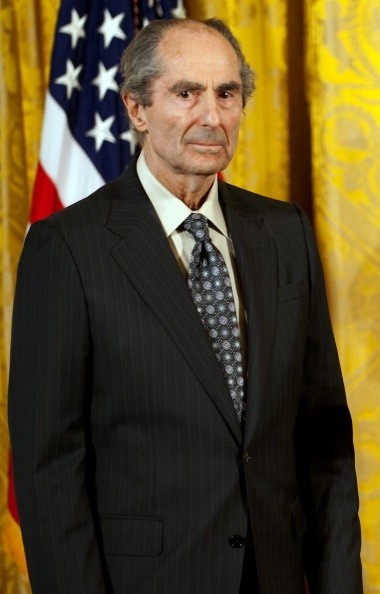
JIM WATSON/AFP/Getty Images
Academia
Roth was a longtime faculty member at the University of Pennsylvania, where he taught comparative literature until his retirement in 1991. After that, he became a part-time visiting lecturer at Bard College in Annandale-on-Hudson, New York. There, Roth co-taught a class with his friend and fellow writer Norman Manea.
Personal Life and Death
Roth married his first wife, Margaret Martinson, in 1959. They divorced in 1963, and Martinson was killed in a car crash in 1968. He later began a relationship with English actress Patricia Claire Bloom, whom he wed in 1990. They divorced in 1995.
On May 22, 2018, Roth passed away from heart failure at a hospital in Manhattan. He was 85 years of age.
/2015/09/philip-roth-1.jpg)
/2014/12/Rod-Steiger.jpg)
/2025/07/Anne-Tyler.jpg)
/2022/11/toni.jpg)
/2014/07/Gabriel-Garcia-Marquez-1.jpg)
/2012/08/Dave-Eggers.png)
/2025/12/Margaret-Atwood.jpg)
/2010/12/Jonathan-Franzen.jpg)
/2020/02/Angelina-Jolie.png)
/2020/01/lopez3.jpg)