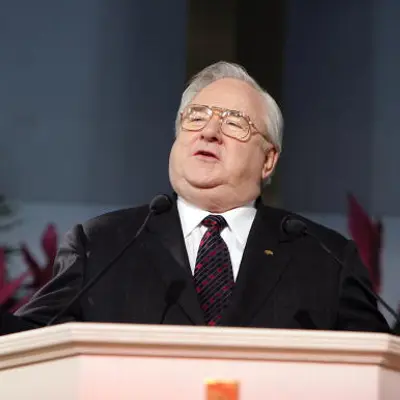
















What Was Jerry Falwell's Net Worth?
Jerry Falwell was an American evangelical pastor, televangelist, author, political activist, and university founder who had a net worth of $10 million at the time of his death.
Jerry Falwell built one of the largest religious and educational organizations in the United States from a church he founded with 35 members in Lynchburg, Virginia, in 1956. Over the next five decades, he created Thomas Road Baptist Church, the nationally syndicated "Old Time Gospel Hour," Liberty University, Liberty Christian Academy, and the Moral Majority, which became a major force in conservative American politics during the 1980s.
Falwell's organizations eventually handled enormous sums of money. By the early 1980s, his television ministry was raising more than $1 million per week, and in 1984 the "Old Time Gospel Hour" was receiving more than $72 million per year in contributions. By the time of his death, the broader network of institutions he had founded was generating roughly $200 million in annual revenue. Those organizations were largely nonprofits and were not Falwell's personal property.
Falwell nevertheless earned substantial personal income from salaries, book royalties, speaking fees, and other activities. He disclosed income of $435,000 for 1986, including a $100,000 salary, and separately received a $1 million advance for his autobiography. He also earned as much as $5,000 per speaking engagement. Falwell wrote more than a dozen books during his career and spent decades as one of the highest-profile religious figures in America.
He died on May 15, 2007, at the age of 73.
Early Life
Jerry Lamon Falwell Sr. was born on August 11, 1933, in Lynchburg, Virginia. He had a twin brother named Gene.
His father, Carey Hezekiah Falwell, was an entrepreneur who operated businesses including service stations, restaurants, and a bus company. Jerry's upbringing was not particularly religious, and his father described himself as an agnostic.
Falwell attended Brookville High School and experienced a religious conversion as a young man. He subsequently enrolled at Baptist Bible College in Springfield, Missouri, graduating in 1956.
That same year, at just 22 years old, Falwell returned to Lynchburg and began building the institutions that would define the rest of his life.
Thomas Road Baptist Church
Falwell founded Thomas Road Baptist Church in Lynchburg in 1956 with a congregation of just 35 people. The church initially operated out of a former soda bottling plant.
Falwell proved to be an aggressive recruiter and fundraiser. He went door to door inviting Lynchburg residents to services and quickly expanded the congregation.
Thomas Road eventually grew into a megachurch with more than 20,000 members. Falwell remained its senior pastor for more than 50 years.
At the same time, he launched a radio program that evolved into "The Old Time Gospel Hour." The program eventually aired on hundreds of television and radio stations across the United States and became the principal fundraising engine for Falwell's growing religious empire.
By 1981, Falwell said the television ministry was raising more than $1 million per week.
Fundraising Empire
Falwell's greatest organizational skill may have been fundraising.
In 1984, the "Old Time Gospel Hour" was receiving more than $72 million per year in contributions. Falwell's Moral Majority political operation was bringing in another $12 million annually.
The television ministry's money supported an enormous operation. At the time, Falwell's organizations employed roughly 2,200 people and had an annual payroll of $15 million. The ministry spent approximately $18 million per year buying television and radio airtime and directed millions more toward Liberty University, missionary work, churches, and other religious programs.
In 1986, Falwell said the combined operations of the "Old Time Gospel Hour," Thomas Road Baptist Church, and Liberty University generated $84 million.
Falwell's aggressive fundraising style became famous. His television broadcasts frequently included direct appeals for specific amounts of money, and his mail operations sent millions of fundraising letters to supporters.
Despite the enormous flow of donations, Falwell's organizations also frequently operated under heavy financial pressure. Liberty University in particular accumulated substantial debt during the 1980s and 1990s.
Salary and Personal Income
Falwell's personal compensation was much more modest than the revenue flowing through his ministries, but he still earned significant money.
In 1981, he said his salary was $42,500. At the time, he and his family lived in a large home connected to the ministry, and the church owned an aircraft reserved for his travel.
By 1986, Falwell disclosed personal income of $435,000. His salary accounted for $100,000 of that amount, with the remainder coming largely from book royalties and speaking fees.
Falwell was capable of earning up to $5,000 for a single speaking appearance.
In 1987, he disclosed that his combined salaries from Thomas Road Baptist Church and the "Old Time Gospel Hour" totaled $125,000.
That same year, Falwell received a $1 million advance for his autobiography. He said that after paying taxes, his agent, and writing expenses, he intended to direct the remaining proceeds toward scholarships and ministry work at Liberty University.

Jeff Fusco/Getty Images
Liberty University
Falwell founded Lynchburg Baptist College with Elmer Towns in 1971. It was later renamed Liberty Baptist College and ultimately Liberty University.
Falwell dreamed of creating a major evangelical university that could compete with prestigious secular institutions while maintaining strict conservative Christian principles.
Liberty grew quickly but repeatedly encountered financial difficulties. Falwell poured money raised through his television ministry into the school, at times subsidizing it with millions of dollars per year.
During the 1990s, Liberty's debt reached as high as $100 million, and there were periods when faculty salaries were delayed.
A number of wealthy supporters helped rescue the school. Insurance entrepreneur Arthur L. Williams Jr. and his family became particularly important benefactors, providing tens of millions of dollars that helped reduce Liberty's debt. Other donors provided millions for buildings and athletic facilities.
Falwell and his son, Jerry Falwell Jr., also sold land around the campus and negotiated repayment arrangements with creditors.
By the time Falwell died in 2007, Liberty had more than 10,000 students on campus and another 17,000 enrolled through distance-learning programs.
The online education model Falwell began developing decades earlier would eventually turn Liberty into one of America's largest universities and dramatically strengthen its finances after his death.
$29 Million Life Insurance Policy
One of Falwell's most consequential financial decisions near the end of his life involved Liberty rather than his own family estate.
As part of his succession planning, Liberty University purchased substantial life-insurance coverage on Falwell. Some of the policies had been in place for years, while approximately $21 million of additional coverage was purchased in 2003 after Falwell turned 70.
When he died in 2007, Liberty received $29 million in insurance proceeds.
The money belonged to the university rather than Falwell's personal estate. Liberty used most of the proceeds to eliminate its remaining debt, with millions left over to begin strengthening the school's endowment.
The arrangement illustrates an important distinction in Falwell's finances: although he exercised enormous influence over institutions controlling tens or hundreds of millions of dollars, those institutional assets were not his personal wealth.
Moral Majority
Falwell founded the Moral Majority in 1979 as a political organization designed to mobilize conservative Christians.
The group advocated against abortion and gay rights and supported school prayer, traditional gender roles, conservative judicial appointments, increased military spending, and other causes associated with the emerging religious right.
Falwell used his enormous mailing lists, television audience, churches, and political organization to encourage evangelical Christians to register and vote.
The Moral Majority strongly supported Ronald Reagan during the 1980 presidential election against incumbent Jimmy Carter and helped accelerate a broader political realignment in which many white evangelical voters became reliable Republican supporters.
The organization remained influential throughout much of the 1980s. Falwell dissolved the Moral Majority in 1989, declaring that it had accomplished many of its original goals.
PTL and Jim Bakker
Falwell became a central figure in one of the biggest televangelist scandals of the 1980s.
In March 1987, Jim Bakker resigned from PTL after his sexual encounter with church secretary Jessica Hahn and the financial arrangement used to keep the matter private became public.
Bakker turned control of PTL over to Falwell.
Falwell quickly discovered an organization facing severe financial problems. PTL eventually disclosed debts exceeding $70 million, including millions owed to television stations and other creditors.
Falwell used his considerable fundraising abilities to try to save the ministry. In one week, supporters sent in $3.5 million following an emergency fundraising appeal.
He also publicly criticized Bakker's compensation and spending after auditors uncovered millions of dollars in salaries, bonuses, and personal expenses paid to Bakker and his wife, Tammy Faye Bakker.
Relations between Falwell and Bakker rapidly deteriorated. Bakker had initially envisioned Falwell as a temporary caretaker who would eventually return PTL to him. Falwell instead said Bakker would not be permitted to return.
PTL filed for Chapter 11 bankruptcy protection in June 1987. Falwell resigned from the organization later that year.
Hustler Magazine Lawsuit
One of Falwell's most important legal battles began after "Hustler" magazine published a parody advertisement in 1983 depicting him giving a fictional interview about a drunken sexual encounter with his mother.
Falwell sued "Hustler," publisher Larry Flynt, and Flynt's distribution company for libel, invasion of privacy, and intentional infliction of emotional distress.
A jury rejected the libel claim because no reasonable reader would have understood the parody as describing actual events. However, Falwell initially won $200,000 for emotional distress.
The case reached the U.S. Supreme Court.
In 1988, the Supreme Court unanimously overturned Falwell's award, ruling that public figures could not recover damages for intentional infliction of emotional distress from parody or satire without showing a false statement of fact made with actual malice.
"Hustler Magazine v. Falwell" became a landmark First Amendment decision protecting political parody and offensive satire.
Other Legal and Financial Disputes
Falwell and his organizations were involved in numerous financial and legal controversies over the years.
In the early 1970s, securities regulators challenged bond sales used to finance Falwell's church operations, alleging violations connected to the sale of unsecured church bonds. Falwell and his organization contested the allegations and ultimately prevailed in litigation.
He also became involved in a widely publicized dispute with gay-rights activist Jerry Sloan, a former classmate from Baptist Bible College. After Falwell denied making comments attributed to him about a gay church, Sloan produced a recording. A court ultimately ordered Falwell to pay Sloan $5,000.
Falwell's political organizations also faced questions about how money raised for political purposes was transferred among organizations affiliated with his broader ministry. Falwell denied wrongdoing and argued that the transfers were legitimate.
Views on Race
Falwell's views on race evolved substantially during his public career.
During the civil-rights era, he criticized federal desegregation efforts and delivered sermons opposing the political activism of Martin Luther King Jr. and other civil-rights leaders.
Falwell founded Lynchburg Christian Academy in 1967. Historians have described the school during its early years as one of the private Christian academies that attracted white families during public-school desegregation, a characterization Falwell later disputed.
In later years, Falwell said his earlier opposition to racial integration had been wrong. Thomas Road Baptist Church integrated, and Falwell increasingly spoke publicly against racism.
Political and Religious Controversies
Falwell remained one of America's most polarizing religious figures for decades.
He strongly opposed abortion and same-sex relationships and fought efforts to extend civil-rights protections to gay and lesbian Americans. He argued that homosexuality was sinful and rejected comparisons between LGBTQ rights and the African-American civil-rights movement.
Falwell also drew criticism for comments following the September 11, 2001 terrorist attacks. During a television appearance with Pat Robertson, he blamed groups including abortion-rights supporters, gay people, feminists, and secular organizations for helping provoke divine judgment against the United States. Falwell later apologized.
His relationship with Jewish organizations was complicated. Falwell was one of Israel's most prominent evangelical supporters and developed a close relationship with Israeli Prime Minister Menachem Begin. At the same time, Jewish organizations condemned several remarks Falwell made about Jewish people, including his 1999 statement that the Antichrist would be Jewish. Falwell rejected accusations that he was antisemitic.
He also promoted the conspiratorial video "The Clinton Chronicles," which suggested that Bill Clinton had connections to criminal activity and suspicious deaths. Falwell later said he could not personally verify all of the video's allegations.
Books
Falwell was a prolific author whose books combined religion, politics, autobiography, and commentary.
His titles included "Listen, America!," "The Fundamentalist Phenomenon," "If I Should Die Before I Wake," "Wisdom for Living," "Falwell: An Autobiography," "Strength for the Journey," and "Building Dynamic Faith."
Book publishing became a meaningful source of personal income. His autobiography alone generated a $1 million advance in the late 1980s.
Personal Life
Falwell married Macel Pate in 1958. The couple had three children: Jerry Jr., Jonathan, and Jeannie.
Jerry Jr., an attorney, became closely involved in Liberty University's business and financial operations and succeeded his father as the university's president following Falwell's death.
Jonathan Falwell became senior pastor of Thomas Road Baptist Church.
Falwell remained deeply involved with both organizations until the end of his life.
Jerry Falwell Jr. Controversies
Following his father's death, Jerry Falwell Jr. took over Liberty University and oversaw a period of extraordinary financial expansion. By the time he left the university in 2020, Liberty said its endowment had grown to more than $2 billion.
His tenure eventually became engulfed in controversy. In 2019, scrutiny focused on a university real-estate transaction involving Falwell's personal trainer, Benjamin Crosswhite. Falwell had approved the transfer of an 18-acre Liberty-owned fitness facility in a transaction valued at $1.2 million, with Liberty financing the purchase. Falwell and the university defended the deal as beneficial to Liberty.
Additional reports examined Falwell's private business relationships, use of university resources, and emails in which he insulted Liberty students and employees.
The crisis intensified in August 2020 after Falwell posted a photograph of himself with his pants unzipped while posing with a woman aboard a yacht. Liberty's board placed him on an indefinite leave of absence.
Later that month, Falwell announced that his wife, Becki, had previously had an affair with Giancarlo Granda, a former pool attendant the couple had met in Miami. Granda subsequently alleged that Jerry Falwell Jr. had been aware of and participated in the sexual relationship by watching encounters between Granda and Becki. Becki acknowledged the affair, but both she and Jerry denied Granda's claim that Jerry participated.
Falwell resigned as Liberty University's president in August 2020.
The financial terms of his departure attracted attention of their own. Falwell told the "Washington Post" that his contract entitled him to a package totaling $10.5 million, consisting of $2.5 million paid over two years and roughly $8 million in retirement benefits. Liberty subsequently emphasized that only two years of base salary constituted severance and that the additional money represented retirement benefits Falwell had already accrued during his decades working for the university.
In 2021, Liberty sued its former president for $30 million, accusing him of breaching his duties to the university and withholding damaging information while negotiating a new employment agreement. Falwell denied wrongdoing and pursued his own legal claims against the school as their relationship deteriorated.
The controversies represented a dramatic postscript to the Falwell family's leadership of Liberty. Jerry Falwell Sr. had spent decades struggling to keep the university financially alive; his son helped transform it into a multibillion-dollar institution before leaving amid one of the biggest scandals in the school's history.
Homes and Ministry Property
Falwell's personal lifestyle was comfortable but generally less extravagant than that of several other famous televangelists of his era.
In the late 1970s, his family lived in a large Lynchburg home that had been provided through his television ministry. By 1981, he described his residence as a 12-room parsonage on six acres with a swimming pool. The property had been donated to the church by a wealthy supporter, allowing Falwell and his family to live there without paying rent.
His ministry also owned an aircraft that was used for Falwell's extensive travel schedule.
Falwell later became closely associated with Montview, the historic former home of U.S. Senator Carter Glass on the Liberty University campus. Liberty had acquired the property in the 1970s. Falwell used Montview as his office for years, but it belonged to the university rather than to him personally.
Death
Falwell experienced several significant health problems during his final years.
In 2005, he was hospitalized with a viral infection and later suffered respiratory failure. He subsequently underwent surgery to implant a stent after doctors discovered cardiovascular problems.
On May 15, 2007, Falwell was found unconscious in his office at Liberty University's Montview mansion. He was taken to Lynchburg General Hospital, where he was pronounced dead.
The cause of death was cardiac arrhythmia. He was 73 years old.
Following his death, leadership of the institutions he founded was divided largely between his sons. Jerry Falwell Jr. assumed control of Liberty University, while Jonathan Falwell became senior pastor of Thomas Road Baptist Church.
Falwell was buried on the grounds of Montview overlooking the Liberty University campus.