
/2019/07/GettyImages-697025572.jpg)
/2014/09/GettyImages-145897680.jpg)
/2009/12/Hu-Jintao.png)
/2025/05/charles-krautheimer.png)
/2015/06/Mahatma-Gandhi-1.jpg)
/2020/06/taylor.png)
/2019/04/rr.jpg)
/2017/02/GettyImages-528215436.jpg)
/2019/11/GettyImages-1094653148.jpg)
/2009/09/Jennifer-Aniston.jpg)
/2009/09/Cristiano-Ronaldo.jpg)
:strip_exif()/2009/09/P-Diddy.jpg)
/2009/09/Brad-Pitt.jpg)
/2019/10/denzel-washington-1.jpg)
/2020/02/Angelina-Jolie.png)
/2018/03/GettyImages-821622848.jpg)
/2020/04/Megan-Fox.jpg)
What is the Dalai Lama's net worth?
The Dalai Lama is a Tibetan monk and religious leader who has a net worth of $1. The 14th Dalai Lama, Tenzin Gyatso, is the spiritual leader of Tibetan Buddhism and a universally revered figure whose influence extends far beyond the religious realm. His fame stems from his early identification as the reincarnation of the previous Dalai Lamas, his political leadership of Tibet before and during the Chinese invasion, and his subsequent six decades of unwavering dedication to non-violence while leading the Tibetan Government in Exile. He won the Nobel Peace Prize in 1989 for his tireless, peaceful efforts to secure autonomy for Tibet. He is celebrated worldwide not only as a religious leader but also as a moral compass, recognized for his philosophical teachings on secular ethics, compassion, and his warm, humorous public demeanor.
Early Life and Spiritual Identification
Tenzin Gyatso was born Lhamo Thondup on July 6, 1935, in the small, remote farming village of Taktser, Amdo, northeastern Tibet. His family was simple and humble, reflecting a common start that contrasts sharply with his divine destiny. At the age of two, he was identified by high-ranking lamas and regents—following ancient, complex traditions that included specific visions and the interpretation of signs—as the reincarnation of the 13th Dalai Lama.
He was formally enthroned in Lhasa in 1940 and began a rigorous, traditional monastic education. This intense, decades-long curriculum involved advanced study in five major subjects: logic, Tibetan art and culture, medicine, Buddhist philosophy, and language. He eventually earned his Lharampa degree (equivalent to a Doctorate of Buddhist Philosophy) at the age of 24.
Political Leadership and The Flight to India
The Dalai Lama was forced to assume full political power over Tibet in 1950 at the young age of 15, immediately following the invasion of Tibet by the People's Republic of China. For the next nine years, he attempted to negotiate a peaceful coexistence, even traveling to Beijing to meet with Chinese leader Mao Zedong. However, the situation for the Tibetan people deteriorated rapidly as China tightened its oppressive control.
In March 1959, following a failed popular uprising against Chinese rule in the capital city of Lhasa, the Dalai Lama was compelled to flee. Disguised as a soldier, he undertook a perilous 14-day journey across the Himalayas to India, where he was granted asylum. He established the Central Tibetan Administration (the Tibetan Government in Exile) in the northern Indian town of Dharamshala, which remains his residence and the headquarters of the exile community to this day. This event marked the beginning of his transformation from a localized religious and political leader into a preeminent global figure.
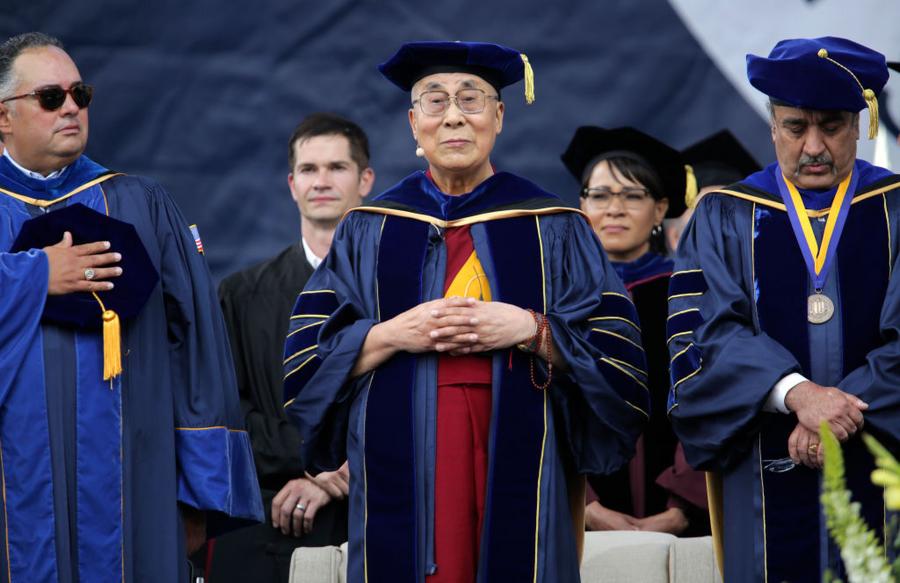
(BILL WECHTER/AFP/Getty Images)
Global Advocacy and The Nobel Peace Prize
From his exile base, the Dalai Lama became the world's most recognizable advocate for the Tibetan cause, always adhering strictly to the path of non-violence. He has traveled the world, addressing political bodies and large audiences on the principles of compassion, universal responsibility, and the urgent need for human rights in Tibet. His core political proposal, known as the "Middle Way Approach," does not seek outright independence but rather advocates for genuine autonomy for all Tibetan areas within the framework of the People's Republic of China.
His global impact was officially recognized in 1989 when he was awarded the Nobel Peace Prize. The Nobel Committee cited his consistent opposition to the use of violence and his commitment to finding a peaceful solution based on tolerance and mutual respect. This award significantly raised the profile of the Tibetan struggle and cemented his reputation as a moral leader for humanity.
Philosophical Teachings and Institutional Reform
In addition to his political and human rights work, the 14th Dalai Lama has devoted a significant portion of his life to philosophical outreach. He has consistently championed the importance of secular ethics—values like compassion and kindness that can be adopted regardless of religious belief—as the foundation for a peaceful society. He is deeply engaged in dialogue between Buddhism and modern science, particularly in the fields of cosmology, physics, and neuroscience, seeking common ground for understanding the mind and the universe. He has authored dozens of books on his philosophy, meditation, and life, including "The Art of Happiness" and "Ethics for the New Millennium."
In a critical move toward democratizing the Tibetan political system, he formally relinquished all his political authority in 2011 to the democratically elected leader of the Central Tibetan Administration. By stepping back from the political role traditionally held by the Dalai Lamas, he ensured the long-term viability of the Tibetan political system without depending on his reincarnation, allowing him to focus entirely on his role as a spiritual teacher and humanitarian. His enduring legacy is defined by his profound spirituality, intellectual curiosity, and an unshakeable commitment to non-violence as the ultimate path to justice.
/2019/07/GettyImages-697025572.jpg)
/2014/09/GettyImages-145897680.jpg)
/2025/02/missing_profile.jpg)
/2015/12/Sam-Harris.jpg)
/2016/10/nob.jpg)
/2021/08/Malala-Yousafzai.jpg)
/2021/01/albert-einstein-copy.jpeg)
/2021/09/Eckhart-Tolle.jpg)
/2020/01/lopez3.jpg)
/2009/11/George-Clooney.jpg)
:strip_exif()/2015/09/GettyImages-476575299.jpg)