
/2014/09/Marty-Feldman.png)
/2019/10/Mel-Brooks-1.jpg)
/2020/01/Terry-Jones.png)
/2013/09/GettyImages-86431798.jpg)
/2014/08/GettyImages-51300014.jpg)
/2020/03/Gene-Wilder.jpg)
/2009/09/Jennifer-Aniston.jpg)
/2009/11/George-Clooney.jpg)
/2020/06/taylor.png)
/2018/03/GettyImages-821622848.jpg)
/2019/10/denzel-washington-1.jpg)
/2009/09/Brad-Pitt.jpg)
/2019/04/rr.jpg)
/2020/01/lopez3.jpg)
/2019/11/GettyImages-1094653148.jpg)
:strip_exif()/2015/09/GettyImages-476575299.jpg)
/2020/02/Angelina-Jolie.png)
What was Marty Feldman's Net Worth?
Marty Feldman was an English comedy writer, actor, and comedian who had a net worth of $5 million at the time of his death in 1982. Marty Feldman passed away on December 2, 1982, at the age of 48, from a heart attack.
Marty Feldman was one of most distinctive comedic talents of his era, celebrated for his whirlwind physicality, offbeat intelligence, and the unforgettable wide-eyed look that became both his trademark and an essential part of his humor. Long before American audiences discovered him as Igor in Mel Brooks' "Young Frankenstein," Feldman was already a major creative force in British comedy as a writer, performer, and satirist whose influence helped shape a generation that included Graham Chapman and John Cleese. His career crossed radio, television, and film, and he moved between writing, directing, and performing with equal ease. Feldman cultivated a persona that embraced eccentricity rather than smoothing it out, turning his unusual appearance into a comedic asset and using it to deliver some of the most memorable moments in 1970s comedy. His life was cut short at 48, but he left behind a body of work that remains original, daring, and widely admired.
Early Life
Marty Feldman was born Martin Alan Feldman on July 8, 1934, in London's East End to Ukrainian Jewish immigrants. He grew up in a working-class environment he described with both pride and humor. Feldman disliked school and dropped out at 15, drawn instead to performance, music, and spectacle. He formed a jazz group in which he played trumpet and then spent time touring the British carnival circuit as an assistant to an Indian fakir. These early experiences, rooted in improvisation and eccentric showmanship, shaped his comedic instincts and helped prepare him for the unpredictable world of entertainment.
Early Writing Career
Feldman began in show business as a writer for British radio and television during the 1950s and 1960s. His partnership with writers Barry Took and Denis Norden helped produce some of the era's most popular radio comedy, including segments for "Round the Horne." His humor was surreal, fast-paced, and language-driven, characteristics that made him a natural fit for the new wave of irreverent British sketch comedy.
In 1967 David Frost, then a producer at the BBC, hired Feldman to write and perform alongside Graham Chapman and John Cleese in "At Last the 1948 Show." The program became a breakout moment. Audiences were drawn to Feldman's off-kilter timing and expressive face, and he soon became known not only as a gifted writer but as a compelling on-screen performer. The success of the program led to his own weekly series, which cemented his place as one of Britain's leading comic figures.
Film Breakthrough and American Fame
Feldman's introduction to American audiences came with Mel Brooks's 1974 film "Young Frankenstein," in which he played Igor, delivering quips like "Call me Eye-gore" with a mix of mischief and deadpan absurdity. The role transformed him into an international star. His American film career accelerated quickly, with performances in Gene Wilder's "The Adventure of Sherlock Holmes's Smarter Brother" and Brooks's "Silent Movie."
Feldman's physicality was central to his comedy. He often joked about his bulging eyes, caused by a thyroid condition, describing his face as "the sum total of the disasters of my life." Rather than hiding his appearance, he made it a signature feature. As he once put it, "If I aspired to be Robert Redford, I'd have my eyes straightened and my nose fixed and end up like every other lousy actor. But this way I'm a novelty."
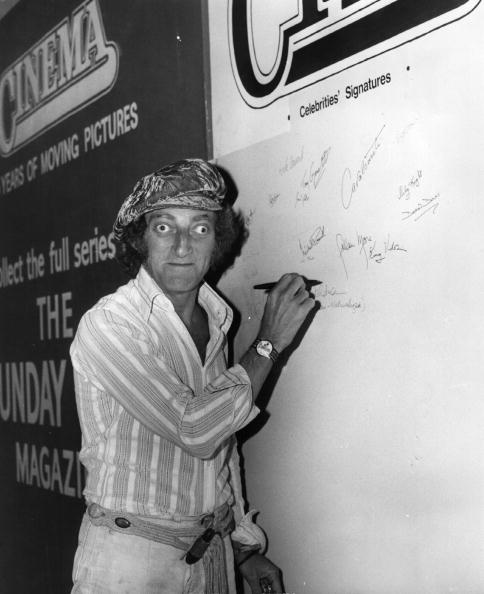
Getty Images
Directing and Later Film Work
In 1977 Feldman made his directorial debut with "The Last Remake of Beau Geste," a Foreign Legion satire he co-wrote with Chris Allen. The film featured an impressive ensemble including Ann-Margret, Michael York, Peter Ustinov, James Earl Jones, and Trevor Howard. He followed it with 1979's "In God We Trust (or Gimme That Prime Time Religion)," again directing, co-writing, and starring. The film featured Peter Boyle, Louise Lasser, and Andy Kaufman.
By the late 1970s Feldman had committed himself fully to Hollywood, determined to succeed financially after leaving Britain with a reported $118,000 tax debt. According to the BBC, he achieved that goal, becoming both creative and commercially successful in the U.S. industry.
In 1982 Feldman traveled to Mexico City to film "Yellowbeard," written by his longtime friend Graham Chapman. The production was nearly complete when tragedy struck.
Death and Legacy
Marty Feldman died on December 2, 1982, in his Mexico City hotel room from a massive heart attack at age 48. His sudden death shocked colleagues and fans, cutting short a career defined by originality and fearlessness. Feldman was survived by his wife, Lauretta, his mother, Cecillia, and his sister, Pamela.
Though his time in the spotlight was brief, Feldman's impact has endured. His writing helped shape the foundations of modern British comedy, and his performances in films like "Young Frankenstein" remain iconic. His willingness to embrace what made him different helped redefine how physicality and character could be used in comedy. Feldman left behind a legacy of creative risk-taking, enduring humor, and a reminder that the most unconventional performers often leave the deepest mark.
/2014/09/Marty-Feldman.png)
/2020/03/Gene-Wilder.jpg)
/2013/09/GettyImages-86431798.jpg)
/2020/11/John-Cleese.jpg)
/2014/08/GettyImages-51300014.jpg)
/2015/02/carlos.jpg)
/2018/09/Harvey-Korman.png)
/2014/03/beth-riesgraf.png)
/2020/04/Megan-Fox.jpg)
:strip_exif()/2009/09/P-Diddy.jpg)
/2017/02/GettyImages-528215436.jpg)