
/2014/08/GettyImages-666629522.jpg)
/2014/08/Dinah-Manoff.png)
/2015/07/GettyImages-631269774.jpg)
/2013/09/Ann-Blyth.png)
/2020/11/Bruce-Dern.jpg)
/2014/12/Rod-Steiger.jpg)
/2019/10/denzel-washington-1.jpg)
/2020/06/taylor.png)
/2009/09/Brad-Pitt.jpg)
/2018/03/GettyImages-821622848.jpg)
/2019/04/rr.jpg)
/2020/01/lopez3.jpg)
/2009/09/Jennifer-Aniston.jpg)
/2009/11/George-Clooney.jpg)
/2020/04/Megan-Fox.jpg)
/2020/02/Angelina-Jolie.png)
/2017/02/GettyImages-528215436.jpg)
What is Lee Grant's net worth?
Lee Grant is an Academy Award-winning actress, Emmy-winning television performer, and pioneering documentary filmmaker who has a net worth of $10 million.
Rising to prominence in the early 1950s with a breakout performance in "Detective Story," she appeared destined for major stardom before her trajectory was abruptly derailed by the Hollywood blacklist. For more than a decade, Grant was effectively shut out of film and television after refusing to cooperate with the House Un-American Activities Committee. When she returned in the mid-1960s, she rebuilt her career from the ground up, earning acclaim on the television series "Peyton Place" and reestablishing herself as one of Hollywood's most versatile character actresses. During the 1970s, she reached new heights with a string of acclaimed performances, culminating in an Academy Award for "Shampoo." Rather than slowing down, Grant reinvented herself again in the 1980s as a director, producing a series of socially conscious documentaries and television films. Her 1986 documentary "Down and Out in America" won the Academy Award, making her the only Oscar-winning actor to also direct an Oscar-winning documentary. Across acting and directing, Grant's career stands as one of resilience, reinvention, and creative independence.
Early Life
Lee Grant was born Lyova Haskell Rosenthal on October 31 in the mid-1920s in New York City. The exact year of her birth has long been debated, with various sources placing it between 1925 and 1927, a confusion that she later acknowledged was partly the result of efforts to obscure her age during the blacklist years.
She was the only child of Jewish parents. Her father was a real estate agent and educator of Polish descent, while her mother emigrated from Russia to escape anti-Jewish violence. Grant grew up in Manhattan's Hamilton Heights neighborhood and showed artistic promise at a very young age.
Her first stage appearance came remarkably early, performing at the Metropolitan Opera as a child in the early 1930s. She later trained as a dancer with the American Ballet and studied at several prestigious New York institutions, including the High School of Music & Art, Juilliard, and the Neighborhood Playhouse School of the Theatre, where she trained under Sanford Meisner. She also studied with Uta Hagen and became a member of the Actors Studio, immersing herself in method acting.
Early Career and Breakthrough
Grant's early professional career began in theater. She made her Broadway debut in 1948 and quickly gained attention for her emotionally intense performances. Her breakthrough came in 1949 when she starred as a troubled shoplifter in the Broadway play "Detective Story."
Two years later, she reprised the role in the 1951 film adaptation opposite Kirk Douglas. The performance was a sensation. Grant earned an Academy Award nomination for Best Supporting Actress and won the Best Actress prize at the Cannes Film Festival. At just 24 years old, she appeared poised to become one of Hollywood's most important new talents.
The Hollywood Blacklist
That momentum came to an abrupt halt in the early 1950s. Grant's career was derailed during the anti-communist investigations led by the House Un-American Activities Committee. After she delivered a passionate eulogy suggesting that the stress of the investigations had contributed to an actor's death, her name appeared in the publication "Red Channels," which effectively labeled individuals as suspected communists or sympathizers.
Compounding the situation, she was married at the time to screenwriter Arnold Manoff, who was identified as a communist. Grant refused to testify against him when called before investigators. As a result, she was blacklisted from Hollywood.
For roughly 12 years, Grant was largely unable to work in film or television during what should have been the prime of her career. She survived by teaching acting, working under pseudonyms, and taking occasional stage roles. The experience left a deep emotional impact that she would later describe as traumatic, shaping both her career choices and her worldview.
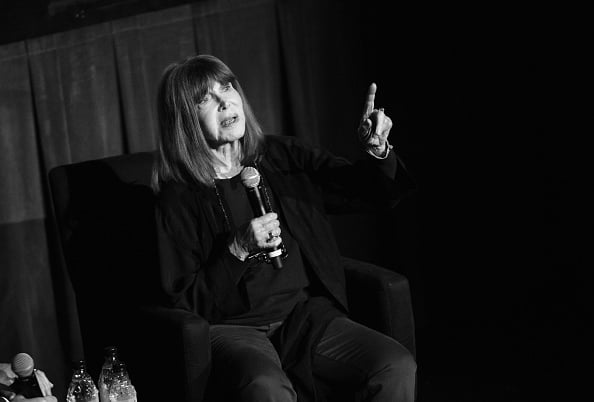
Getty
Career Resurgence in the 1960s
Grant's professional revival began in the mid-1960s after the blacklist effectively dissolved. By that time, she was a single mother raising her daughter, Dinah Manoff, and was determined to rebuild her career.
Her comeback role came in the television series "Peyton Place," where she played Stella Chernak. The performance earned her a Primetime Emmy Award in 1966 and reintroduced her to a national audience.
She soon transitioned back into film, appearing in notable projects such as "In the Heat of the Night" and "Valley of the Dolls" in 1967. These roles helped reestablish her as a reliable and compelling supporting actress capable of handling complex, emotionally layered characters.
1970s Peak and Academy Award
The 1970s marked the most acclaimed period of Grant's acting career. She received multiple Academy Award nominations during the decade, including for "The Landlord" and "Voyage of the Damned."
Her defining role came in 1975 with "Shampoo," where she played the older lover of Warren Beatty's character. The performance showcased her sharp comedic timing and emotional depth, earning her the Academy Award for Best Supporting Actress.
During this period, she also appeared in a wide range of film and television projects, from comedies like "Plaza Suite" to television dramas and miniseries. She demonstrated remarkable versatility, moving seamlessly between stage, television, and film.
Despite her success, Grant remained acutely aware of the challenges facing women in Hollywood, particularly as they aged. She later reflected on the anxiety she felt about maintaining her career in an industry that often sidelined older actresses.
Transition to Directing
In the late 1970s and early 1980s, Grant began a second major career transformation by moving behind the camera. She participated in the American Film Institute's directing workshop for women, which proved to be a turning point.
Her early directing work included narrative films and television projects, but she quickly found her voice in documentary filmmaking. Her projects often focused on social issues, particularly those affecting women and marginalized communities.
She directed documentaries such as "When Women Kill," which examined women in prison, and "What Sex Am I?," which explored transgender identity. Her work was notable for its empathy, curiosity, and willingness to tackle difficult subjects.
Directing Success and Historic Achievement
Grant reached the peak of her directing career in 1986. That year, she directed the documentary "Down and Out in America," which examined poverty, homelessness, and economic displacement in the United States. The film won the Academy Award for Best Documentary Feature.
That same year, she directed the television film "Nobody's Child," which earned her the Directors Guild of America Award. With these accomplishments, Grant became the first woman to win the DGA Award for a dramatic special.
Her success as a director was historically significant. She remains the only person to have won an Academy Award for acting and also directed an Academy Award-winning documentary.
Later Career and Legacy
In the decades that followed, Grant continued to work both in front of and behind the camera. She appeared in films such as "Mulholland Drive," directed by David Lynch, and remained active in television and independent film projects.
She also directed numerous television movies and documentary programs, including episodes of the series "Intimate Portrait," which highlighted influential women from various fields.
Grant returned to the stage occasionally and remained involved with the Actors Studio, serving as a co-artistic director in the mid-2000s. Even into her later years, she continued to participate in film festivals, retrospectives, and panel discussions about her work.
Personal Life and Impact
Grant's personal life has been closely intertwined with her professional journey. Her first marriage to Arnold Manoff ended in divorce, and she later married producer Joseph Feury. Her daughter, Dinah Manoff, followed her into acting and achieved success in television and film.
The experience of being blacklisted left a lasting imprint on Grant. She has spoken openly about the fear, anger, and resilience that defined that period of her life. In many ways, her later work as a director, particularly her focus on social issues, reflected a desire to use her voice after years of enforced silence.
Lee Grant's legacy is one of extraordinary perseverance. Few performers have experienced such a dramatic interruption and comeback, followed by a successful reinvention in an entirely new creative field. From Broadway stages to Oscar-winning films and groundbreaking documentaries, her career remains a powerful example of artistic endurance and reinvention.
/2014/08/GettyImages-666629522.jpg)
/2014/08/Dinah-Manoff.png)
/2020/11/Bruce-Dern.jpg)
/2012/11/Lynn-Whitfield.jpg)
/2018/06/amy-mad.jpg)
/2013/10/GettyImages-146313423.jpg)
/2016/12/Max-Gail.jpg)
/2009/09/Cristiano-Ronaldo.jpg)