
/2022/08/jane-russell-2.png)
/2020/11/raquel-welch.jpg)
/2021/04/monroe.jpg)
/2014/02/mary-grace.jpg)
/2020/01/lopez3.jpg)
/2022/05/howard-hughes-1.jpg)
/2009/09/Jennifer-Aniston.jpg)
/2018/03/GettyImages-821622848.jpg)
/2020/02/Angelina-Jolie.png)
/2009/09/Brad-Pitt.jpg)
:strip_exif()/2015/09/GettyImages-476575299.jpg)
/2020/06/taylor.png)
/2019/04/rr.jpg)
/2019/11/GettyImages-1094653148.jpg)
/2019/10/denzel-washington-1.jpg)
/2009/11/George-Clooney.jpg)
/2020/04/Megan-Fox.jpg)
What Was Jane Russell's Net Worth?
Jane Russell was an American actress, singer, and model who had a net worth of $40 million at the time of her death on February 28, 2011. Jane Russell rose to fame in the 1940s as one of Hollywood's defining bombshells, pairing a striking on-screen presence with natural comedic talent and a confident, rebellious persona that helped reshape the era's standards for female stardom. She was discovered by Howard Hughes and cast in "The Outlaw," a film whose provocative marketing and controversial production battles made her an overnight sensation even before its wide release. Though audiences initially fixated on her image, Russell quickly proved she was more than a studio publicity creation. She displayed sharp timing and strong musical instincts, becoming a versatile performer across westerns, noirs, comedies, and musicals.
Throughout the 1950s she starred in some of the decade's biggest hits, including "Gentlemen Prefer Blondes," where her partnership with Marilyn Monroe produced one of the most iconic duos in film history. Russell's performance, especially her comic energy and memorable number "Ain't There Anyone Here for Love," earned her praise as both a singer and actress. She continued working steadily in productions such as "His Kind of Woman," "The Las Vegas Story," "The French Line," and "The Revolt of Mamie Stover," often playing bold, self-assured characters who matched her real-life persona.
Off-screen, Russell built a parallel career as a successful recording artist, performing with the Kay Kyser Orchestra and releasing solo albums that highlighted her rich contralto voice. She was also deeply engaged in humanitarian work, particularly through the adoption advocacy organization she co-founded, which placed thousands of children with families.
By the time she stepped back from major film roles in the 1960s, Russell had cemented her status as a Hollywood icon whose influence extended beyond pin-up imagery. Her blend of glamour, humor, vocal talent, and activism made her one of the most distinctive and enduring stars of the Golden Age.
Early Life
Ernestine Jane Geraldine Russell was born on June 21, 1921, in Bemidji, Minnesota. Her mother, Geraldine, had pursued modeling and acting before settling into family life. A portrait of her titled "The Girl in the Blue Hat," painted by Mary B. Titcomb, was once displayed in the White House after being purchased by President Woodrow Wilson. Jane was the eldest of five children. When she was still an infant, her father moved the family to Southern California after accepting an office management job. His death during Jane's teenage years left her mother to support and raise the family.
Russell attended public school in Los Angeles and grew up with an interest in the arts. She took acting classes at Max Reinhardt's theater workshop and studied with the prominent actress and coach Maria Ouspenskaya. Modeling for a photographer friend provided her first exposure to professional posing and publicity. Although she had taken steps toward a performing career, she was working in a chiropodist's office when a photograph of her reached Howard Hughes's casting department, setting the stage for her dramatic entry into Hollywood.
The Breakthrough: "The Outlaw"
Russell was only nineteen when Howard Hughes cast her in "The Outlaw," a 1940s western centered on a fictional love triangle involving Doc Holliday and Billy the Kid. The film pushed boundaries through both its imagery and its marketing, and Hughes seized upon Russell's striking presence to promote it. A famous poster featuring Russell reclining in a haystack with a low-cut blouse sparked uproar among censors, religious leaders, and local decency groups. The Roman Catholic Church became one of the film's most outspoken opponents, and disputes with censorship boards delayed the movie's release for years.
Although "The Outlaw" premiered in 1943 in San Francisco, it did not reach New York until 1947 and did not have a full national release until 1950. Critical responses were mixed, and some reviewers dismissed the film's quality. None of that mattered. The controversy transformed Russell into a major star. Public fascination grew around her figure, her on-screen persona, and the specially engineered bra that Hughes purportedly created for her, though she insisted for the rest of her life that she never wore it. The scandal cemented her reputation and became one of the most storied censorship episodes of Hollywood's Golden Age.
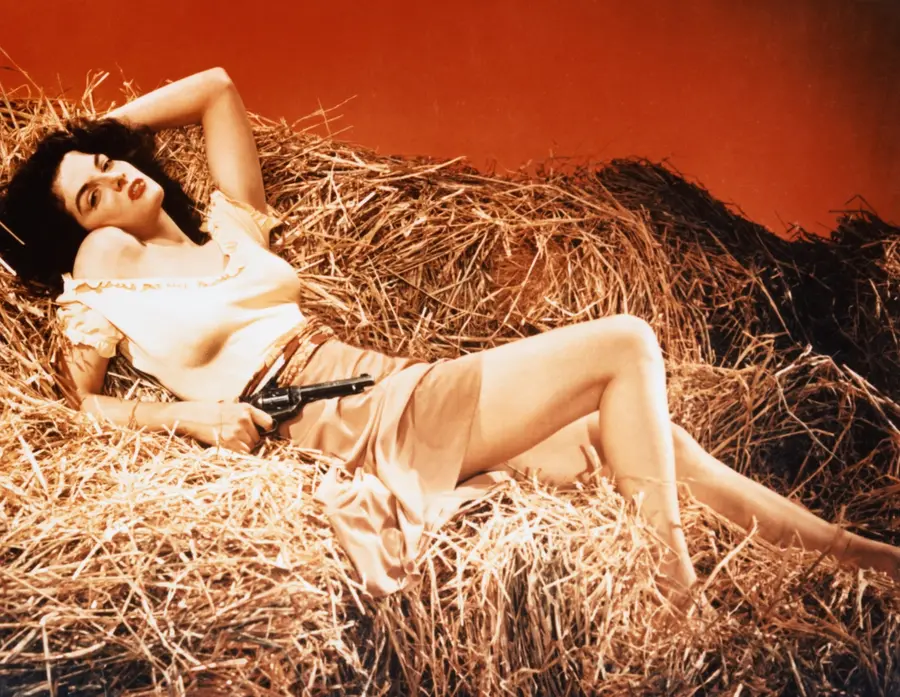
(Photo by Herbert Dorfman/Corbis via Getty Images)
Post–"Outlaw" Stardom
After the film finally reached wide distribution, Russell became a leading lady for the next decade. She made approximately two dozen features between 1948 and 1957, many of them westerns, musical comedies, or adventure pictures. In "The Paleface" (1948), she played Calamity Jane opposite Bob Hope, showcasing her gift for physical comedy and deadpan delivery. The success of the film led to a sequel, "Son of Paleface," released in 1952, in which she again shared the screen with Hope.
Russell's most enduring film from this period is "Gentlemen Prefer Blondes" (1953), a vibrant musical comedy that paired her with Marilyn Monroe as two ambitious showgirls. The film featured several duets, including "Two Little Girls From Little Rock," and gave Russell her iconic solo number, "Ain't There Anyone Here for Love?" She later described the film as her personal favorite. In 1955, she starred in "Gentlemen Marry Brunettes," a follow-up set in Paris with Jeanne Crain.
Through these projects, Russell became known for her self-assured presence, her sultry voice, and her ability to command comedic scenes without undermining her glamour. Films such as "The French Line," "The Las Vegas Story," "His Kind of Woman," and "The Revolt of Mamie Stover" further reinforced her status as a top-tier star of mid-century Hollywood.
Stage, Music, and Later Acting Work
Russell's musical ability shaped much of her later career. She began performing in Las Vegas in 1957 and continued appearing in clubs, cabarets, and musical showcases for decades. Her contralto voice earned her steady bookings, and she proved comfortable working outside the film studio system.
Though she acted only sporadically on television, she made a notable Broadway appearance in 1971 when she joined the cast of the Stephen Sondheim musical "Company." She replaced Elaine Stritch as the character who performs "The Ladies Who Lunch," delivering a performance that impressed audiences and demonstrated her versatility.
Her final film role came in "Darker Than Amber" (1970), a crime drama starring Rod Taylor. She made occasional television appearances afterward, including a 1986 episode of "Hunter," but by then her focus had shifted to singing, commercial work, and philanthropy. In the 1970s and 1980s she became widely recognized as the spokeswoman for Playtex bras, promoting them as ideal for "full-figured gals" like herself.
Endorsements
Capitalizing on her buxom fame, Jane served as the spokeswoman for Playtex bras and girdles throughout the 1970s and 80s.
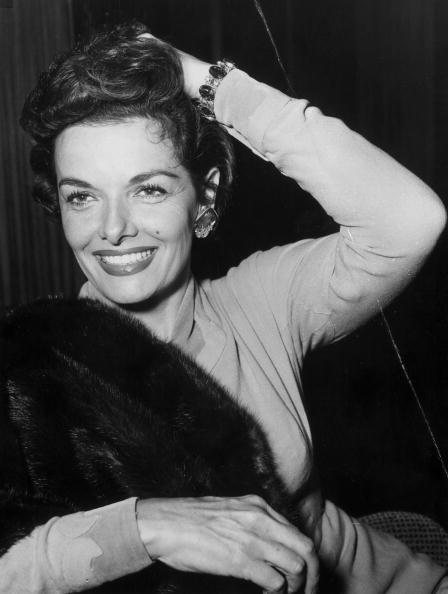
Terry Disney/Central Press/Getty Images
Personal Life
Russell married her high school sweetheart, Bob Waterfield, in 1943. Waterfield became a star quarterback for the Los Angeles Rams. The couple adopted three children, Tracy, Thomas, and Robert, after Jane was rendered unable to have biological children due to a botched abortion before marriage. Her personal experience later shaped her public advocacy against abortion and her strong support of adoption.
After twenty-four years of marriage, Russell and Waterfield divorced in 1967. She married actor Roger Barrett in 1968, but he died of a heart attack only three months later. In 1974, she married John Calvin Peoples, a real estate broker and retired Air Force lieutenant, and they remained together until his death in 1999.
Russell struggled with alcohol at various points in her life, with her dependence worsening after Peoples's death. When she was seventy-nine, her children insisted she enter rehabilitation, and she credited her recovery to her deep Christian faith. She became increasingly outspoken about her conservative political beliefs and religious convictions in her later years. In interviews she often framed her worldview as the product of loyalty, discipline, and firm moral boundaries.
Philanthropy
Russell's most enduring charitable contribution was her work in adoption advocacy. In the 1950s she founded the World Adoption International Fund, which helped place thousands of children with families over several decades. She organized Bible study groups, supported church initiatives, and shared her faith publicly in speeches and interviews. Her 1985 memoir, "My Path and My Detours," chronicled her spiritual journey and her reliance on faith during hardships.
Legacy
Jane Russell died on February 28, 2011, at her home in Santa Maria, California, from a respiratory-related illness. She was eighty-nine. She left behind her children, eight grandchildren, and ten great-grandchildren.
Russell's influence extended far beyond the censorship struggles that first made her famous. She became one of Hollywood's most recognizable symbols of mid-century glamour, yet she also proved to be a capable actress, singer, and comedic performer. Her partnership with Marilyn Monroe in "Gentlemen Prefer Blondes" remains one of the most iconic duos in classic film history. Through her Las Vegas shows, television work, Playtex commercials, religious advocacy, and philanthropic efforts, Russell constructed a long, varied, and meaningful career. Her legacy reflects not only her striking screen presence but also her dedication to family, faith, and charitable service.
Real Estate
In 1985, Jane paid $285,000 for an estate in Santa Barbara. She sold this property in 2000 for $1.9 million.
/2022/08/jane-russell-2.png)
/2021/04/monroe.jpg)
/2020/11/raquel-welch.jpg)
/2013/09/Ann-Blyth.png)
/2011/02/Brigitte-Bardot.jpg)
/2019/01/joanna.png)
/2015/09/Larry-Storch.png)
/2020/07/morgan-fairchild.jpg)
/2017/02/GettyImages-528215436.jpg)
:strip_exif()/2009/09/P-Diddy.jpg)
/2009/09/Cristiano-Ronaldo.jpg)