












What Is Jane Fonda's Net Worth?
Jane Fonda is an American actress, producer, author, political activist, and fitness entrepreneur who has a net worth of $200 million.
Jane Fonda is one of Hollywood's most accomplished and enduring stars, having won two Academy Awards, seven Golden Globes, and an Emmy Award during a career spanning more than six decades. The daughter of legendary actor Henry Fonda, she emerged as a major movie star in the 1960s with films such as "Cat Ballou," "Barefoot in the Park," and "Barbarella." She subsequently reinvented herself as one of the industry's most respected dramatic actresses, winning Best Actress Oscars for "Klute" and "Coming Home." Her other landmark films include "They Shoot Horses, Don't They?," "The China Syndrome," "9 to 5," and "On Golden Pond."
Fonda also became a successful Hollywood producer, earning millions from film salaries and profit-sharing arrangements. In the early 1980s, she launched the "Jane Fonda's Workout" video empire, which sold more than 17 million copies and helped transform the home fitness industry. After stepping away from Hollywood during the 1990s, she returned to acting with "Monster-in-Law" and eventually starred alongside Lily Tomlin in the Netflix comedy "Grace and Frankie," which ran for seven seasons.
Beyond entertainment, Fonda is famous for her political activism and her marriage to billionaire media entrepreneur Ted Turner. The couple divorced in 2001, and Turner publicly disclosed that he had given Fonda $100 million. Their financial separation became one of the most significant celebrity wealth transfers of that era. Her fortune has also been supported by investments and substantial real estate holdings, including a New Mexico ranch that was listed for $19.5 million before being sold in 2015. In 2025, Fonda received the SAG Life Achievement Award in recognition of her contributions to acting and humanitarian causes.
Ted Turner Divorce Settlement
One of the most significant financial events in Jane Fonda's life was her divorce from CNN founder and media billionaire Ted Turner. The couple married on December 21, 1991, Fonda's 54th birthday, and separated in January 2000 before finalizing their divorce in May 2001.
Turner was one of the wealthiest men in the United States during their marriage. He had built a media empire that included CNN, Turner Broadcasting, and major cable television networks before merging his company with Time Warner in 1996. The subsequent AOL-Time Warner merger created an enormous media conglomerate, with Turner holding a substantial ownership position.
In March 2001, while speaking at Harvard University's Kennedy School of Government, Turner publicly stated that he had given Fonda $100 million. His comments were documented in an April 2001 "New Yorker" profile by journalist Ken Auletta. Turner also discussed how Fonda had donated more than $12 million from that money to Harvard's School of Education to support research on gender and education.
The $100 million disclosure provides unusually strong evidence of the financial magnitude of Fonda's separation from Turner. However, the precise terms of their divorce agreement were kept confidential. When the divorce was finalized in May 2001, Fonda's attorney confirmed that all financial matters had been resolved but declined to disclose the division of assets. Consequently, there is no public itemized accounting establishing how much of Turner's payment consisted of cash, securities, or other property.
Fonda had also acquired significant personal assets during the separation, including Forked Lightning Ranch in New Mexico, which she purchased in 2000. The ranch was not simply a property transferred to her as part of the divorce; she described personally discovering and purchasing it after the couple separated.
The marriage ended after nearly a decade, with Fonda later explaining that she and Turner had fundamentally different personalities and expectations. Despite the divorce, she continued speaking warmly about his environmental philanthropy and his historic commitment to donating $1 billion to United Nations programs.
Film Salaries and Production Earnings
Fonda was among Hollywood's highest-paid actresses during the late 1970s and early 1980s. By 1982, she was commanding $2 million per movie plus a percentage of gross profits, according to a contemporary "Savvy" magazine profile written by journalist Maureen Orth.
Her financial success extended beyond traditional acting salaries. Working with producer Bruce Gilbert, Fonda helped establish IPC Films, a production company that developed projects reflecting her interests while giving her greater creative and financial control.
The company's early productions included "Coming Home" in 1978, "The China Syndrome" in 1979, and "9 to 5" in 1980. These films were both commercial successes and vehicles for Fonda to address issues such as the Vietnam War, nuclear safety, and workplace discrimination.
"9 to 5" was particularly lucrative. The comedy, which starred Fonda alongside Lily Tomlin and Dolly Parton, generated more than $103 million at the domestic box office against a production budget of $10 million.
In her February 1982 investigation of Fonda's business activities, Orth wrote that Fonda had already earned $7 million from "9 to 5" through her participation as both an actress and producer. The article also disclosed that IPC Films controlled 50% of the television rights to the "9 to 5" television series, adding another potential source of income.
Fonda's ability to negotiate production ownership and profit participation distinguished her from actresses who received only fixed salaries. She also helped produce "On Golden Pond," which became another major commercial success. These arrangements allowed her to participate in the financial performance of films she helped develop rather than relying exclusively on upfront compensation.
Early Life
Jane Seymour Fonda was born on December 21, 1937, in New York City. Her father, Henry Fonda, was one of the most respected actors in Hollywood, while her mother, Frances Ford Seymour, was a Canadian-born socialite. Her younger brother, Peter Fonda, also became a successful actor and filmmaker, best known for "Easy Rider." Through Peter, Jane is the aunt of actress Bridget Fonda.
Despite growing up in a wealthy and famous family, Fonda experienced considerable emotional difficulties during childhood. Her father was frequently absent while filming, and her parents had a troubled marriage. Her mother suffered from serious mental health problems and died by suicide in 1950, when Jane was 12 years old. Jane initially believed her mother had died from a heart attack and later discovered the circumstances of her death through a magazine.
Fonda attended Greenwich Academy in Connecticut and the Emma Willard School in Troy, New York, before enrolling at Vassar College. During her adolescence and early adulthood, she struggled with body image and eating disorders, experiences she would discuss openly later in life.
After leaving Vassar, she spent time studying art in Paris before returning to New York, where she began modeling professionally. She appeared on the cover of "Vogue" and attracted attention for her appearance, although she initially resisted following her father into acting.
Her perspective changed after she studied with acting teacher Lee Strasberg at the Actors Studio. Strasberg recognized her talent and encouraged her to take acting seriously, giving her the confidence to pursue a professional career.
Early Acting Career
Fonda made her Broadway debut in the 1960 play "There Was a Little Girl," earning a Tony Award nomination for her performance. That same year, she made her film debut in the romantic comedy "Tall Story," opposite Anthony Perkins.
Her early films included "Walk on the Wild Side" (1962), "Sunday in New York" (1963), and "Cat Ballou" (1965). The latter, a Western comedy co-starring Lee Marvin, became a major commercial success and established Fonda as a leading actress.
In 1967, she starred opposite Robert Redford in "Barefoot in the Park," the film adaptation of Neil Simon's Broadway comedy. Their chemistry proved popular with audiences, beginning a professional partnership that continued with films including "The Electric Horseman" and "Our Souls at Night."
The following year, Fonda starred in "Barbarella," the science-fiction fantasy directed by her then-husband Roger Vadim. Although the film received mixed reviews, it became a cult classic and cemented Fonda's reputation as an international sex symbol.
By the end of the 1960s, Fonda was increasingly interested in challenging dramatic material. Her performance in Sydney Pollack's "They Shoot Horses, Don't They?" (1969), in which she portrayed a desperate contestant in a Depression-era dance marathon, earned her first Academy Award nomination for Best Actress.
Academy Awards and 1970s Stardom
Fonda reached a new level of critical acclaim with the 1971 thriller "Klute." She played Bree Daniels, a New York call girl whose life becomes entangled in a criminal investigation. Her performance earned her the Academy Award for Best Actress and established her as one of the defining dramatic performers of her generation.
Throughout the 1970s, Fonda increasingly chose films that reflected her personal and political interests. She appeared in Jean-Luc Godard's "Tout Va Bien" (1972), the comedy "Fun with Dick and Jane" (1977), and the historical drama "Julia" (1977), for which she received another Academy Award nomination.
Her second Oscar came for "Coming Home" (1978), a drama examining the emotional consequences of the Vietnam War. Fonda portrayed Sally Hyde, a military wife who falls in love with a disabled Vietnam veteran played by Jon Voight. She was deeply involved in developing the project, which drew on her experiences meeting veterans and became both a critical and commercial success.
In 1979, she starred alongside Jack Lemmon and Michael Douglas in "The China Syndrome," a thriller about a potential nuclear power plant catastrophe. The film was released just days before the Three Mile Island nuclear accident, giving its subject matter unexpected relevance and generating widespread public discussion.
That same year, Fonda reunited with Robert Redford in "The Electric Horseman," a commercially successful romantic adventure that continued her run of prominent leading roles.
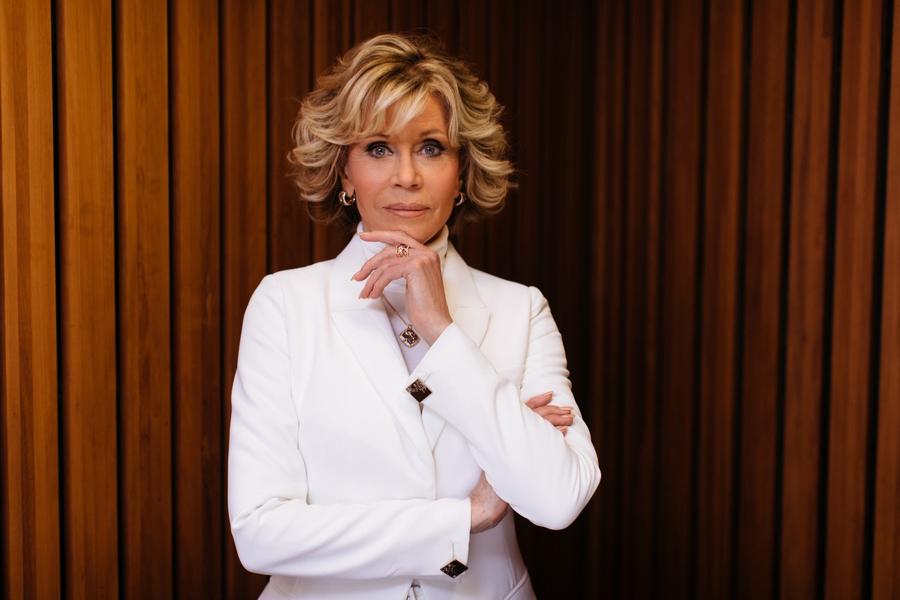
Caroline McCredie/Getty Images
"9 to 5," "On Golden Pond," and the 1980s
In 1980, Fonda starred in "9 to 5," a workplace comedy about three female employees who rebel against their abusive boss. She had helped develop the project after becoming interested in the experiences of female office workers and their efforts to organize against discrimination.
The movie became the second-highest-grossing release of 1980 and turned into a cultural landmark. Dolly Parton's theme song also became a #1 hit, while the film's success led to a television adaptation and stage musical.
The following year, Fonda starred alongside her father in "On Golden Pond," which also featured Katharine Hepburn. Jane played Chelsea Thayer Wayne, the estranged daughter of an elderly man struggling with aging and his complicated family relationships. The story mirrored aspects of her own difficult relationship with Henry Fonda.
The film became a major box-office success and earned Jane an Academy Award nomination for Best Supporting Actress. Henry won the Best Actor Oscar, his first competitive Academy Award, shortly before his death in 1982. Jane later described their collaboration as an important opportunity to reconnect with her father.
Other significant performances during the decade included the television movie "The Dollmaker" (1984), for which she won an Emmy Award, "Agnes of God" (1985), and "The Morning After" (1986), which earned her another Academy Award nomination.
Her later films included "Old Gringo" (1989) and "Stanley & Iris" (1990). By this point, Fonda had become one of the most decorated actresses of her generation, but she was preparing to leave Hollywood behind for an extended period.
Jane Fonda's Workout Empire
Fonda's greatest entrepreneurial success outside the film industry came from the home fitness revolution of the 1980s.
After suffering a foot injury while making "The China Syndrome," she was unable to continue her regular ballet classes and began taking aerobic exercise classes taught by Leni Cazden. She became an enthusiastic participant and eventually developed her own workout program.
In 1979, she opened the first "Jane Fonda's Workout" studio in Beverly Hills, followed by additional locations in Southern California and San Francisco. The studios became highly popular, attracting thousands of clients each week.
In 1981, she published "Jane Fonda's Workout Book," which became a major bestseller. The following year, she released her first exercise video, "Jane Fonda's Workout," which became one of the most successful home video releases in history.
The timing was ideal. As VCR ownership expanded during the 1980s, millions of consumers began purchasing exercise videos to use at home. Fonda's routines, colorful leotards, and energetic instruction became defining images of the decade.
The "Jane Fonda's Workout" series ultimately sold more than 17 million copies, becoming one of the most commercially successful home video franchises ever created. She produced more than 20 exercise videos, along with books and audio programs.
Despite the enormous sales, the workout business was not initially structured primarily to enrich Fonda personally. She and her husband, Tom Hayden, directed the proceeds toward the Campaign for Economic Democracy, a political organization they had established. In a 2005 interview with CBS, Fonda said the workout business had provided $17 million to support their political activities.
Fonda later returned to the exercise market with programs designed for older adults, including the "Prime Time" fitness series beginning in 2010. Her influence extended beyond her own businesses, helping establish a multibillion-dollar market for home workouts, fitness instruction, and exercise media.

Jason Kempin/Getty Images
Retirement and Return to Acting
Fonda announced her retirement from acting in the early 1990s, having already spent three decades as a major Hollywood star. She relocated to Atlanta following her marriage to Ted Turner and devoted much of her attention to family life, philanthropy, and personal interests.
Her absence from the screen lasted 15 years before she returned in the 2005 comedy "Monster-in-Law," starring opposite Jennifer Lopez. The film became a commercial success and introduced Fonda to a younger generation of moviegoers.
She subsequently appeared in "Georgia Rule" (2007), "Peace, Love & Misunderstanding" (2011), "The Butler" (2013), and "This Is Where I Leave You" (2014). In 2009, she returned to Broadway in "33 Variations," receiving another Tony Award nomination.
Her most successful later television project was the Netflix series "Grace and Frankie," which premiered in 2015. The comedy starred Fonda as Grace Hanson and Lily Tomlin as Frankie Bergstein, two women whose lives are upended when their husbands announce that they are in love with each other.
The series became one of Netflix's longest-running original comedies, producing 94 episodes across seven seasons before concluding in 2022. Fonda also served as an executive producer and received Emmy nominations for her performance.
Her later film appearances included "Our Souls at Night" (2017), again opposite Robert Redford, "Book Club" (2018), "Moving On" (2022), and the 2023 comedies "80 for Brady" and "Book Club: The Next Chapter." In "80 for Brady," she starred alongside Tomlin, Rita Moreno, and Sally Field.
Political Activism and the Vietnam War Controversy
Fonda became increasingly politically active during the late 1960s, opposing the Vietnam War and participating in civil rights, feminist, and antiwar campaigns.
Her activism created one of the most controversial episodes of her career in 1972, when she traveled to North Vietnam during the war. While visiting Hanoi, she was photographed sitting on a North Vietnamese anti-aircraft gun, an image that caused widespread outrage in the United States.
The photograph earned her the nickname "Hanoi Jane" and became a lasting source of resentment among American veterans and military families. Critics viewed her visit and public statements as support for an enemy government during wartime.
Fonda later acknowledged that posing for the photograph was a serious mistake and repeatedly expressed regret for the image. However, she continued to defend her opposition to the war and maintained that her antiwar activism had been motivated by a desire to end the conflict.
The controversy affected her public reputation for decades, and some veterans' organizations continued protesting her appearances long after the war ended. Fonda nevertheless remained one of Hollywood's most politically outspoken figures.
Her later activism included opposition to the Iraq War, advocacy for women's rights, and efforts to address environmental problems and climate change.
In 2019, she launched "Fire Drill Fridays," a series of climate demonstrations in Washington, D.C., organized with Greenpeace. She was arrested multiple times while participating in protests calling for stronger government action on fossil fuels and climate policy.
In 2022, she established the Jane Fonda Climate PAC, a political action committee supporting candidates committed to reducing fossil fuel dependence. She also helped found the Women's Media Center and has supported campaigns addressing reproductive rights, adolescent health, and violence against women.
Personal Life
Jane Fonda has been married three times, with each marriage ending in divorce.
Her first husband was French filmmaker Roger Vadim, whom she married in 1965. They had a daughter, Vanessa Vadim, before divorcing in 1973. Vadim directed Fonda in several films, most famously "Barbarella."
In January 1973, shortly after finalizing her divorce from Vadim, Fonda married political activist Tom Hayden. They had a son, Troy Garity, who became an actor, and welcomed Mary Luana Williams into their family through an informal adoption arrangement. Williams later wrote about her experiences in the memoir "The Lost Daughter."
Fonda and Hayden were closely connected through their political activities, particularly the Campaign for Economic Democracy. Their marriage lasted until 1990, and both remained prominent figures in progressive political circles.
Her third marriage was to Ted Turner, whom she married in 1991. Their relationship combined two of the most recognizable personalities in American entertainment and media. They separated in 2000 and divorced the following year.
Fonda subsequently began a relationship with record producer Richard Perry in 2009. They lived together in Los Angeles and shared several properties before ending their relationship in 2017.
In addition to her marriages and children, Fonda has spoken extensively about her relationship with her father, the emotional consequences of her mother's death, and her struggles with eating disorders earlier in life.
Health
Fonda has experienced several significant health challenges, including breast cancer and osteoporosis. She underwent a lumpectomy in 2010 and later had a cancerous growth removed from her lower lip in 2018.
In September 2022, she announced that she had been diagnosed with non-Hodgkin lymphoma and was undergoing chemotherapy. Three months later, she revealed that her cancer was in remission and that she had been advised to discontinue chemotherapy treatment.
Throughout her later years, Fonda has continued emphasizing the importance of physical activity, healthy aging, and maintaining independence. Her experiences with health problems have also influenced her public discussions of exercise and wellness.

Getty Images
Real Estate
Jane Fonda has owned several multimillion-dollar properties in California, Georgia, and New Mexico. Her real estate history includes a large Southwestern ranch, a Beverly Hills estate, and an expensive Century City townhouse.
Forked Lightning Ranch, New Mexico
In 2000, shortly after separating from Ted Turner, Fonda purchased Forked Lightning Ranch near Pecos, New Mexico. The 2,300-acre property included 3.5 miles of frontage along the Pecos River and had previously formed part of a larger ranch owned by actress Greer Garson and her husband, Buddy Fogelson.
Fonda developed the property extensively, constructing a 9,600-square-foot residence known as River House and incorporating architectural features inspired by traditional Northern New Mexico buildings. The estate also featured historic structures designed by architect John Gaw Meem.
The property was featured in "Architectural Digest" in 2014, shortly before Fonda decided to sell it. She listed the ranch for $19.5 million, and the sale was completed in 2015. The buyer's identity and final purchase price were not publicly disclosed.
Hollywood Hills and Beverly Hills
Fonda and Richard Perry owned a home in Hollywood Hills West that had originally been built for Ronald Reagan and his first wife, Jane Wyman. The property included a five-bedroom main residence, swimming pool, tennis court, and Balinese-style pool house. The couple sold the property in October 2012 for $8.5 million.
That same year, they purchased a contemporary estate in Beverly Hills' prestigious Trousdale Estates neighborhood for $7.3 million. The property featured glass walls, a glass elevator, a solar-heated swimming pool, and more than 7,000 square feet of living space.
Following their separation, Fonda and Perry listed the Trousdale property for nearly $13 million in January 2017. After several price reductions, they sold it in January 2018 for $8.535 million.
Century City Townhouse
In April 2017, Fonda purchased a luxury townhouse in Los Angeles' Century City neighborhood for $5.45 million in cash.
Located within the exclusive Enclave at Century Woods development, the property features four bedrooms, 6.5 bathrooms, a private elevator, rooftop terrace, courtyard, and three-car garage. It is part of a gated development containing just ten residences.
The townhouse has served as Fonda's principal Los Angeles residence. Public property records reviewed in 2025 continued to associate the home with the trust through which she purchased it.
Books and Awards
Fonda is also a successful author whose books have addressed fitness, personal growth, aging, politics, and social activism.
Her 2005 memoir, "My Life So Far," became a #1 "New York Times" bestseller. She subsequently published "Prime Time: Love, Health, Sex, Fitness, Friendship, Spirit—Making the Most of All of Your Life" in 2011 and "What Can I Do? My Path from Climate Despair to Action" in 2020.
Her numerous acting honors include two Academy Awards, seven Golden Globe Awards, an Emmy Award, and the American Film Institute Life Achievement Award, which she received in 2014.
In 2021, she received the Golden Globes' Cecil B. DeMille Award for her contributions to entertainment. In February 2025, she was presented with the SAG Life Achievement Award, the Screen Actors Guild's highest career honor, by Julia Louis-Dreyfus.
Fonda's legacy encompasses far more than her performances on screen. She helped change the economics of Hollywood by becoming an influential producer, revolutionized the fitness video industry, and remained an outspoken public figure through several generations of American political and cultural change.