
/2016/04/gregory-peck.jpg)
/2021/05/audrey.jpg)
/2009/12/Ben-Affleck.jpg)
/2020/01/Jennifer-Garner.jpg)
/2010/06/Harper-Lee.jpg)
/2015/12/GettyImages-142736727.jpg)
/2009/09/Cristiano-Ronaldo.jpg)
:strip_exif()/2009/09/P-Diddy.jpg)
/2020/02/Angelina-Jolie.png)
/2020/06/taylor.png)
/2017/02/GettyImages-528215436.jpg)
/2018/03/GettyImages-821622848.jpg)
/2020/04/Megan-Fox.jpg)
/2019/10/denzel-washington-1.jpg)
/2009/09/Jennifer-Aniston.jpg)
:strip_exif()/2015/09/GettyImages-476575299.jpg)
/2019/11/GettyImages-1094653148.jpg)
What Was Gregory Peck's Net Worth?
Gregory Peck was an American actor who had a net worth of $40 million at the time of his death in 2003. That's the same as around $70 million in today's dollars after adjusting for inflation. As we detail at the end of this article, a significant portion of Gregory Peck's net worth at death was his 3-acre Holmby Hills estate. A year after his death, his widow, Veronique, sold the estate for $22 million to Google billionaire Eric Schmidt.
Gregory Peck's career spanned over six decades, cementing him as one of Hollywood's most enduring and respected stars. He became an emblematic figure in classic American cinema, known for his distinctive voice and towering presence. His on-screen versatility allowed him to perform a wide range of roles, from morally upright heroes to complex, nuanced individuals.
One of Peck's most iconic roles came early in his career when he played Atticus Finch in "To Kill a Mockingbird" (1962), a performance that earned him an Academy Award for Best Actor. Atticus Finch became a cultural icon of integrity and decency, and the role set a precedent for the kind of characters Peck would portray throughout his career—honorable men often faced with ethical dilemmas.
Beyond "To Kill a Mockingbird," Peck starred in an array of critically acclaimed films. These included "Gentleman's Agreement" (1947), a groundbreaking film that tackled anti-Semitism and won three Oscars, including Best Picture, "Twelve O'Clock High" (1949), a World War II drama for which he received another Oscar nomination, and "Roman Holiday" (1953), in which he starred alongside Audrey Hepburn in her breakout role.
In addition to his Academy Award for "To Kill a Mockingbird," Peck received four other Oscar nominations during his career. He also received a Lifetime Achievement Oscar in 1968, acknowledging his long-term contribution to the world of cinema.
Peck was also highly active outside of his film work. He served as the president of the Academy of Motion Picture Arts and Sciences and was a founding trustee of the American Film Institute. His humanitarian work included supporting various causes, such as the American Cancer Society and the National Endowment for the Arts. He worked well into his later years, transitioning smoothly into television roles and even making appearances in a few made-for-TV movies.
Peck was awarded a star on the Hollywood Walk of Fame at 6100 Hollywood Blvd. He was honored by President Lyndon Johnson with the Presidential Medal of Freedom in 1969. Gregory Peck passed away on June 12, 2003, at the age of 87 from bronchopneumonia.
Early Life
Gregory Peck was born on April 5, 1916, in San Diego, California, to Bernice Mae "Bunny" and Gregory Pearl Peck. His father worked as a chemist and pharmacist and came from English and Irish roots, while his mother was of English and Scottish descent. Peck's parents divorced when he was five, and he spent much of his childhood in the care of his maternal grandmother. At age 10, he was sent to St. John's Military Academy in Los Angeles. His grandmother died while he was at school, a loss that deeply affected him. When Peck was 14, he returned to San Diego to live with his father and later graduated from San Diego High School in 1934.
He attended San Diego State Teachers' College for a year, where he joined the track team, took public speaking and theater classes, and pledged the Epsilon Eta fraternity. Though he initially planned to become a doctor, Peck transferred to the University of California, Berkeley as an English major and pre-med student. He rowed on the university's crew team and continued exploring theater. Encouraged by his public speaking professors and recruited by the director of Berkeley's Little Theater, he acted in five plays during his senior year, including a stage adaptation of "Moby Dick." The experience solidified his decision to pursue acting professionally.
Early Training and Broadway Success
After graduating from Berkeley, Peck moved to New York City to study acting at the Neighborhood Playhouse under famed teacher Sanford Meisner. Money was tight, and he often slept outdoors in Central Park while working a series of odd jobs, including a barker at the 1939 World's Fair, an NBC tour guide at Rockefeller Center, and an employee at Radio City Music Hall.
His professional stage career began in 1941 with a role in George Bernard Shaw's "The Doctor's Dilemma." He made his Broadway debut the following year, starring in Emlyn Williams's "The Morning Star," and later appeared in "The Willow and I." With many actors serving in World War II, Peck found steady stage work. He performed in roughly 50 plays across Broadway productions, touring companies, and summer stock. A lingering back injury made him ineligible for military service, allowing him to continue building his career uninterrupted.
Breakthrough in Hollywood
Peck transitioned to film in the mid-1940s and quickly emerged as one of Hollywood's most compelling young leading men. His first major screen role came in "Days of Glory," followed by "The Keys of the Kingdom," which earned him his first Academy Award nomination. Alfred Hitchcock cast him in "Spellbound," a major hit that helped cement Peck's reputation for gravitas, sensitivity, and moral authority.
Although a few of his late-1940s projects underperformed, he rebounded decisively in the early 1950s with standout roles in "The Gunfighter," "David and Bathsheba," and the beloved romantic comedy "Roman Holiday" opposite Audrey Hepburn. By this point, Peck was one of the most recognizable and respected actors in the world.
Peak Stardom and Later Work
Over the next several decades, Peck delivered many of the defining performances of his career. He starred in "Moby Dick," portraying Captain Ahab in John Huston's ambitious adaptation, and anchored the war epic "The Guns of Navarone." In 1962, he played Atticus Finch in "To Kill a Mockingbird," a role that became the signature performance of his career and earned him the Academy Award for Best Actor.
Peck continued acting steadily into the 1970s and 1980s, appearing in films such as "The Boys from Brazil" and the television film "The Scarlet and the Black." Beyond acting, he was a prominent figure in the industry and served as president of the Academy of Motion Picture Arts and Sciences.
Film Salaries & Financial Success
Peck's film earnings evolved dramatically over his six-decade career, and contemporary sources offer rare insight into how his compensation grew as he became one of the era's most bankable stars. He earned approximately $10,000 for his first film, "Days of Glory," in 1944, a sum he later said allowed him to finally "pay off old debts." By the late 1940s, he was negotiating substantial flat salaries combined with profit participation, a structure still unusual at the time. For the 1952 adventure film "The World in His Arms," he reportedly earned $100,000 plus a share of the profits, positioning him among Hollywood's better-compensated leading men.
Peck's most lucrative single payday came from his deal on the 1976 thriller "The Omen." Rather than taking a large upfront salary, he agreed to a percentage-of-gross contract that gave him 10% of the film's box office receipts. "The Omen" became a major worldwide hit, earning approximately $60.9 million at the domestic box office and an estimated $20–25 million internationally, for a total worldwide gross in the range of $80–85 million.
Based on those widely reported gross figures, Peck's 10% share would have equated to roughly $8–8.5 million in 1976 dollars. Adjusted for inflation, that is approximately $40–45 million today. It was by far the largest single payday of his career and, at the time, one of the most successful backend deals ever struck by an actor of his generation. The payout dwarfed the fixed salaries he earned during the height of Hollywood's Golden Age and demonstrated how dramatically profit participation could out-earn even the highest weekly studio contracts of the era.
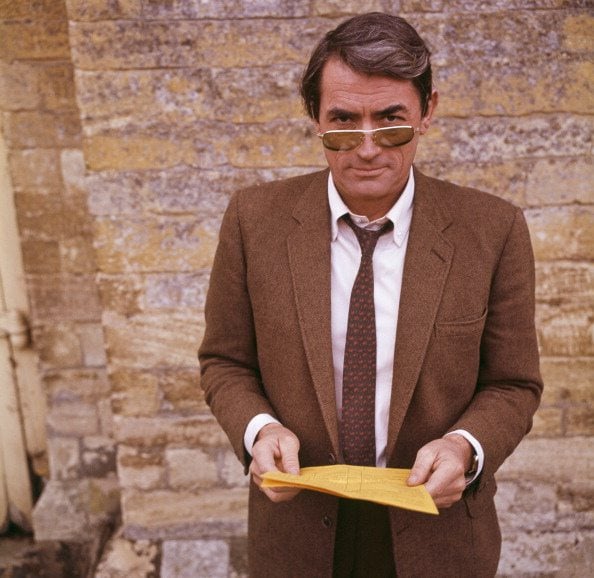
Gregory Peck / Hulton Archive/Getty Images
Awards and Honors
Over his long and distinguished career, Peck earned five Academy Award nominations, winning Best Actor for "To Kill a Mockingbird." He received eight Golden Globe nominations and won five times. In 1967, he was honored with the Jean Hersholt Humanitarian Award for his philanthropic and civic contributions. President Lyndon B. Johnson awarded him the Presidential Medal of Freedom in 1969, and in 1998, President Bill Clinton presented him with the National Medal of Arts.
Peck was celebrated throughout the industry with many lifetime honors, including the AFI Life Achievement Award, the Screen Actors Guild Life Achievement Award, and the Kennedy Center Honors. His star on the Hollywood Walk of Fame stands as a tribute to one of the most admired actors in American film history.
Personal Life and Death
In October 1942, Peck married Finnish-born Greta Kukkonen. Together, they had three sons – Jonathan, Stephen, and Carey Paul. They divorced in December 1955. During this marriage, Gregory had an affair with co-star Ingrid Bergman. The day after his divorce was finalized in 1955, Peck married Véronique Passani, a Parisian news reporter who had interviewed him in 1952 before he went to Italy to film "Roman Holiday." They had a son together in 1956 and a daughter in 1958. They remained married until Peck's death.
On June 12, 2003, Peck died in his sleep from bronchopneumonia at the age of 87 at his home in Los Angeles. His wife, Véronique, was by his side. He is entombed in the Cathedral of Our Lady of the Angels mausoleum in Los Angeles. His eulogy was read by Brock Peters. Celebrities who attended Peck's funeral included Lauren Bacall, Sidney Poitier, Harry Belafonte, Harrison Ford, Mike Farrell, Tony Danza, and Piper Laurie, among many others.
In 2008, the Peck family created the Gregory Peck Award for Cinematic Excellence to commemorate his legacy. The award is given to a director, producer, or actor to honor their life's work.
Pacific Palisades Mansion
In 1947, after establishing himself as a major film star, Gregory purchased a ranch-style estate in Pacific Palisades designed by famed architect Cliff May. The 8,800-square-foot home sits on more than three acres and features sweeping canyon views, a wood-paneled den he loved, and spacious grounds. The family lived in this home until the early 1950s. The home later became a sought-after architectural property. In 2009, Ben Affleck and Jennifer Garner bought the home from producer Brian Grazer for $17.55 million. Jennifer continued living in this house until late 2018. After she and the kids moved out, Ben and Jen sold this mansion to Maroon 5 singer Adam Levine for $32 million in December 2018. In May 2022, Adam sold the property for a mouth-watering $52 million. The buyer was Franz Von Holzhausen, the chief designer at Tesla. Here's a video tour of this incredible 3-acre property:
Beverly Hills Mansion
Peck's primary residence for the last three decades of his life was a grand 1930s French chateau–style estate in Holmby Hills. Gregory and Véronique acquired the home in the 1970s, raising their two children there and hosting regular charity events in the garden and greenhouse Peck personally tended. The mansion measured roughly 8,600 square feet and sat on more than three acres of meticulously landscaped grounds. A year after his death, Véronique sold the estate for approximately $22 million, noting that the extensive gardens were too large for her to maintain alone. The buyer was Google billionaire Eric Schmidt. She remained in the neighborhood, buying a nearby house for $14 million. Veronique remained in this home until her death in August 2012.
/2016/04/gregory-peck.jpg)
/2021/05/audrey.jpg)
/2009/09/Sandra-Bullock.jpg)
/2019/10/denzel-washington-1.jpg)
/2020/01/Jennifer-Garner.jpg)
/2009/12/Ben-Affleck.jpg)
/2018/01/Edward-G.-Robinson.jpg)
/2020/01/lopez3.jpg)
/2019/04/rr.jpg)
/2009/11/George-Clooney.jpg)