
/2014/10/GettyImages-913330826.jpg)
/2014/10/GettyImages-937438648.jpg)
/2017/05/Adelmo-Fornaciari.jpg)
/2017/10/ffb.jpg)
/2014/08/Anouk-Aimee.jpg)
/2022/01/Jane-Birkin.jpg)
:strip_exif()/2015/09/GettyImages-476575299.jpg)
/2017/02/GettyImages-528215436.jpg)
/2009/09/Jennifer-Aniston.jpg)
/2020/02/Angelina-Jolie.png)
/2019/11/GettyImages-1094653148.jpg)
/2020/04/Megan-Fox.jpg)
/2009/09/Cristiano-Ronaldo.jpg)
/2019/04/rr.jpg)
/2020/06/taylor.png)
/2019/10/denzel-washington-1.jpg)
/2018/03/GettyImages-821622848.jpg)
What was Françoise Hardy's Net Worth?
Françoise Hardy was a French actress and singer who had a net worth of $25 million. Françoise Hardy was an iconic figure whose career, spanning over five decades, fundamentally shaped modern French pop music and established her as a global cultural touchstone. She died on June 11, 2024, at the age of 80, after a long battle with cancer.
Hardy was most famous for being the undisputed "Queen of Yé-yé," the upbeat, youth-driven French pop movement of the 1960s, though she quickly distinguished herself from her peers. Hardy was one of the few artists in the genre who wrote and composed her own material, injecting her songs with a distinctive, melancholic introspection that resonated internationally. Her serene yet intensely emotional voice, combined with an effortlessly chic, minimalist style, made her a muse for fashion designers and a genuine celebrity admired by rock legends like Mick Jagger and Bob Dylan. Hardy's enduring fame rests on her ability to translate complex emotional landscapes—loneliness, vulnerability, and the passage of time—into exquisite, sophisticated ballads, ensuring her influence persists across generations.
Early Life and The Yé-yé Breakthrough (1944–1962)
Françoise Madeleine Hardy was born on January 17, 1944, in Paris, France, during the final years of the German occupation. Raised primarily by her mother in a modest household, her childhood was marked by shyness and a solitary nature, a trait that would later define the tone of her music. Her interest in music served as a refuge, and after she passed her baccalauréat exams, her absent father gifted her a guitar—a pivotal moment that enabled her to begin writing her own songs.
In 1961, while attending the Sorbonne, Hardy signed a contract with Disques Vogue. Her breakthrough came the following year with the release of her debut single, "Tous les garçons et les filles." This self-penned song, which plaintively described the loneliness of watching couples pass by, was an immediate cultural phenomenon, selling over a million copies in France and rocketing the 18-year-old to stardom. The song became the defining anthem of the emerging Yé-yé movement, a genre named after the common "yeah, yeah" refrain heard in British and American rock music, which was translated into French as yé-yé.
Global Stardom and Musical Evolution (1963–1975)
Following her initial success, Hardy quickly became a transatlantic star. She represented Monaco in the 1963 Eurovision Song Contest with her original song "L'Amour s'en va" (Love Goes Away), which placed fifth but became another international hit. Unlike many of her contemporaries, Hardy took complete artistic control, releasing songs in English, Italian, German, and Spanish, most notably the English-language single "All Over the World" in 1965, which charted in the UK.
As the 1960s progressed, Hardy deliberately distanced herself from the youthful buoyancy of the Yé-yé genre. Her music matured, shifting towards a more introspective and folk-influenced singer-songwriter style, emphasizing her poetic lyrics and delicate vocal delivery. This evolution was showcased on albums like Mon amie la rose (1964) and Ma jeunesse fout le camp (1967), the title of which translates roughly to "My youth is slipping away." By the 1970s, working with Brazilian singer Tuca, she released the highly acclaimed album La Question (1971), a landmark album in her discography that blended sophisticated instrumentation with intense emotional depth. This era culminated with the huge success of the 1973 album Message personnel, with its title track becoming one of her signature classics.
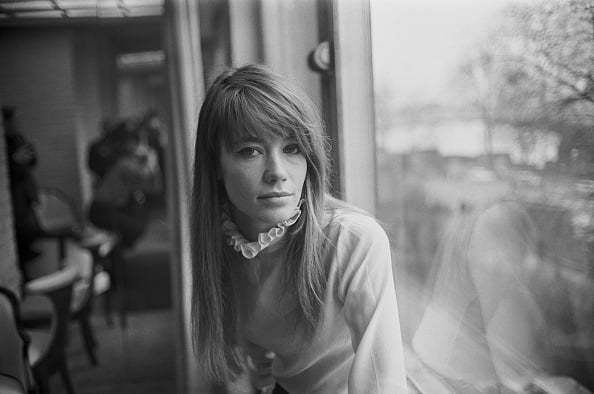
Getty Images
Film, Fashion, and Personal Life
Hardy's striking beauty and distinctive aesthetic—characterized by long, straight hair, minimalist styling, and a graceful melancholia—made her a perpetual icon of fashion. She was cited as a muse by top designers, including Yves Saint Laurent and Paco Rabanne, and was frequently photographed for major publications like Vogue and Paris Match.
She also explored a brief but notable acting career in the mid-1960s. Her most substantial film role was in the John Frankenheimer-directed racing epic "Grand Prix" (1966). She also appeared in hip, French New Wave films, including a cameo in Jean-Luc Godard's "Masculin Féminin" (1966) and a role in Clive Donner's screwball comedy "What's New Pussycat?" (1965).
In her personal life, Hardy began a long-term relationship with fellow French rock star and songwriter Jacques Dutronc in the late 1960s. The couple, considered the French rock equivalent of celebrity power couples of the time, had a son, Thomas Dutronc, in 1973, who would later become a successful musician in his own right. Hardy and Dutronc formally married in 1981, maintaining a unique, unconventional relationship throughout their lives. Hardy also developed a strong interest in astrology, becoming an author on the subject later in her career.
Later Career, Health, and Enduring Legacy
After announcing a temporary retirement following the release of her 1988 album Décalages, Hardy made a successful return to music in the mid-1990s, reinventing her sound with a harder, alternative rock edge on the 1996 album Le Danger. Her final decades were defined by resilience in the face of severe health issues. Diagnosed with lymphatic cancer in the mid-2000s, and later with laryngeal cancer, Hardy underwent years of grueling treatments, including radiotherapy, which caused significant physical suffering and eventually led to her ceasing to sing in 2021. Despite her illness, she continued to record and release albums, including L'Amour fou (2012) and her final album, Personne d'autre (2018), a work marked by contemplative themes of mortality. In her final years, she became a prominent public advocate for the legalization of assisted dying in France, arguing for the right to choose a dignified end to insufferable pain. Françoise Hardy died on June 11, 2024, at the age of 80.
Her legacy is that of a complex, multifaceted artist who transcended the superficiality of teen pop. She influenced artists across the globe, from David Bowie to contemporary French musicians. Her early hits continue to find new audiences, often through their inclusion in modern cinema, such as "Le Temps de l'Amour" being prominently featured in Wes Anderson's film "Moonrise Kingdom" (2012). Françoise Hardy's work stands as a high watermark of sophisticated, emotionally nuanced popular music, celebrated equally for its elegant style and its profound sincerity.
/2014/10/GettyImages-913330826.jpg)
/2022/01/Jane-Birkin.jpg)
/2010/11/Damien-Rice.jpg)
/2017/05/Adelmo-Fornaciari.jpg)
/2014/10/GettyImages-937438648.jpg)
/2025/02/Fernanda-Torres.jpg)
/2014/10/GettyImages-72823338.jpg)
/2015/02/GettyImages-451678577.jpg)
/2009/11/George-Clooney.jpg)
/2009/09/Brad-Pitt.jpg)
:strip_exif()/2009/09/P-Diddy.jpg)