











What Was Chuck Connors' Net Worth?
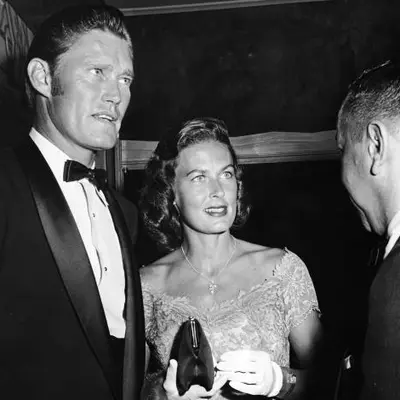
Chuck Connors was an American actor and professional basketball and baseball player who had a net worth of $5 million at the time of his death in 1992.
Chuck Connors became best known as Lucas McCain, the widowed rancher at the center of "The Rifleman." Before that television success, he had played basketball for the Boston Celtics and baseball for the Brooklyn Dodgers and Chicago Cubs, making him one of a small number of athletes to reach the top professional level in both sports. His move into acting produced more than 130 screen credits over a career spanning four decades.
"The Rifleman" ran from 1958 to 1963 and made Connors an enduring Western star. He followed it with series including "Arrest and Trial," "Branded," "Cowboy in Africa," "The Yellow Rose," and "Werewolf," and took a markedly different role as a slaveholder in the 1977 miniseries "Roots." His films included "Old Yeller," "The Big Country," "Soylent Green," and "Airplane II: The Sequel."
Connors also hosted the annual Chuck Connors Charitable Invitational Golf Tournament through his charitable foundation. He received a star on the Hollywood Walk of Fame in 1984, recognizing a screen career that ultimately eclipsed his unusual achievements in professional sports.
Early Life
Chuck Connors was born Kevin Joseph Aloysius Connors on April 10, 1921, in Brooklyn, New York City. He was the son of Marcella and Alban Francis "Allan" Connors, immigrants of Irish descent from Newfoundland and Labrador. Chuck grew up with his younger sister, Gloria. His father had become a citizen of the United States in 1914 and was working in Brooklyn in 1930 as a longshoreman. His mother had attained her U.S. citizenship in 1917.
Growing up, Connors was a devoted fan of the Brooklyn Dodgers and hoped to one day join the team. While attending a preparatory school in Brooklyn, he earned a scholarship to the Adelphi Academy, which he graduated from in 1939. He then received offers for athletic scholarships from more than two dozen colleges and universities. Chuck decided to attend Seton Hall University in South Orange, New Jersey. While there, he played both basketball and baseball.
Athletic Career
Connors left Seton Hall after two years to accept a contract to play professional baseball. He played on two minor league teams in 1940 and 1942. He then joined the United States Army following the country's entrance into World War II. During most of the war, he served as a tank warfare instructor at Fort Campbell, Kentucky, and later at West Point in New York.
Following his time in the Army, Connors played for the Newport News Dodgers in 1946, the Mobile Bears in 1947, the Montreal Royals from 1948 to 1950, and the Los Angeles Angels from 1951 to 1952. He was also playing professional basketball around this time. Chuck joined the Rochester Royals for their 1945 to 1946 championship season. For the 1946-47 season, he joined the newly formed Boston Celtics of the Basketball Association of America, a predecessor of the NBA. Rochester's 1946 championship had come in the National Basketball League, not the NBA.
During his tenure with the Celtics, Connors became the first professional basketball player to break a backboard. He played 53 games for Boston before leaving the team early in the 1947 to 1948 season.
Connors attended spring training with the Brooklyn Dodgers in 1948 without making the major-league roster. He reached the club in 1949 for one major-league appearance, then played 66 games for the Chicago Cubs in 1951. He also attracted interest from the NFL's Chicago Bears but never played for the team. As his baseball opportunities narrowed, he began pursuing acting.
The backboard incident came during warmups in November 1946. Connors took an ordinary set shot, and the glass shattered when the ball struck the rim; the backboard was missing a protective rubber component. His brief major-league baseball career produced a .238 batting average, two home runs, and 18 runs batted in.
Playing for the Los Angeles Angels of the Pacific Coast League brought him close to the film industry. Producers and casting personnel attended games, and Connors' height and outgoing personality made him easy to notice. That connection proved more useful to his future than another attempt to secure a permanent major-league job.
Acting Career
In 1952, Connors appeared in "Pat and Mike," starring Spencer Tracy and Katharine Hepburn. In 1953, he starred opposite Burt Lancaster in the film "South Sea Woman" and then as an American football coach opposite John Wayne in "Trouble Along the Way." In 1956, he appeared in "The Comeback," an episode of "Screen Directors Playhouse," and then in the film "Old Yeller" in 1957.
Connors appeared in his most prominent role in 1958 when he beat 40 other actors for the lead in "The Rifleman," widowed rancher Lucas McCain. The ABC Western series aired from 1958 to 1963.
Chuck also acted in a number of feature films like "The Big Country," "Move Over Darling," "Soylent Green," and "Airplane II: The Sequel." Some of his other television appearances include roles on shows like "Hey, Jeannie!," "The Loretta Young Show," "Schlitz Playhouse," "Screen Directors Playhouse," "Four Star Playhouse," "Matinee Theatre," "The Millionaire," "General Electric Theater," "The Restless Gun," "Here's Lucy," and "The Virginian."
On July 18, 1984, Connors was awarded a star on the Hollywood Walk of Fame. Over 200 of his close friends attended the ceremony.
"The Rifleman" and Acting Earnings
Connors' first film work made a strong financial impression. He earned $500 for a small role in "Pat and Mike," and later recalled making $12,000 from acting during one baseball offseason, more than twice his baseball pay. He did not return to the Cubs for the 1953 season.
When "The Rifleman" was first offered to him, Connors considered the salary too low and declined. After seeing his performance as a father in "Old Yeller," the producers returned with a higher salary and a 5% ownership stake in the series. He accepted the improved deal.
The show paired Connors with Johnny Crawford as his son, Mark. Their relationship gave the series an emotional center beyond its gunfights and frontier disputes. Lucas McCain could handle danger with his modified Winchester, but many episodes turned on the example he set for his son and the consequences of his decisions.
Set near the fictional town of North Fork in the New Mexico Territory, "The Rifleman" produced 168 episodes across five seasons. Connors' rapid-fire opening sequence became one of the most recognizable images of the television Western. The series continued to reach audiences through reruns long after its original network run ended.
Connors' physical presence could also be used against his heroic image. In "The Big Country," he played the volatile Buck Hannassey opposite a cast led by Gregory Peck. In "Soylent Green," starring Charlton Heston, he took a supporting role in a bleak science-fiction story. "Move Over, Darling," with Doris Day, and "Airplane II: The Sequel" placed him in comedy, illustrating how readily filmmakers could use his imposing appearance in different genres.
Later Television
After "The Rifleman," Connors moved into "Arrest and Trial," a ninety-minute crime series that divided its stories between police investigation and courtroom proceedings. He then returned to the Western with "Branded," playing Jason McCord, a former army officer wrongly accused of cowardice. "Cowboy in Africa" placed him in another outdoor adventure setting, this time on a ranch in Kenya.
His later television work included "The Yellow Rose," a Texas ranch drama, and "Werewolf," in which he played the sinister Janos Skorzeny. The 1977 production of "Roots" cast him as Tom Moore, a brutal slaveholder, sharply reversing the reassuring father figure audiences remembered from "The Rifleman." He also appeared in numerous television films and guest roles as his career continued through the 1980s.
Personal Life and Death
Chuck was married three times in his life. He began a relationship with Elizabeth Jane Riddell after meeting at one of his baseball games, and they married on October 1, 1948. They welcomed sons Michael, Jeffrey, Stephen, and Kevin together before divorcing in 1961. In 1963, Connors married his "Geronimo" co-star Kamala Devi. They also appeared in a number of other films together before divorcing in 1973. Chuck married his third wife, Faith Quabius, in 1977.
They had both appeared in the film "Soylent Green" together. After two years of marriage, they divorced in 1979.
Connors was a supporter of the Republican Party and attended several fundraisers for campaigns for U.S. President Richard M. Nixon. He also backed Barry Goldwater, Gerald Ford, and Ronald Reagan. Chuck had a friendly relationship with Leonid Brezhnev, the leader of the Soviet Union during the 1960s and 1970s. Brezhnev was a big fan of "The Rifleman," and it was one of the only American programs permitted to be broadcast in the Soviet Union.
Connors died on November 10, 1992, at Cedars-Sinai Medical Center in Los Angeles, at age 71.
Connors met Brezhnev during the Soviet leader's 1973 visit to the United States. The encounter produced photographs of the actor and the Soviet leader enthusiastically greeting one another, an unusual meeting between a Republican Hollywood celebrity and a Communist head of state. Their shared connection was a television Western rather than politics.
Connors had been a heavy smoker, reportedly consuming as many as three packs of cigarettes a day before quitting in his fifties. He died after being hospitalized with pneumonia while suffering from lung cancer. His burial took place at San Fernando Mission Cemetery in the Los Angeles area.