
/2022/02/bronson.jpg)
/2019/01/jill.jpg)
/2014/10/GettyImages-886658018.jpg)
/2018/07/gary.png)
/2012/09/GettyImages-3097447.jpg)
/2020/06/taylor.png)
/2017/02/GettyImages-528215436.jpg)
:strip_exif()/2009/09/P-Diddy.jpg)
/2019/04/rr.jpg)
/2009/11/George-Clooney.jpg)
/2018/03/GettyImages-821622848.jpg)
/2019/10/denzel-washington-1.jpg)
/2009/09/Cristiano-Ronaldo.jpg)
/2019/11/GettyImages-1094653148.jpg)
/2020/02/Angelina-Jolie.png)
/2020/01/lopez3.jpg)
:strip_exif()/2015/09/GettyImages-476575299.jpg)
What was Charles Bronson's Net Worth and Salary?
Charles Bronson was an American actor who had a net worth of $45 million at the time of his death. That's the same as around $75 million in today's dollars. Charles Bronson's career spanned from the 1950s until the 1990s. He often portrayed tough film and television characters like gunfighters and vigilantes. At one point at the peak of his career in the early 1970s, Charles was the highest-paid actor in the world.
In 1960, he landed a role in what would become his breakout film, "The Magnificent Seven," which co-starred Steve McQueen. From there, Bronson would continue to be a familiar face in other ensemble action/adventure movies like "The Great Escape." He finally broke out as a solo star in "Death Wish," which led to his being a real star with smaller studios, starring in sequels to his signature movie and other action movies unrelated to Death Wish. He remains a cult favorite among movie fans today. Charles Bronson died on August 30, 2003, at the age of 81. He was married three times and was survived by four children.
Highest-Paid Actor
At the peak of his career, Charles Bronson was the highest-paid actor on the planet. He earned $1 million for each of "The Stone Killer," "Chino," "Death Wish," and "St. Ives." He earned $1.5 million for "Death Wish II". He earned $2 million for "10 To Midnight" in 1982, which is the same as $5 million today. In addition to salary, Bronson wisely negotiated large gross points on some of his movies. As part of his 1975 deal with Warner Brothers, Bronson would receive 10-15% of gross receipts from movie ticket sales AND film rentals. Negotiating for a cut of film rentals in the 1970s was particularly forward-thinking. When he struck the deal, film rentals were basically non-existent. Throughout the 80s, the VHS rental market exploded. In 2011, the Bronson estate sued Warner Brothers, accusing the studio of improper accounting related to his 1975 revenue-share deal.
Estate Details and Houses
According to his will, Charles Bronson was worth $45 million when he died in 2003. That's the same as around $75 million today. His surviving wife was given $1.6 million plus an $8 million Malibu mansion. Other assets that went to his children included a $5 million Vermont beach house and a $5 million Bel Air mansion (that was sold by an unrelated party in 2014 for $20 million).
There was a lot of drama in Bronson's family over his will. His third wife was disappointed for not being left the Vermont beach house. Bronson's son Tony was annoyed that so much was left to Weeks, as he alleged she had banned the family from visiting Bronson on his death bed. The family was also infuriated that so much of Bronson's money was locked up in trust funds. The most money went to Bronson's youngest child, his daughter Zuleika, who got twice as much money as the other members of the family.
In 1999, a complete stranger to Bronson named Audrey Knauer infuriated her family when she left her $300,000 estate to Charles Bronson, a man she had never met. Knauer's family challenged the will in court but ultimately were unsuccessful. Bronson donated the money to the woman's favorite charity, the Louisville Public Library.
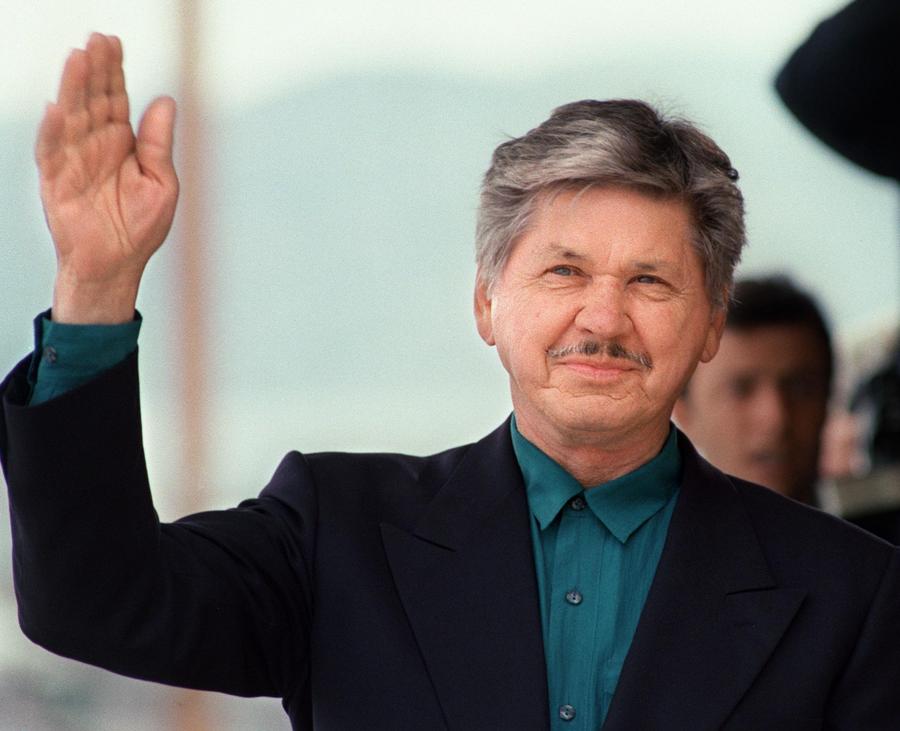
GERARD JULIEN/AFP/Getty Images
Early Life
Charles Buchinsky on November 3, 1921 in Ehrenfeld, Pennsylvania. He was the 11th of 15 children. His father was from southern Lithuania and his mother was born in Pennsylvania to Lithuanian parents. As a child, Bronson and his family spoke Lithuanian and Russian in the home. He didn't learn to speak English until he was a teenager. His father died when he was 10 years old, and Bronson went to work in the coal mines to support his family. His family was so poor that he had to wear his sister's dress to school at one point because he didn't have clothes of his own.
Bronson was the first person in his family to graduate high school. He continued to work in the coal mines after high school until he enlisted in the Army in 1943. During World War II, Bronson served as an aerial gunner in the Guam based 61st Bombardment Squadron running combat missions in Japan. He received a Purple Heart for the wounds he received during his 25 missions.
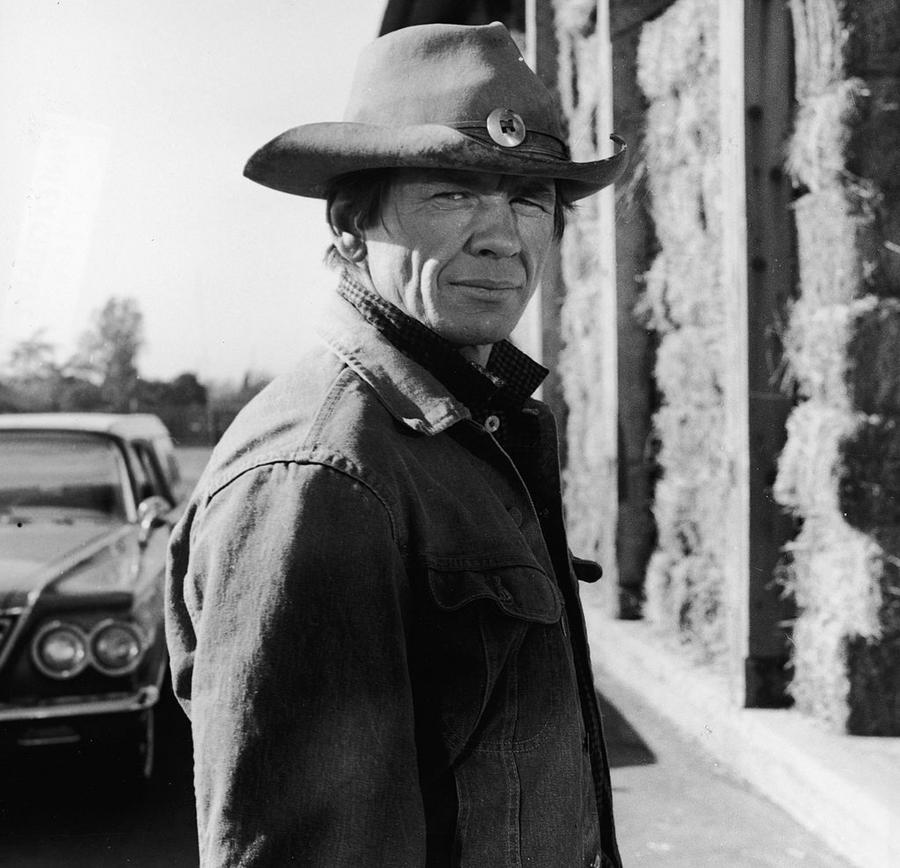
(Photo by Pictorial Parade/Courtesy of Getty Images)
Acting Career
After World War II ended, Bronson worked a number of odd jobs before joining a theatrical group in Philadelphia. He then moved to New York City to pursue theater before moving to Hollywood in 1950. All of his early roles are either uncredited or credited as Charles Buchinsky. In 1954, he changed his surname to Bronson after an agent suggested the idea. His first credit under his new name was in the film, "Vera Cruz," in 1954. Throughout the latter half of the 1950s, he appeared in the films "Target Zero," "Big House, U.S.A.," and "Jubal." He also booked a number of roles in series like "U.S. Marshal," "Colt .45," and "Tales of Wells Fargo."
In 1958, he scored the lead role in the detective series, "Man with a Camera," and then began booking more and more lead roles in film and television. He landed one of the roles in "The Magnificent Seven" and in an episode of "General Electric Theater," for which he was nominated for an Emmy Award. In 1963, he was cast in "The Great Escape," which became a huge hit. He then booked roles in "4 for Texas" and "Guns of Diablo." He starred alongside Richard Burton and Elizabeth Taylor in the 1966 film, "The Sandpiper," and also appeared in a leading role in "This Property is Condemned."
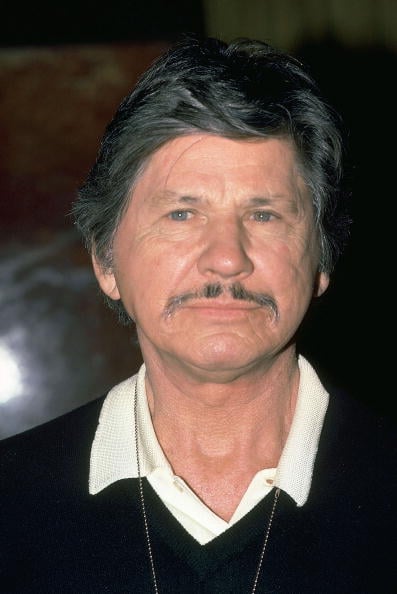
Newsmakers/Getty Images
In 1967, he booked one of the leading roles in "The Dirty Dozen," which became a huge box-office success. However, he remained unsatisfied with his roles, which generally were billed third or fourth, and he wanted to become a true leading man. This desire propelled him to move to Europe, where he enjoyed great success throughout the late 1960s and early 1970s. Some of his most successful films there include "Once Upon a Time in the West," by director Sergio Leone, "Guns for San Sebastian," and "Rider on the Rain," which won a Golden Globe for Best Foreign Language Film.
Bronson returned to the United States after a successful few years in Europe and finally began booking major roles. His most famous role was in the film, "Death Wish," which he booked at age 52. He then appeared in such films as, "Breakout," "Breakheart Pass," and "Hard Times." By the late 1970s, he was one of the most sought-after actors in Hollywood.
Through the 1980s, he began to star in films made by smaller production companies. He appeared in "Death Wish II", "10 to Midnight," "The Evil That Men Do," "Murphy's Law," "Assassination," and "Messenger of Death," among others. His final film and television appearances came in the 1990s when he appeared in the "Family of Cops" trilogy of television movies from 1995 to 1999.

Charles Bronson and his wife Jill Ireland in 1970 (Getty)
Personal Life
Bronson was described as shy and introverted, as well as suspicious of others who had not given him a chance early in his career. He did not enjoy speaking with the media and was described by some as willing to hold a grudge against critics and directors who did not pay attention to him until he was at the height of his fame. He was also unable to watch his own films and did not elaborate on his acting style or the reasons why he became an actor. However, his tough guy persona and ability to bring authentic strength to his roles earned him many fans in Hollywood. He received a star on the Hollywood Walk of Fame in 1980.
When Bronson was 26, he met fellow actor Harriet Tendler in an acting class in Philadelphia when she was 18. The two married in 1949 and had two children together, later divorcing in 1965.
In 1968, Bronson married actress Jill Ireland. They met in 1962. At the time she was married to actor David McCallum, with whom Bronson starred in "The Great Escape." Bronson infamously once told McCallum, "I'm going to marry your wife." And several years later he did exactly that. Bronson and Ireland lived in a mansion in Bel Air with seven children – two from his previous marriage, three from hers, and two of their own. After they were married, she often played his leading lady. They starred in 14 films together. Ireland passed away in 1990 after a long battle with breast cancer.
Bronson married his third wife, Kim Weeks, in 1998. In the final years of his life, Bronson's health began deteriorating after he had hip replacement surgery. He died at age 81 in August of 2003 in Los Angeles. His cause of death is listed as respiratory failure, metastatic lung cancer, chronic obstructive pulmonary disease, and congestive cardiomyopathy.
/2022/02/bronson.jpg)
/2019/01/jill.jpg)
/2014/10/GettyImages-886658018.jpg)
/2018/07/gary.png)
/2021/05/Mickey-Rooney.jpg)
/2021/12/leslie-nielsen.jpg)
/2022/02/kevin-dillon.png)
/2009/09/Jennifer-Aniston.jpg)
/2009/09/Brad-Pitt.jpg)
/2020/04/Megan-Fox.jpg)