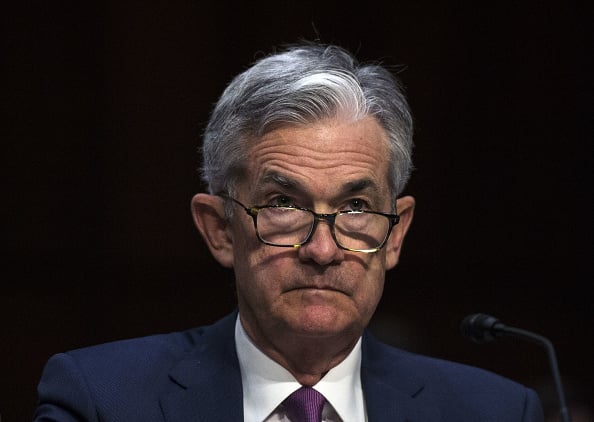
What is Jerome Powell's Net Worth and Salary?
Jerome Powell is an American central banker, lawyer, former investment banker, and former private equity executive who has a net worth of $50 million. Jerome Powell is best known for serving as chairman of the Federal Reserve from 2018 to 2026, a period that included the Covid-19 economic crisis, the post-pandemic inflation surge, one of the fastest interest-rate hiking cycles in modern American history, and repeated political pressure over the Fed's independence. Jerome is one of the richest people to ever hold the position of chairman of the Federal Reserve. According to his 2017 personal financial disclosure, Jerome Powell had a net worth ranging between roughly $19 million and $55 million.
Unlike many of his predecessors, Powell did not come up through academic economics. His career combined law, investment banking, private equity, public service, and monetary policy. He served at the Treasury Department during the George H. W. Bush administration, later became a partner at The Carlyle Group, joined the Federal Reserve Board of Governors in 2012, and was elevated to Fed chair by President Donald Trump in 2018. President Joe Biden reappointed him to a second term, and Powell was succeeded by Kevin Warsh in May 2026.
Fed Chairman Salary
The salary for the chairman of the Federal Reserve is set under the federal Executive Schedule. In 2019, the Fed chair earned an annual salary of $203,500, while other Fed governors earned $183,000. By 2023, Jerome Powell's salary had increased to $226,300.
In 2026, the Executive Schedule Level I salary was $253,100. After Powell's term as chair ended and Kevin Warsh took over, Powell remained a member of the Board of Governors, whose term extends through January 31, 2028. The 2026 Executive Schedule Level II salary for governor-level positions was $228,000.

Getty
Early Life and Education
Jerome Hayden Powell was born on February 4, 1953, in Washington, D.C. He grew up in the Washington area and attended Princeton University, where he earned a bachelor's degree in politics in 1975. He later earned a law degree from Georgetown University Law Center in 1979. While at Georgetown, he served as editor-in-chief of the Georgetown Law Journal.
Although Powell was trained as a lawyer, he did not spend his career as a courtroom attorney. He moved toward finance, capital markets, and economic policy, creating an unusual résumé for a future Fed chair.
Early Career and Wall Street
Powell began his professional career as a lawyer before moving into investment banking. He joined Dillon, Read & Co., a prominent Wall Street firm, where he worked on leveraged buyouts, mergers, acquisitions, and corporate finance transactions. His work during the 1980s gave him direct exposure to capital markets, credit cycles, financial risk, and dealmaking.
Powell's Wall Street experience later became one of the defining features of his public identity. Unlike Fed chairs such as Ben Bernanke and Janet Yellen, Powell was not primarily an academic economist. He came to monetary policy through markets, law, government finance, and private investment.
Treasury Department Service
Powell entered senior government service during the George H. W. Bush administration. He served as assistant secretary and later undersecretary of the Treasury for domestic finance. In that role, he worked on financial institutions, Treasury debt management, the Treasury securities market, and related policy issues.
His Treasury service helped deepen his understanding of the relationship between government financing, financial markets, regulation, and monetary policy. It also gave him experience operating inside Washington during periods of financial stress and policy negotiation.
The Carlyle Group and Private Sector Work
After leaving government, Powell returned to the private sector. From 1997 to 2005, he was a partner at The Carlyle Group, one of the world's largest private equity firms. His work there focused on investments, corporate finance, and financial services.
Powell's wealth largely comes from his years in finance and private equity rather than his government salary. His personal financial disclosures showed substantial holdings in mutual funds, trusts, and other investment vehicles, making him unusually wealthy by the standards of Federal Reserve leadership.
Powell also worked with the Bipartisan Policy Center in Washington, D.C., where he focused on federal and state fiscal issues. That work helped position him as a centrist policy figure with both private-sector and public-sector credibility.
Federal Reserve Governor
Powell joined the Federal Reserve Board of Governors in 2012 after being nominated by President Barack Obama. His appointment was notable because Powell was a Republican nominated by a Democratic president, part of an effort to fill Fed vacancies with bipartisan support.
As a Fed governor, Powell developed a reputation as a pragmatic consensus builder rather than an ideological policymaker. He focused on financial stability, market structure, regulation, and communication with investors. He was reappointed to the Board in 2014 for a term ending January 31, 2028.
Chairman of the Federal Reserve
President Donald Trump nominated Powell to serve as chairman of the Federal Reserve, and Powell took office as chair in February 2018. He inherited an economy still expanding after the Great Recession, then quickly found himself at the center of political fights over interest rates, bank regulation, trade tensions, and Fed independence.
Powell's chairmanship was defined by crisis management. During the Covid-19 pandemic, he led the Fed's emergency response, cutting interest rates to near zero, launching emergency lending programs, and dramatically expanding the central bank's balance sheet to stabilize financial markets. Those actions were credited with helping prevent a deeper financial collapse, though they later became part of the debate over inflation.
As inflation reached multi-decade highs in the post-pandemic economy, Powell shifted sharply. The Fed moved away from emergency stimulus and began one of the fastest rate-hiking campaigns in modern history. Powell repeatedly argued that restoring price stability was essential to long-term economic health, even if higher rates slowed growth and created political backlash.
President Joe Biden reappointed Powell to a second term, and he continued to lead the Fed through the inflation fight, a volatile banking environment, and debates over whether the economy could avoid recession. Powell's tenure as chair ended in May 2026, when Kevin Warsh was sworn in as chairman of the Federal Reserve.
Kevin Warsh Succession
Kevin Warsh succeeded Jerome Powell as Federal Reserve chair in May 2026. Warsh had previously served as a Fed governor from 2006 to 2011 and later became a prominent figure in finance, academia, and economic policy circles. His appointment marked a major leadership transition at the central bank after more than eight years of Powell at the helm.
Powell remained on the Federal Reserve Board after leaving the chairmanship, with his governor term running until January 31, 2028.
Personal Life
Jerome Powell is married and has three children. He has generally kept his personal life private, especially compared with the intense public scrutiny attached to his role at the Federal Reserve.
Powell's legacy centers on steering the central bank through overlapping crises while defending the Fed's institutional credibility. His supporters credit him with acting forcefully during the pandemic and later pivoting aggressively against inflation. His critics argue that the Fed stayed too easy for too long and was slow to recognize the persistence of post-pandemic inflation. Either way, Powell's tenure made him one of the most consequential economic officials of the 21st century.
/2026/01/kevin-warsh.png)
/2018/06/Paul-Volcker.jpg)
/2010/08/Ben-Bernanke.jpg)
/2013/10/Janet-Yellen.jpg)
/2010/08/GettyImages-487195485.jpg)
/2020/06/taylor.png)
/2018/03/GettyImages-821622848.jpg)
/2020/04/Megan-Fox.jpg)
/2017/02/GettyImages-528215436.jpg)
/2019/10/denzel-washington-1.jpg)
/2009/09/Brad-Pitt.jpg)
:strip_exif()/2009/09/P-Diddy.jpg)
:strip_exif()/2015/09/GettyImages-476575299.jpg)
/2009/09/Cristiano-Ronaldo.jpg)
/2020/02/Angelina-Jolie.png)
/2020/01/lopez3.jpg)
/2019/09/Jerome-Powell.png)
/2013/10/Janet-Yellen.jpg)
/2018/06/Paul-Volcker.jpg)
/2010/08/Ben-Bernanke.jpg)
/2010/11/GettyImages-462521122.jpg)
/2009/11/Rick-Santelli.jpg)
/2010/08/GettyImages-460635372.jpg)
/2010/12/CNW-Man.png)
/2009/09/Jennifer-Aniston.jpg)
/2019/11/GettyImages-1094653148.jpg)
/2019/04/rr.jpg)