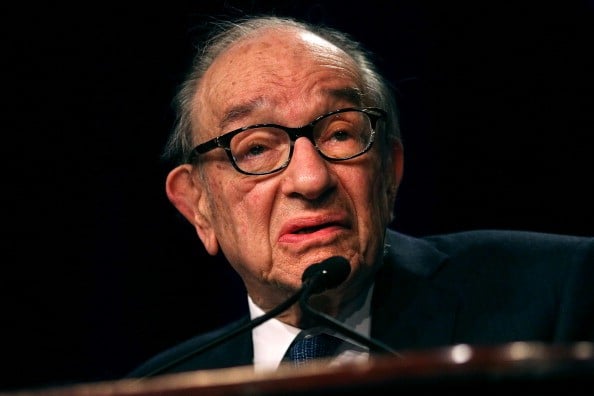
What was Alan Greenspan's Net Worth and Salary?
Alan Greenspan was an American economist, author, and longtime public official who had a net worth of $20 million at the time of his death. Alan Greenspan died on June 22, 2026, at his home in Washington, D.C. He was 100 years old. His wife, NBC News journalist Andrea Mitchell, said the cause was complications of Parkinson's disease.
Greenspan was best known for serving as Chair of the Federal Reserve of the United States from 1987 to 2006. During his final year in the role, he earned an annual government salary of around $180,000. That paycheck was modest compared with the power he wielded. For nearly 19 years, Greenspan was arguably the most influential economic policymaker in the world, with investors, politicians, bankers, and foreign governments parsing his every public comment for clues about the future of interest rates.
President Ronald Reagan appointed Greenspan to the Fed chairmanship in August 1987, and he was later reappointed by George H. W. Bush, Bill Clinton, and George W. Bush. His tenure was the second-longest in the position's history. At the height of his influence in the 1990s, he was nicknamed the "Maestro" for helping preside over a long period of economic growth, low inflation, rising productivity, and soaring stock prices. After the 2008 financial crisis, however, his legacy became much more complicated, with critics arguing that his faith in deregulation and self-policing financial markets helped create the conditions for the housing bubble and Wall Street collapse.
Greenspan received numerous honors during his career, including the Presidential Medal of Freedom, which George W. Bush presented to him in November 2005. He also wrote several books, including "The Age of Turbulence: Adventures in a New World" (2007) and "Capitalism in America: A History" (2018).
Financial Disclosure, Salary, and Book Advance
According to his last financial disclosure statement, submitted in 2004, Alan controlled assets valued between $3 million and $6.5 million at that point. While he was Chair of the Fed, his assets were invested in short-term Treasury bills, a conservative structure that helped avoid conflicts of interest while he was setting interest-rate policy. At the same time, his wife, NBC News correspondent Andrea Mitchell, listed her separate assets as being worth $1.3 million to $3 million.
Greenspan's income increased significantly after he left the Federal Reserve. In 2006, he founded Greenspan Associates LLC, an economic consulting firm through which he advised corporations, investment firms, hedge funds, and financial institutions. Pacific Investment Management Company hired him as a special consultant, he advised clients at Deutsche Bank, and he later joined Paulson & Co. as an adviser.
One of Greenspan's largest known post-Fed paydays came from publishing. His 2007 memoir, "The Age of Turbulence: Adventures in a New World," reportedly earned him an $8.5 million advance, one of the largest nonfiction book advances of that era. The book became a bestseller and arrived at a particularly dramatic moment, just as the financial system was beginning to show signs of the crisis that would later reshape Greenspan's legacy.
Early Life
Alan Greenspan was born on March 6, 1926, in New York City. His parents, Rose and Herbert Greenspan, were of Hungarian-Jewish and Romanian-Jewish descent, respectively. Herbert worked as a stockbroker and market analyst. Rose and Herbert divorced when Alan was young, and he was raised by his mother in the Washington Heights neighborhood of Manhattan.
Before economics became his life's work, Greenspan was a serious musician. He graduated from George Washington High School in 1943 and went on to attend the Juilliard School, where he studied clarinet. He also played saxophone in a swing band. During breaks from performing, he would read books about business, finance, and the stock market, an interest that eventually pulled him away from music and toward economics.
Greenspan attended the Stern School of Business at New York University, graduating summa cum laude with a Bachelor of Arts degree in economics in 1948. He earned a Master of Arts degree in economics two years later and briefly studied advanced economics at Columbia University, where he studied under Arthur Burns, who later became Fed chairman. Greenspan ultimately earned a Ph.D. in economics from NYU in 1977.
Early Finance Career
Greenspan began working in the equity research department of investment bank Brown Brothers Harriman while attending NYU, and he was an analyst at the National Industrial Conference Board from 1948 to 1953. He became president and chairman of the economic consulting firm Townsend-Greenspan & Co., Inc. in 1955 and remained in those roles until 1987, with a three-year break to serve as Chairman of the Council of Economic Advisers under President Gerald Ford from 1974 to 1977.
Townsend-Greenspan specialized in economic forecasting, and Greenspan developed a reputation for studying obscure industrial data to understand where the economy was headed. His specialty was not grand theory as much as highly detailed analysis of how businesses, consumers, manufacturers, and investors were behaving in real time.
In 1968, Greenspan served as an economic adviser to Richard Nixon during his presidential campaign. He also held corporate directorships at several major companies, including J.P. Morgan & Co., Automatic Data Processing, General Foods, and Mobil Corporation. From 1982 to 1988, Alan was a director of the Council on Foreign Relations, and in 1984, he joined the Group of Thirty, a financial advisory body.
One of Greenspan's most important pre-Fed assignments came in the early 1980s, when he led a commission created to address Social Security's looming funding crisis. The commission recommended a politically difficult mix of tax increases and benefit changes. Many of its recommendations were adopted by Congress in 1983, boosting Greenspan's reputation in Washington as a serious, bipartisan economic technician.

Spencer Platt / Getty Images
Ayn Rand and Free-Market Philosophy
A major influence on Greenspan's worldview was author Ayn Rand. Through his first wife, artist Joan Mitchell, Greenspan met Rand in the early 1950s and became part of her inner circle. Rand's defense of laissez-faire capitalism and individual self-interest left a deep impression on him.
Although Greenspan later became known as a pragmatic central banker rather than a purely ideological figure, his belief in market discipline shaped much of his career. He generally favored limited regulation, low barriers to financial innovation, and the idea that markets could often police risk better than government officials.
That philosophy became one of the most debated parts of his legacy. Supporters saw it as part of the reason the U.S. economy became so dynamic during the 1980s and 1990s. Critics later argued that the same philosophy left the financial system too lightly regulated heading into the housing bubble and the 2008 financial crisis.
Federal Reserve
In August 1987, Greenspan succeeded Paul Volcker as chairman of the Board of Governors of the Federal Reserve, two months after being nominated by President Ronald Reagan. His first major test came almost immediately. On October 19, 1987, the stock market crashed, with the Dow Jones Industrial Average falling 22.6% in a single day.
Greenspan responded by signaling that the Federal Reserve would provide liquidity to support the financial system. The move helped calm markets and prevent a broader collapse of banks and brokerages. It also established one of the defining ideas of his tenure: that the Fed would step in aggressively when financial markets were under severe stress. That perception later became known as the "Greenspan put."
During the 1990s, Greenspan became one of the most celebrated figures in American finance. He supported Bill Clinton's deficit reduction program in 1993 and was involved in the country's response to the Mexican peso crisis in 1994 and 1995. He also helped steer the U.S. through the Asian financial crisis, the Russian debt crisis, the collapse of Long-Term Capital Management, the dot-com bubble, and the economic shock that followed the September 11 attacks.
Greenspan was especially influential in the second half of the 1990s, when he argued that technology and globalization were allowing the economy to grow faster without sparking traditional inflation. That view helped justify a looser interest-rate stance than many older models might have recommended. For several years, he appeared to be right: inflation stayed low, unemployment fell, productivity improved, and the stock market boomed.
He also became famous for his deliberately opaque public language, often called "Fedspeak." Investors treated his speeches and congressional testimony like market-moving events, searching for hints about the direction of interest rates. In 1996, he famously warned about possible "irrational exuberance" in the stock market, a phrase that instantly entered financial history.
In 2000, Greenspan raised interest rates multiple times, and many observers believed those hikes helped contribute to the bursting of the dot-com bubble. In 2001, he supported George W. Bush's proposed tax cuts, a position that angered Democrats who felt it contradicted his earlier support for deficit reduction. In 2004, Bush nominated Greenspan to serve a fifth term as Fed chairman. Greenspan served until January 31, 2006, when he was succeeded by Ben Bernanke.
2008 Financial Crisis and Legacy Debate
Only after Greenspan left the Federal Reserve did the most intense criticism of his tenure emerge. The collapse of the housing market, the near-failure of major Wall Street institutions, and the 2008 financial crisis led many economists, lawmakers, and commentators to reassess his record.
Critics argued that Greenspan kept interest rates too low for too long in the early 2000s, helping inflate the housing bubble. Others blamed his resistance to tighter regulation of derivatives and complex financial instruments, arguing that his faith in market self-discipline allowed banks and investment firms to take on dangerous levels of risk.
Greenspan defended much of his record, but he also conceded that the crisis had exposed a flaw in his belief that financial institutions would act rationally to protect their own shareholders and balance sheets. That admission became one of the most memorable moments of his post-Fed life.
His legacy remains deeply debated. To admirers, Greenspan was the central banker who helped guide America through nearly two decades of prosperity, technological change, market shocks, and low inflation. To critics, he was a symbol of the deregulatory confidence that preceded the worst financial crisis since the Great Depression. Both views are central to understanding why he remained one of the most consequential economic figures of his era.
Greenspan Associates
After retiring from the Federal Reserve, Greenspan formed Greenspan Associates LLC, an economic consulting firm, and took an honorary position at the United Kingdom's HM Treasury. In 2007, he predicted a possible U.S. recession, and the Dow Jones Industrial Average dropped 416 points the next day.
That year, Pacific Investment Management Company hired Alan as a special consultant, and he began advising investment bankers and clients at Deutsche Bank. The following year, Greenspan joined the Paulson & Co. hedge fund as an adviser. His transition from government service to private consulting was financially lucrative and helped explain how his net worth grew far beyond the assets he had disclosed while still serving as Fed chairman.
In 2007, Alan released his memoir, "The Age of Turbulence: Adventures in a New World." He stated that he wrote the book by hand in the bathtub because that was where he got many of his best ideas. The bathtub habit became one of his better-known personal anecdotes and added to the mystique around a man who was otherwise known for technical language, privacy, and disciplined routine.
Personal Life
Alan married artist Joan Mitchell in 1952, and the couple annulled their marriage the following year. Joan introduced him to Ayn Rand, whose writings and social circle had a major influence on Greenspan's intellectual development.
Greenspan later had a relationship with Barbara Walters in the 1970s. He married journalist Andrea Mitchell on April 6, 1997, in a ceremony officiated by Supreme Court Justice Ruth Bader Ginsburg. Mitchell was his only immediate survivor.
Despite his reputation as a reserved technocrat, Greenspan was a fixture in Washington social life. He moved comfortably among politicians, journalists, judges, cabinet officials, and business leaders. He was also an avid tennis player, a sport he picked up seriously while serving in the Ford administration and continued playing into his 80s.
Awards and Honors
Some of Greenspan's most honorary titles included Commander of the French Legion d'honneur (Legion of Honor, 2000) and Knight Commander of the British Empire (2002). In 2006, Alan was awarded the Department of Defense Medal for Distinguished Public Service, and the Eisenhower Fellowships honored him with the Dwight D. Eisenhower Medal for Leadership and Service in 2004.
In 2005, Greenspan became the first person to receive the Harry S. Truman Medal for Economic Policy, and in December of that year, NYU gave him an honorary Doctor of Commercial Science degree. Alan also received the U.S. Senator John Heinz Award for Greatest Public Service by an Elected or Appointed Official (1976), the Thomas Jefferson Foundation Medal in Citizen Leadership (2007), and the Eugene J. Keogh Award for Distinguished Public Service (2012). The American Statistical Association made him a Fellow, its highest honorary level of membership, in 1989.
/2019/09/Jerome-Powell.png)
/2026/01/kevin-warsh.png)
/2010/08/GettyImages-456848248.jpg)
/2018/06/Paul-Volcker.jpg)
/2013/08/andrea-mitchell.jpg)
/2020/02/Angelina-Jolie.png)
/2018/03/GettyImages-821622848.jpg)
/2009/11/George-Clooney.jpg)
/2009/09/Brad-Pitt.jpg)
:strip_exif()/2015/09/GettyImages-476575299.jpg)
/2019/10/denzel-washington-1.jpg)
/2019/11/GettyImages-1094653148.jpg)
/2019/04/rr.jpg)
/2020/01/lopez3.jpg)
/2020/06/taylor.png)
:strip_exif()/2009/09/P-Diddy.jpg)
/2010/08/GettyImages-487195485.jpg)
/2013/08/andrea-mitchell.jpg)
/2026/06/Greenspan_Alan_Whitehouse.jpg)
/2018/06/Paul-Volcker.jpg)
/2010/08/Ben-Bernanke.jpg)
/2013/10/Janet-Yellen.jpg)
/2010/07/GettyImages-143770613.jpg)
/2017/02/GettyImages-528215436.jpg)
/2009/09/Cristiano-Ronaldo.jpg)
/2009/09/Jennifer-Aniston.jpg)
/2020/04/Megan-Fox.jpg)