
/2020/01/robert-kiyosaki.png)
/2019/01/James-Altucher.jpg)
/2018/12/GettyImages-646042882.jpg)
/2014/01/northrup.jpg)
/2010/09/Tim-Ferriss.jpg)
:strip_exif()/2009/09/donald.jpg)
/2019/10/denzel-washington-1.jpg)
/2009/09/Cristiano-Ronaldo.jpg)
/2018/03/GettyImages-821622848.jpg)
/2009/09/Jennifer-Aniston.jpg)
/2009/09/Brad-Pitt.jpg)
/2019/11/GettyImages-1094653148.jpg)
/2017/02/GettyImages-528215436.jpg)
/2009/11/George-Clooney.jpg)
/2020/04/Megan-Fox.jpg)
:strip_exif()/2009/09/P-Diddy.jpg)
/2019/04/rr.jpg)
What Is Robert Kiyosaki's Net Worth?
Robert Kiyosaki is an American investor, businessman, author, motivational speaker, and financial commentator who has a net worth of $100 million. Robert Kiyosaki first became renowned for his book "Rich Dad Poor Dad," which would later be considered a seminal work in personal finance. His career encompasses diverse entrepreneurial ventures and a passion for financial education. Kiyosaki's philosophy stems from his experiences with two paternal figures: his biological father, who followed traditional academic and employment paths, and his friend's father, who pursued entrepreneurial success and provided financial insights.
His book "Rich Dad Poor Dad," released in 1997, became an international bestseller and sparked a series of books under the "Rich Dad" brand. These publications focus on financial independence, investing, real estate, and the importance of financial literacy, often challenging conventional views on employment and income. Kiyosaki's influence extends beyond writing; he has been involved in various business ventures and educational initiatives, emphasizing practical financial education. Despite some controversy and criticism, particularly regarding the operations of his "Rich Dad" seminars, Kiyosaki remains a prominent figure in the field of personal finance and wealth development.
Early Life
Robert Kiyosaki was born Robert Toru Kiyosaki on April 8, 1947, in Hilo, Territory of Hawaii. Robert is the son of Ralph and Marjorie Kiyosaki, and he is a 4th-generation Japanese-American, otherwise known as a "Yonsei." His father was an educator who held a Ph.D. at the time of his death in 1991. Kiyosaki would later ridicule those who took the time to earn a Ph.D., indirectly referencing and criticizing his father for his poverty and unemployment in his later years. Robert graduated from high school in 1965.
After high school, Kiyosaki attended Naval College and eventually joined the U.S. Marine Corps after his brother joined the Air Force to fight in the Vietnam War. He became a helicopter gunship pilot and served in Vietnam from 1972 to 1973. Robert has stated that his time as a U.S. Marine gave him the strength of character needed to succeed in the business world.
After his tour in Vietnam, Kiyosaki attended college in Hilo, Hawaii. After earning an MBA, he started to venture into the business world for the first time. He worked as a sales associate for Xerox until 1968, at which point he started his first business.
Early Attempts at Entrepreneurship
Kiyosaki's first business revolved around selling nylon/velcro wallets. These were among the first wallets of their kind, and the business experienced moderate success. That being said, it eventually went bankrupt. His second attempt was a retail company that sold t-shirts. He licensed the rights to make apparel for various rock bands, including hats, wallets, and bags. Once again, the company went bankrupt. By 1980, Robert had shifted his focus more toward education.
Early Educational Businesses
Kiyosaki's first foray into the world of education began with a company called the Accelerated Learning Institute. It was Robert's first attempt at business education, although the company also focused on educating students on social responsibility. The entrepreneur started the company in 1985 and sold it in 1994.
In the mid-1990s, Kiyosaki started to build the education empire that would help him earn his fortune. It started with the publishing of his first book: "If You Want to Be Rich and Happy, Don't Go to School." As the name suggests, the book was critical of college education as a pathway to success and encouraged readers to become involved in real estate instead. At this point, Robert and his second wife were heavily involved in real estate themselves.
The most critical point of progress came when Kiyosaki founded Cashflow Technologies, Inc. in 1997. This was the financial education company that would own and operate the "Rich Dad" brand, among others. During the same year, Robert published his most famous book, "Rich Dad Poor Dad."
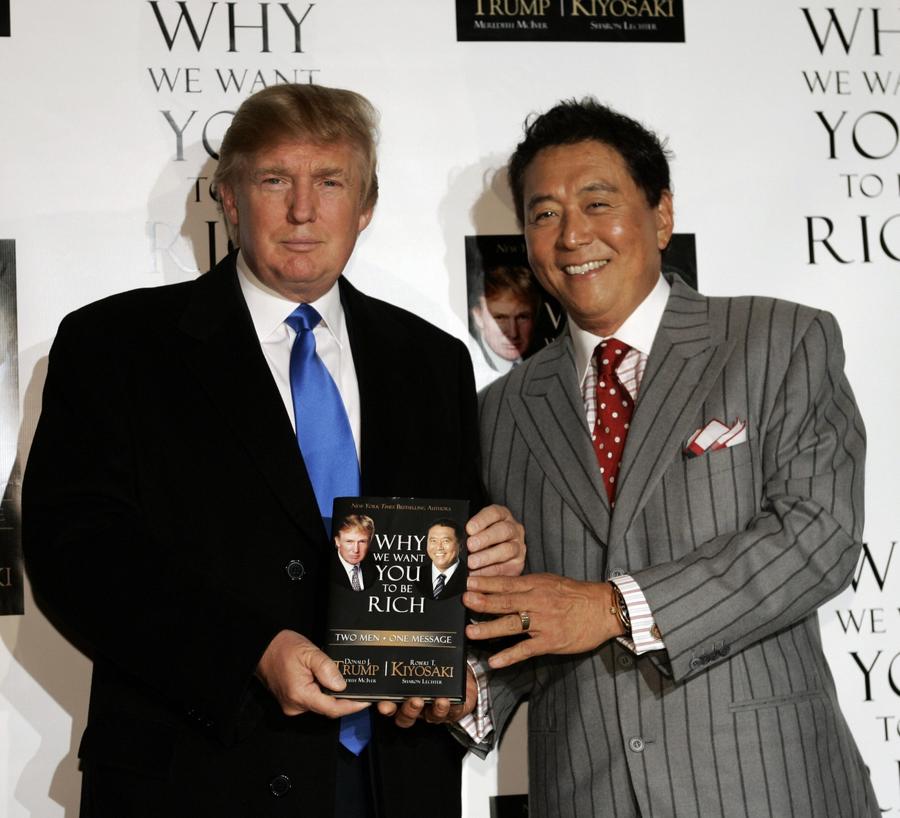
TIMOTHY A. CLARY/AFP via Getty Images
"Rich Dad Poor Dad"
The book has sold over 32 million copies and was originally self-published. After gathering momentum, the book was picked up by major publishers and remained on the "New York Times" Best Sellers list for over six years. The Oprah Winfrey Show" also boosted sales after its host mentioned the book. Without a doubt, the book launched Kiyosaki's career in earnest, winning him fame and financial success.
The book is about two fathers, one of whom is poor while the other has accumulated wealth after intelligent investments and entrepreneurship. Later, Robert reveals the "rich dad" to be a fictional character, while the "poor dad" is allegedly based on his own father. "Rich Dad Poor Dad" delivers a series of financial lessons, including those related to real estate and starting a business.
The book was commercially successful, although it has been criticized for many reasons. The most glaring issue is that none of the financial success stories that Kiyosaki speaks about have been documented. No one has been able to prove that he was actually involved with the level of financial success he discusses in this book. In addition, many have criticized the book for being too vague and ridiculing American culture. Robert has since claimed that the book was not intended to be a guide for financial success but rather a motivational tool.
Later Books
After "Rich Dad Poor Dad," Kiyosaki published many other books. These include "Cashflow Quadrant: Rich Dad's Guide to Financial Freedom," as well as books co-authored with Donald Trump, such as "Why We Want You to be Rich: Two Men, One Message." More recent publications include 2020's "Who Stole My Pension?: How You Can Stop The Looting," 2022's "Capitalist Manifesto: Money for Nothing – Gold, Silver, and Bitcoin For Free," and 2023's "Ravens: How To Prepare For And Profit From The Turbulent Times Ahead." In total, Kiyosaki has published 26 books that have sold more than 41 million copies worldwide.
Seminars
In addition to writing books, Kiyosaki's business model focuses on seminars. These seminars are typically conducted by other experts through a franchise-like approach. Some seminars are free, while others can cost hundreds or even tens of thousands of dollars.
Criticism
Robert has received considerable criticism over the years. Many complain that his seminars contain no real, concrete information. Kiyosaki has also been involved in multi-level marketing. Some of his books and seminars have advocated questionable or even illegal actions, such as insider trading or dropping out of college. His company also recommended investing in real estate in 2007, shortly before the economic recession of 2008.
Company Bankruptcy
In 2012, Kiyosaki's company, Rich Global LLC, went bankrupt after a series of class-action lawsuits. His company was sued by attendees of his seminars who felt they were scammed. His company was also sued as a result of royalty disputes. Losing in court left the company in bad shape, and so Kiyosaki chose bankruptcy. He was ordered to pay nearly $24 million to The Learning Annex and its founder.
/2020/01/robert-kiyosaki.png)
/2009/09/donald.jpg)
/2018/12/GettyImages-646042882.jpg)
/2010/09/Tim-Ferriss.jpg)
/2011/01/Screen-Shot-2018-02-25-at-1.09.37-PM.png)
/2018/02/gw.jpg)
/2019/11/GettyImages-91596456.jpg)
/2016/12/Matthew-Lesko.jpg)
:strip_exif()/2015/09/GettyImages-476575299.jpg)
/2020/06/taylor.png)
/2020/02/Angelina-Jolie.png)
/2020/01/lopez3.jpg)