What was David Hockney's Net Worth?
David Hockney was an English painter, draughtsman, printmaker, stage designer, photographer, and digital artist who had a net worth of $200 million at the time of his death. David Hockney stood as one of the most influential British artists of the 20th and 21st centuries, building a career that spanned more than six decades and moved restlessly across painting, drawing, photography, printmaking, theater design, fax machines, photocopiers, iPhones, and iPads. Though often associated with British Pop Art, Hockney resisted being confined to any single movement. His work was rooted in looking closely at the world, whether he was painting a swimming pool in Los Angeles, a friend seated in a domestic interior, a Yorkshire road, a Normandy garden, or his own aging face.
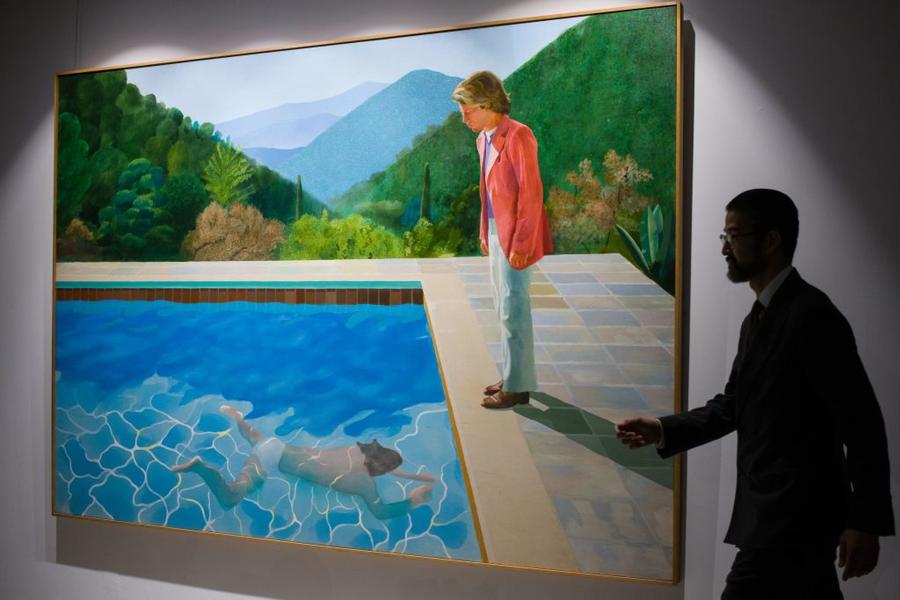
Hockney became especially famous for his bright California paintings of swimming pools, modernist houses, palm trees, and sunlit leisure. Works such as "A Bigger Splash," "Peter Getting Out of Nick's Pool," and "Portrait of an Artist (Pool with Two Figures)" helped define the visual mythology of Southern California in the 1960s and 1970s. Later in life, he became equally celebrated for his landscapes, digital drawings, stage designs, and museum-filling retrospectives. His commercial success matched his artistic stature. In 2018, "Portrait of an Artist (Pool with Two Figures)" sold for $90.3 million, setting a record at the time for a work by a living artist.
David Hockney died at his home in London in June 2026. He was 88. No cause of death was provided.
Portrait of an Artist (Pool with Two Figures) (ANTHONY WALLACE/AFP/Getty Images)
Early Life and Education
David Hockney was born on July 9, 1937, in Bradford, Yorkshire, England. He was one of five children in a working-class family. His father, Kenneth Hockney, restored baby carriages and was a committed pacifist and anti-nuclear activist. His mother, Laura Hockney, was an important emotional presence in his life and later became one of his most frequent portrait subjects.
Hockney showed artistic ability early and earned a scholarship to Bradford School of Art, where he studied from 1953 to 1957. In his late teens, when he faced the possibility of military service, he declared himself a conscientious objector and instead performed alternative service as a hospital orderly.
In 1959, Hockney entered the Royal College of Art in London. There, he became known as an exceptional draftsman with a rebellious streak. He experimented with abstraction, figuration, printmaking, and autobiographical imagery, but he never fully accepted the idea that serious art had to move away from recognizable human subjects. When the Royal College awarded him its gold medal, Hockney accepted the honor while wearing a gold lamé jacket, an early example of the dandyish public style that became part of his persona.
Early Career and Rise in London
Hockney emerged in London during a period when abstraction, conceptual art, and Pop Art were reshaping the art world. His early work borrowed from Pop's use of modern imagery, text, and flat color, but his art was also intensely personal. In the early 1960s, he made work that openly addressed gay desire at a time when homosexuality was still criminalized in Britain.
A 1961 trip to New York had a major impact on him. America appeared to Hockney as freer, brighter, and less sexually repressive than England. After that visit, he created a modern version of William Hogarth's "A Rake's Progress," transforming the old morality tale into a contemporary story involving gay bars, cruising, and American life.
By 1963, Hockney had gallery representation and growing international attention. His first solo exhibition in London sold out, and he soon became one of the most talked-about young British artists of his generation.
California Dreams and Swimming Pools
Hockney first visited Los Angeles in 1964, and the city transformed his life and work. He was captivated by the light, climate, architecture, freeways, palm trees, swimming pools, and openness of Southern California. He later referred to himself as an "English Los Angeleno," a phrase that captured both his Yorkshire roots and his long identification with Los Angeles.
California gave Hockney a new visual language. He painted swimming pools, lawn sprinklers, glass houses, showering men, and modern domestic spaces with a clarity and brightness that made his work instantly recognizable. His pool paintings captured the glamour and emptiness of Los Angeles leisure culture, but they were also formal experiments in color, surface, transparency, and water.
Works such as "A Bigger Splash" (1967), "Peter Getting Out of Nick's Pool" (1966), and "Portrait of an Artist (Pool with Two Figures)" (1972) became among his most famous paintings. These images helped make Hockney one of the defining artists of Southern California, even though he remained unmistakably English in background, accent, politics, and temperament.
(Photo by THOMAS COEX/AFP via Getty Images)
Portraits and Personal Relationships
Portraiture was one of the central pillars of Hockney's career. He painted friends, lovers, collectors, curators, parents, dogs, and himself with the same sustained curiosity he brought to landscapes and swimming pools. His portraits often appear calm at first glance, but many contain psychological tension, distance, affection, or unease.
His celebrated double portraits include "Christopher Isherwood and Don Bachardy," "Henry Geldzahler and Christopher Scott," "American Collectors (Fred and Marcia Weisman)," and "Mr and Mrs Clark and Percy." These works placed people inside carefully arranged domestic or architectural spaces, using posture, distance, furniture, clothing, and gaze to suggest the emotional dynamics between them.
Hockney's openness about his sexuality was also central to his importance. Long before same-sex relationships were widely visible in mainstream art, he painted male lovers and domestic intimacy without disguise. His relationship with Peter Schlesinger, a student, model, muse, and lover whom he met while teaching at UCLA in 1966, inspired many drawings and paintings. Their breakup in the early 1970s was later dramatized in the 1974 film "A Bigger Splash."
Photography, Joiners, and Perspective
Although Hockney is best known as a painter, photography played a major role in his career. He began using photographs as reference material, but by the 1970s and 1980s, he was experimenting with photo-collages that became finished works in their own right.
His "joiners" were made by combining multiple Polaroids or small photographs into a single image. Rather than using a camera to freeze one perfect perspective, Hockney used many images to suggest the way people actually experience the world: through movement, memory, repetition, and shifting attention. A face, room, road, or landscape might be built out of dozens of separate views.
These experiments connected to one of Hockney's lifelong concerns: the limits of single-point perspective. He argued that traditional Western perspective and photography could flatten experience, while Cubism, Chinese scroll painting, and multi-viewpoint images made the viewer more active. That idea continued to shape his landscapes, stage designs, and large-scale works for decades.
Stage Design and Opera
Hockney was also a major stage designer. His first important theater work came in 1966, when he designed sets for Alfred Jarry's "Ubu Roi" at the Royal Court Theatre in London. He later became especially admired for opera designs.
In 1975, he created sets and costumes for Stravinsky's "The Rake's Progress" at the Glyndebourne Festival. The production used bold line work and cross-hatching to create a theatrical world that felt both graphic and painterly. In 1981, he designed "Parade" for the Metropolitan Opera, a triple bill involving works by Erik Satie, Francis Poulenc, and Maurice Ravel.
Hockney also designed productions of Puccini's "Turandot," Wagner's "Tristan und Isolde," and Strauss's "Die Frau Ohne Schatten." His stage work allowed him to push color, scale, pattern, and illusion into immersive environments, bringing his painting into a fully theatrical space.
Technological Innovation and Artistic Evolution
Hockney was unusually open to new tools. He began experimenting with computer graphics in the 1980s, made prints with office photocopiers, sent large-scale work by fax, and later embraced the iPhone and iPad as serious drawing tools. He was not interested in technology as a gimmick. He treated each device as another way to draw, observe, compose, and distribute images.
By the late 2000s, he was making iPhone drawings and sending them to friends. He later produced thousands of iPad drawings, including floral studies, portraits, landscapes, and seasonal views from his home and studio. During the pandemic, he created more than 100 iPad images chronicling the arrival of spring in Normandy.
This willingness to experiment kept Hockney unusually relevant late in life. While many artists become frozen in the style that made them famous, Hockney continued to change media, scale, subject, and method well into his 80s.
Yorkshire, Normandy, and Late Landscapes
After decades of association with Los Angeles, Hockney increasingly returned to European landscapes. In the late 1990s and 2000s, he became deeply engaged with the countryside of East Yorkshire, painting roads, trees, fields, and seasonal changes on large canvases. These works culminated in exhibitions such as "A Bigger Picture," which emphasized scale, color, and immersion.
In 2018, Hockney bought a property in Normandy, France, where he continued to paint and draw outdoors. The French countryside became one of his final great subjects. He later returned to London, where he continued working even as his health declined. A major retrospective, "David Hockney 25," opened at the Louis Vuitton Foundation in Paris in 2025 and included more than 400 works, making it the largest exhibition of his career.
Even near the end of his life, Hockney insisted that he was not finished. His final years reinforced the defining rhythm of his career: travel, observation, reinvention, and constant production.
Most Expensive Works
Hockney's market value rose dramatically in the 21st century, placing him among the most valuable British artists in history. His auction prices reflected both his influence and the growing demand for major postwar and contemporary art.
- "Portrait of an Artist (Pool with Two Figures)" (1972): Sold for $90.3 million at Christie's New York in 2018. At the time, it set the record for the most expensive artwork ever sold at auction by a living artist. The painting combines two of Hockney's signature themes: a swimming pool and an emotionally charged double portrait.
- "Henry Geldzahler and Christopher Scott" (1969): Sold for $49.5 million in 2019. The painting depicts the influential curator Henry Geldzahler seated commandingly on a sofa while his partner stands nearby, creating one of Hockney's most psychologically loaded double portraits.
- "Nichols Canyon" (1980): Sold for approximately $41 million in 2020. The work shows Hockney's Los Angeles not through swimming pools, but through a vivid, winding landscape of roads, hills, and compressed color.
- "The Splash" (1966): Sold for $29.8 million at Sotheby's London in 2020. One of Hockney's classic pool paintings, the work captures the instant after a diver has entered the water, leaving only the explosive splash behind.
- "Pacific Coast Highway and Santa Monica" (1990): Sold for $28.5 million in 2018. The large-scale Los Angeles landscape reflects Hockney's later interest in panoramic space, roads, coastline, and multiple viewpoints.
The scale of these prices is especially notable because Hockney worked across so many media. His market was not built on a single signature formula. Collectors pursued the California pool paintings, the double portraits, the landscapes, the photo-based works, and the late digital-era images, all of which contributed to his financial success.
Books, Theories, and Public Persona
Hockney was also a writer, theorist, and public personality. His autobiographical books include "David Hockney by David Hockney" and "That's the Way I See It." In 2001, he published "Secret Knowledge: Rediscovering the Lost Techniques of the Old Masters," in which he argued that many Old Master painters used optical devices such as mirrors and lenses. The theory was controversial, but it reflected his lifelong fascination with how images are made and how people see.
Hockney was famously opinionated, witty, stylish, and contrarian. He turned down a knighthood in 1990, though he later accepted the Order of Merit from Queen Elizabeth II in 2012. He was known for his round glasses, dyed blond hair, colorful clothes, love of cigarettes, and refusal to become fashionable in the usual art-world way.
Personal Life and Death
Hockney lived for long periods in England, Los Angeles, Paris, and Normandy. He had lifelong ties to Yorkshire and remained close to his parents, who appeared in some of his most moving portraits. He also had several significant relationships with men, including Peter Schlesinger, and later shared his life with partner Jean-Pierre Gonçalves de Lima.
In later life, Hockney experienced worsening hearing loss, a condition that also affected members of his family. He wore hearing aids and often said the condition changed the way he experienced the world. He also became devoted to his dachshunds, Stanley and Boodgie, who appeared in his work.
David Hockney died at his home in London in June 2026 at the age of 88. He was survived by his partner, Jean-Pierre Gonçalves de Lima, and his brothers Philip and John. His death came shortly after the largest retrospective of his career, but the defining fact of his final years was not decline. It was productivity. Hockney kept drawing, painting, experimenting, and looking until the end.
/2021/11/basquiat.jpg)
/2014/07/Andy-Warhol-1.jpg)
/2020/09/Alexandra-Grant2.png)
/2021/05/choe.jpg)
/2019/05/GettyImages-1127311160.jpg)
/2019/04/rr.jpg)
/2009/09/Jennifer-Aniston.jpg)
/2019/10/denzel-washington-1.jpg)
/2019/11/GettyImages-1094653148.jpg)
/2009/09/Cristiano-Ronaldo.jpg)
/2020/06/taylor.png)
/2020/01/lopez3.jpg)
:strip_exif()/2015/09/GettyImages-476575299.jpg)
/2018/03/GettyImages-821622848.jpg)
/2020/04/Megan-Fox.jpg)
:strip_exif()/2009/09/P-Diddy.jpg)
/2014/04/david-hockney.jpg)
/2014/07/Andy-Warhol-1.jpg)
/2021/11/basquiat.jpg)
/2019/03/gxc-e1613268551684.jpg)
/2014/07/GettyImages-614828296.jpg)
/2014/08/GettyImages-2667944.jpg)
/2021/05/choe.jpg)
/2009/09/Brad-Pitt.jpg)