


What Is Dale Chihuly's Net Worth?
Dale Chihuly is an American glass sculptor, artist, and entrepreneur who has a net worth of $20 million.
Dale Chihuly is one of the world's most famous glass artists, credited with transforming glassblowing from a traditional craft into a major form of contemporary fine art. His enormous, brilliantly colored installations have appeared in museums, botanical gardens, casinos, and public spaces around the world. Among his most recognizable creations is the spectacular glass ceiling inside the Bellagio hotel in Las Vegas, a project whose total cost has been reported at $10 million. His work is held in more than 200 museum collections, and his major exhibitions have attracted millions of visitors.
Chihuly is also an unusually successful art entrepreneur. Rather than relying exclusively on galleries and museum commissions, he developed an extensive business operation that produces, markets, exhibits, and sells his artwork. His Seattle-based studio has employed more than 100 people, while individual installations have commanded millions of dollars. A 2006 Seattle Times investigation detailed the scale of his business, including a $4.5 million commission for the Children's Museum of Indianapolis and traveling exhibitions that could command rental fees of $500,000. An estimate cited in reporting on his business placed annual sales at $29 million in 2004.
Although Chihuly is internationally famous for glassblowing, he has not personally blown glass on a regular basis since the late 1970s, following a devastating automobile accident and a separate shoulder injury. Instead, he developed a collaborative production model in which teams of skilled glassblowers execute his artistic designs under his direction. This approach allowed him to create increasingly ambitious sculptures while building one of the most recognizable commercial brands in contemporary art.
Early Life
Dale Patrick Chihuly was born on September 20, 1941, in Tacoma, Washington. His father, George Chihuly, worked as a butcher and labor union organizer, while his mother, Viola, was a homemaker and enthusiastic gardener. His older brother, George, died in a Navy aviation training accident in 1957. His father died nine months later, leaving Dale and his mother to cope with two devastating losses.
Chihuly attended the University of Puget Sound before transferring to the University of Washington, where he studied interior design. During his undergraduate years, he developed an interest in incorporating glass into textiles and other decorative objects. He graduated in 1965 with a bachelor's degree in interior design.
He subsequently enrolled at the University of Wisconsin–Madison, where he studied glassblowing under Harvey Littleton, a central figure in the American studio glass movement. Chihuly earned a master's degree in 1967 and continued his education at the Rhode Island School of Design, receiving a Master of Fine Arts degree in 1968.
That same year, he received a Fulbright Fellowship that allowed him to study glassmaking at the Venini factory on the Venetian island of Murano. The experience proved transformative. Italian glassmaking workshops relied on teams of highly skilled artisans rather than individual artists working alone, an approach that would eventually become central to Chihuly's own career.
Early Career and Pilchuck Glass School
After returning from Italy, Chihuly established the glass program at the Rhode Island School of Design in 1969. He taught there for more than a decade, helping train a generation of glass artists and advancing the idea that glass could be used for expressive sculpture rather than simply functional objects.
In 1971, he co-founded the Pilchuck Glass School near Stanwood, Washington, with patrons Anne Gould Hauberg and John H. Hauberg. The institution became one of the world's most influential centers for glass art, attracting internationally recognized artists, students, and instructors.
Chihuly began developing the distinctive series of work that would define his career. His early "Cylinders" incorporated patterns inspired by Native American textiles, while his subsequent "Baskets" emphasized the irregular shapes and movement possible with molten glass.
These experiments helped distinguish his work from conventional decorative glass. Rather than striving for perfectly symmetrical vessels, Chihuly embraced asymmetry, organic forms, and vibrant combinations of color.
Accident and Transition to Studio Production
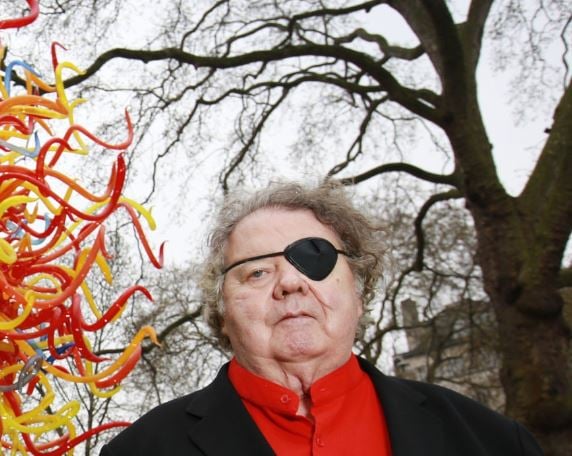
In 1976, Chihuly was involved in a serious automobile accident while visiting England. He was thrown through a windshield, sustaining severe facial injuries and permanently losing vision in his left eye. The accident left him with the distinctive eyepatch that became part of his public appearance.
He recovered and continued blowing glass, but in 1979 he dislocated his right shoulder while bodysurfing. The injury made it difficult to handle the heavy glassblowing pipes required to create large sculptures.
Rather than abandon his artistic career, Chihuly began directing other glassblowers. He developed concepts, selected colors, produced drawings, and supervised teams of artists who physically created the pieces.
The transition ultimately expanded his creative possibilities. With multiple specialists working simultaneously, he could undertake enormous installations that would have been impossible for a single glassblower to produce.
His approach also generated controversy within the art world. Critics questioned whether works fabricated by teams should carry only Chihuly's name, while supporters compared his practice to established artists who relied on studio assistants and specialized fabricators.
Major Installations and International Fame
During the 1980s and 1990s, Chihuly expanded beyond individual glass vessels into increasingly elaborate sculptural installations. His major series included "Seaforms," "Macchia," "Persians," "Venetians," "Niijima Floats," and "Chandeliers."
His international breakthrough came with "Chihuly Over Venice," a project developed between 1995 and 1996. Chihuly and his team created enormous glass chandeliers in workshops across Finland, Ireland, and Mexico before installing 14 sculptures throughout Venice. The project was documented for television and introduced his work to a much broader international audience.
In 1999, he presented "Chihuly in the Light of Jerusalem" at the Tower of David Museum. The exhibition drew more than one million visitors and became one of the most successful temporary art exhibitions of its period.
Chihuly subsequently developed major exhibitions at institutions including the Victoria and Albert Museum in London, the de Young Museum in San Francisco, the Museum of Fine Arts in Boston, and the New York Botanical Garden.
He also pioneered large-scale glass installations in botanical gardens, creating colorful sculptures that interacted with trees, flowers, ponds, and other natural surroundings. His garden exhibitions became a particularly successful part of his international career.
In 2026, Chihuly returned to Venice for a major exhibition celebrating the 30th anniversary of "Chihuly Over Venice," with three new monumental sculptures installed along the Grand Canal.
Bellagio's $10 Million Glass Ceiling
One of Chihuly's most famous commissions came from casino developer Steve Wynn, who hired him to create a monumental glass installation for the Bellagio hotel in Las Vegas.
The resulting sculpture, "Fiori di Como," was installed in the hotel's lobby in 1998. Inspired by the flowers of Italy's Lake Como, the installation contains more than 2,000 individually blown glass blossoms suspended from the ceiling. It covers approximately 2,100 square feet and weighs roughly 40,000 pounds, supported by an enormous steel framework.
The project required nearly two years of work and involved more than 100 artisans, engineers, architects, and installers. Its total cost has been reported at approximately $10 million, although the exact commission amount was never publicly disclosed.
The Bellagio installation became one of the most photographed pieces of public art in Las Vegas and generated additional commercial opportunities. In 2001, Chihuly opened a retail gallery inside the hotel, offering glass sculptures priced from $2,500 to $65,000.
The project demonstrated that Chihuly could successfully market his work not only to traditional museums and private collectors but also to luxury hotels, casinos, corporate clients, and developers.
Art Sales, Commissions, and the Chihuly Business Empire
Chihuly's financial success has been built around an unusually sophisticated business model. In 1985, he established Chihuly Inc., eventually creating an organization that combined glass production, exhibition management, publishing, direct sales, and marketing.
A major Seattle Times investigation published in 2006 described how Chihuly developed a nationwide sales network, cultivated collectors, and marketed his art through galleries while also selling directly from his own studios. His publishing operation, Portland Press, produced art books, documentaries, prints, and other products that increased his visibility and generated additional revenue.
At its peak during the late 1990s, Chihuly's organization employed roughly 150 people, along with independent contractors. His studio also developed a substantial inventory of finished sculptures and glass components, allowing it to supply exhibitions and commissions around the world.
Among his most lucrative publicly documented projects was "Fireworks of Glass," a 43-foot installation commissioned by the Children's Museum of Indianapolis for $4.5 million. Completed in 2006, the sculpture contains thousands of individual glass elements and remains one of the museum's signature attractions.
Chihuly also developed a profitable traveling exhibition business. According to the Seattle Times, elaborate exhibitions could command rental fees reaching $500,000. These exhibitions generated additional opportunities to sell artwork, books, prints, and merchandise.
Historical reporting has also cited a figure of approximately $29 million in estimated sales for his business in 2004. The operation carried substantial expenses, including the wages of specialized glassblowers, warehouse and studio costs, shipping, insurance, installation, and international travel.
His wife, Leslie Jackson Chihuly, eventually assumed a leading role in managing the enterprise and serves as president and CEO of Chihuly Studio and Chihuly Workshop.
Getty
Artwork Values and Auction Records
Chihuly's original glass works have developed a substantial international collector market. Prices vary dramatically depending on size, rarity, age, and whether a piece was produced as a unique sculpture or part of a studio edition.
Smaller glass vessels frequently sell at auction for several thousand dollars, while larger multi-piece works, chandeliers, and architectural installations can command six-figure prices.
In 2022, a "Persian Ceiling Installation" sold through Rago Auctions for $200,000. Other major works have achieved comparable results, including a chandelier that sold for $166,400 during the 2025–2026 auction period.
His studio also sells limited-edition glass works, drawings, and prints. These smaller pieces make Chihuly's art accessible to a wider range of collectors than the enormous installations commissioned by hotels and museums.
Real Estate and Studio Properties
Chihuly has accumulated several important commercial properties that support his artistic business. In 1985, he purchased the former Buffalo Shoe Company building in Seattle and converted it into a studio.
In 1989, he acquired another historic industrial property overlooking Lake Union. Known as the Pocock Building, it had previously housed the workshop of legendary racing-shell designer George Pocock. Chihuly renovated the property and renamed it "The Boathouse," transforming it into one of his principal glassblowing facilities.
He later acquired an industrial building in Seattle's Ballard neighborhood that became an important center for designing, assembling, and displaying large-scale sculptures. His operations also expanded into Tacoma, where additional studio and storage facilities support the business.
These properties have become integral to the production and commercial presentation of Chihuly's artwork. His Ballard studio includes carefully designed viewing rooms where prospective collectors can examine finished sculptures in gallery-like surroundings.
In 2012, the permanent exhibition "Chihuly Garden and Glass" opened next to Seattle's Space Needle. Featuring eight galleries, a glasshouse, and an outdoor garden, the attraction displays an extensive collection of his work. The facility was privately developed and funded by Center Art LLC, a company affiliated with the owners of the Space Needle, rather than being a museum personally owned by Chihuly.
Lawsuits and Authorship Disputes
Chihuly's business practices have occasionally generated legal disputes, particularly involving the rights of collaborators and artists producing work in similar styles.
In 2005, he filed a copyright and trademark infringement lawsuit against former employee Bryan Rubino and businessman Robert Kaindl, alleging that their glass sculptures improperly imitated his designs. The disputes were eventually settled.
A more serious controversy emerged in 2017 when former contractor Michael Moi filed a lawsuit claiming that he had contributed to hundreds of paintings attributed to Chihuly without receiving appropriate credit or compensation.
Before filing suit, Moi demanded $21 million to resolve his claims. Chihuly and his company denied the allegations and argued that Moi had never been a co-author of the disputed artwork.
In June 2019, a federal judge dismissed Moi's claims. The court subsequently awarded Chihuly and his co-defendants $1,646,659.68 in attorney's fees and costs. In March 2021, the Ninth Circuit Court of Appeals upheld the judgment, affirming the defendants' victory.
Personal Life and Philanthropy
Chihuly married Leslie Jackson in 2005. The couple have a son, Jackson Viola Chihuly, who was born in 1998. They live in Seattle, where Chihuly maintains close connections to the city's arts community.
Chihuly has spoken publicly about living with bipolar disorder and the periods of depression that have affected his career. Despite these challenges, he has continued developing new installations and supervising his studio's artistic production.
Alongside his wife, he established the Dale and Leslie Chihuly Foundation in 2009 to support artists, arts education, and cultural organizations. The foundation's charitable activities have expanded substantially, with grants totaling $744,400 in 2025. Beneficiaries have included educational organizations, performing arts institutions, and programs supporting artists and underserved communities.
Over a career spanning more than six decades, Chihuly has received numerous honors, including National Endowment for the Arts fellowships and honorary doctorates. His greatest achievement has been establishing glass as a medium capable of supporting monumental works of fine art while building a worldwide commercial enterprise around his unmistakable artistic style.


