
/2019/11/Frank-Costello2.png)
/2020/06/bs.jpg)
/2014/06/GettyImages-52030444.jpg)
/2018/10/paul-castellano.jpg)
/2021/11/john-gotti-jr.png)
/2009/12/Meyer-Lansky.jpg)
/2019/04/rr.jpg)
/2020/01/lopez3.jpg)
/2018/03/GettyImages-821622848.jpg)
/2019/11/GettyImages-1094653148.jpg)
/2009/09/Brad-Pitt.jpg)
/2017/02/GettyImages-528215436.jpg)
/2020/02/Angelina-Jolie.png)
/2020/04/Megan-Fox.jpg)
/2009/09/Cristiano-Ronaldo.jpg)
:strip_exif()/2015/09/GettyImages-476575299.jpg)
/2009/11/George-Clooney.jpg)
What was Frank Costello's net worth?
Frank Costello was an Italian-American Mafia gangster and crime boss who had a net worth of $150 million at the time of his death in 1973. That's the same as $1 billion in today's dollars after adjusting for inflation. At the peak of his success, his illicit empire generated the equivalent of $60 billion (after adjusting for inflation) in revenue.
Known as "The Prime Minister of the Underworld," Costello was less interested in violence and more in politics, connections, and long-term influence. He served as head of the powerful Luciano crime family (later known as the Genovese family) and helped shape the modern American Mafia's structure, including the formation of the national "Commission" that oversaw inter-family relations. Unlike many of his contemporaries, Costello preferred diplomacy over bloodshed and cultivated alliances with business and political leaders, effectively blurring the lines between legitimate power and criminal enterprise. His ability to operate both in the shadows and in respectable society made him a unique figure in Mafia history, and his life helped inspire multiple Hollywood portrayals of the suave, strategic mob boss archetype.
Early Life
Frank Costello was born Francesco Castiglia on January 26, 1891, in Lauropoli, a village in southern Italy's Calabria region. His family immigrated to the United States when he was four years old, settling in East Harlem, New York City. Like many poor Italian immigrant families at the time, the Castiglias faced harsh economic conditions, and young Frank quickly gravitated toward the local street gangs that dominated his neighborhood. By his teenage years, he was already committing petty crimes, including robbery and assault.
In 1918, after multiple arrests, he was sentenced to a year in prison. Upon his release, Costello decided to give up violent street crime and focus on more profitable and sophisticated forms of criminal activity. Around this time, he began using the name "Frank Costello," a more Americanized version that helped him blend into legitimate society. He soon joined the powerful criminal organization led by Charlie "Lucky" Luciano and embarked on a career that would define the next three decades of organized crime in America.
Rise in Organized Crime
Costello's rise coincided with the Prohibition era, when the nationwide ban on alcohol created massive opportunities for bootlegging. Working under Luciano and alongside associates like Meyer Lansky and Benjamin "Bugsy" Siegel, Costello managed large-scale liquor smuggling and distribution operations. His calm demeanor, intelligence, and gift for negotiation set him apart from more violent contemporaries.
By the early 1930s, Costello was deeply involved in Luciano's national crime syndicate, helping to reorganize the fragmented Mafia families into a structured system with clear territories and leadership. When Luciano established the Mafia's governing body—the Commission—after the bloody Castellammarese War, Costello became one of its most trusted members. His influence extended beyond organized crime, as he forged relationships with politicians, judges, and police officials, particularly through control of gambling interests in New York and Louisiana.
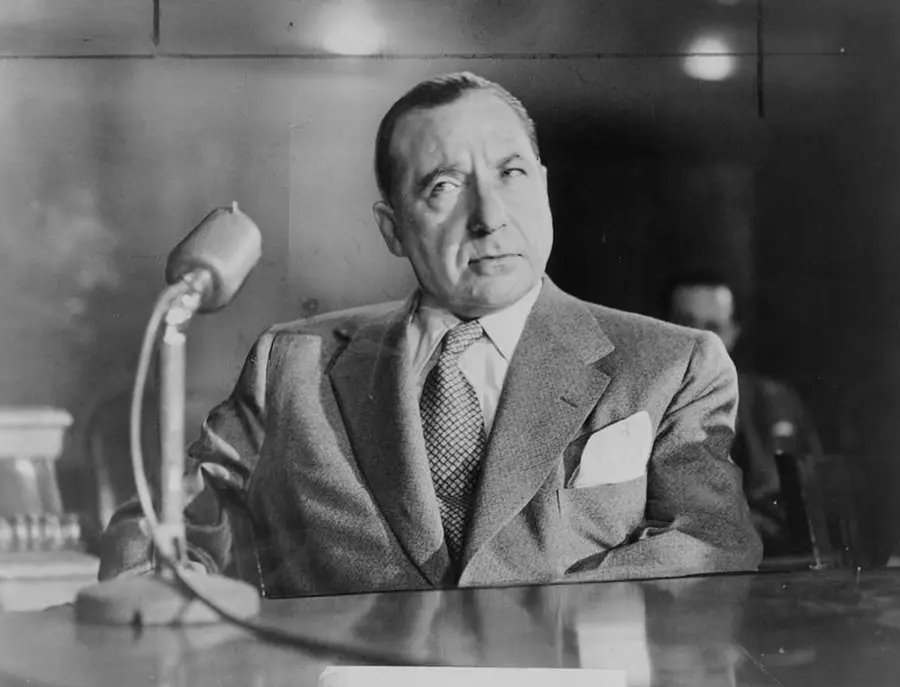
Creative Commons via Public Domain
The Prime Minister of the Underworld
Costello's reputation for diplomacy and strategy earned him the nickname "The Prime Minister of the Underworld." While others sought dominance through violence, Costello preferred persuasion, money, and political power. He built extensive gambling operations across the country, from New York to New Orleans, and maintained a low profile that kept him out of the public eye—until the late 1940s.
When Lucky Luciano was imprisoned in 1936, Costello became acting boss of the Luciano family. Under his leadership, the organization shifted its focus from bootlegging to more sustainable ventures like gambling, construction, and labor racketeering. Costello's era was one of relative peace and prosperity within the Mafia, and he became the public face of organized crime during the early postwar years.
In 1951, his national prominence peaked during the televised Kefauver Hearings, a U.S. Senate investigation into organized crime. Millions of Americans watched as Costello testified, often refusing to answer questions and famously walking out when pressed too hard. Although he was never convicted of major crimes during this period, the hearings cemented his image as the archetypal mob boss—polished, calculating, and untouchable.
Decline and Power Struggles
Despite his political connections and careful image, Costello's position began to erode in the 1950s. The ambitious Vito Genovese, who had long resented Costello's leadership, returned from exile in Italy and began plotting to take control of the family. In 1957, Genovese ordered a hit on Costello. The would-be assassin, Vincent "Chin" Gigante, shot Costello outside his Manhattan apartment but only grazed his head. When questioned, Costello refused to identify his attacker, reportedly telling police, "I know who it was. No hard feelings."
After the attempt, Costello decided to retire from active leadership, effectively ceding power to Genovese. He remained a respected elder statesman within the Mafia but gradually withdrew from criminal operations. In later years, he focused on his legitimate investments, including real estate and stock holdings, which provided him with substantial income and protection from further prosecution.
Later Life and Legacy
Frank Costello lived quietly in retirement during the 1960s and early 1970s, maintaining his residence at the luxurious Waldorf Towers in Manhattan. Though semi-retired, he continued to wield influence behind the scenes and was often consulted by younger mob leaders for advice. Costello died on February 18, 1973, at the age of 82.
His legacy endures as one of the most complex and influential figures in organized crime history. Unlike the more violent figures who followed him, Costello demonstrated that money and connections could be more powerful than guns. He helped institutionalize the Mafia's infiltration of politics and legitimate business, laying the groundwork for decades of organized corruption. His life inspired numerous fictionalized portrayals, including the character of Vito Corleone in "The Godfather" and Frank Costello (played by Jack Nicholson) in "The Departed," whose name was an intentional nod to the real mob boss.
Frank Costello's career remains a study in the intersection of crime, power, and respectability—a man who rose from a poor immigrant background to become one of the most politically connected gangsters in American history, and one who proved that sometimes the most dangerous weapon in organized crime was not violence, but influence.
/2019/11/Frank-Costello2.png)
/2009/12/Meyer-Lansky.jpg)
/2019/02/carlo2.jpg)
/2021/02/gotti.jpg)
/2014/06/GettyImages-52030444.jpg)
/2021/09/al-capone.jpg)
/2014/08/nb.png)
/2009/09/Jennifer-Aniston.jpg)
/2019/10/denzel-washington-1.jpg)
/2020/06/taylor.png)
:strip_exif()/2009/09/P-Diddy.jpg)