
/2016/05/GettyImages-180366422.jpg)
/2010/07/GettyImages-91756929.jpg)
/2022/05/John-Doerr.jpg)
/2014/04/Jim-Breyer.jpg)
/2010/07/GettyImages-180366336.jpg)
/2022/02/andy.jpg)
:strip_exif()/2015/09/GettyImages-476575299.jpg)
/2009/09/Brad-Pitt.jpg)
/2020/06/taylor.png)
/2019/04/rr.jpg)
/2020/04/Megan-Fox.jpg)
:strip_exif()/2009/09/P-Diddy.jpg)
/2019/11/GettyImages-1094653148.jpg)
/2009/09/Cristiano-Ronaldo.jpg)
/2020/02/Angelina-Jolie.png)
/2009/09/Jennifer-Aniston.jpg)
/2020/01/lopez3.jpg)
What Is Vinod Khosla's Net Worth?
Vinod Khosla is an Indian-American entrepreneur and venture capitalist who has a net worth of $9 billion. Vinod Khosla is one of Silicon Valley's most influential venture capitalists and entrepreneurs. He co-founded Sun Microsystems in 1982 with Andy Bechtolsheim and Scott McNealy, serving as the company's first CEO and helping build it into a major computer hardware and software corporation.
In 1986, he joined the venture capital firm Kleiner Perkins as a general partner, where he played key roles in helping develop major technology companies through the 1980s and 1990s. During his time there, he developed a reputation for backing early-stage technology companies and clean technology initiatives. In 2004, Khosla founded his own venture capital firm, Khosla Ventures, which focuses on investing in both traditional technology companies and clean technology startups. The firm has invested in numerous successful companies across sectors, including technology, healthcare, food, agriculture, and sustainable energy.
Known for his contrarian views and willingness to take bold bets, Khosla has been particularly passionate about clean technology and renewable energy investments. He has backed numerous companies working on biofuels, solar technology, batteries, and other sustainable technologies. His career has significantly influenced Silicon Valley's venture capital landscape and the development of both enterprise technology and clean tech sectors.
Martin's Beach Dispute
Vinod is somewhat infamous for his involvement in the "Martin's Beach" dispute, a long-running legal battle between Khosla and the State of California regarding public access to Martin's Beach, near Half Moon Bay. Khosla purchased the land adjacent to the beach in 2008 for $32.5 million. The property features an access trail that is the only way to reach the beach by land. The people who previously owned Vinod's property (for 100 years) allowed members of the public to use the trail. Khosla began locking a gate to the trail in 2010, effectively cutting off all access to the beach. The Surfrider Foundation sued Khosla in 2013, arguing that under the California Coastal Act, he needed to obtain a permit before blocking access to the beach. A series of legal battles ensued. In 2017, the state of California moved to seize the disputed property. Vinod bitterly fought that seizure. In 2018, he took the battle all the way up to the US Supreme Court. After the Supreme Court declined to hear his case, he was sued once again by the state of California.
The case highlighted tensions between private property rights and California's public coastal access laws.
In October 2019, Khosla ultimately reached a settlement agreement with the California Coastal Commission and the State Lands Commission. The agreement requires him to:
- Keep the road open to the public during daylight hours
- Provide public parking
- Charge a reasonable fee for access (similar to what previous owners charged)
The settlement effectively restored the public's right to access Martin's Beach, similar to how it had been for decades before Khosla's purchase of the property. While Khosla maintains ownership of the land, he must ensure public beach access, reflecting California's strong legal protections for public coastal access.
Early Life
Vinod Khosla was born on January 28, 1955, in New Delhi, India. His father served as an officer in the Indian Army and hoped that Vinod would someday join the army as well. Khosla attended elementary school at Mount St Mary's School, and as a teenager, he was inspired to pursue a career in technology after reading an "Electronic Engineering Times" article about the founding of Intel. In 1976, he earned a bachelor's degree in electrical engineering from IIT Delhi, where he started a club for computer programming. When the school's computer center staff went on strike, Vinod operated the center in their absence.
As a teenager, he wrote a paper about parallel processing before the IT industry adopted the concept, and he was later involved in launching India's first biomedical engineering program. In 1975, Khosla tried to start a company that would provide soy milk to Indian consumers who did not own refrigerators and could not preserve cow milk. After graduating from IIT Delhi, he received a full scholarship to Carnegie Mellon University in Pittsburgh, Pennsylvania, and earned a master's degree in biomedical engineering. Vinod applied to the MBA program at Stanford University, but he was not accepted because he didn't have enough work experience. He worked two full-time jobs to get the required two years of work experience, but he was rejected again. Three weeks into studying for his MBA at Carnegie Mellon, Khosla talked the Stanford admissions staff into accepting him, and he earned an MBA from their Graduate School of Business in 1980.
Sun Microsystems
After earning his MBA, Vinod became the Chief Financial Officer of the computer-aided engineering company Daisy Systems, which spent the majority of its resources building custom computer hardware that would be able to run its software. Khosla left Daisy Systems in order to focus on creating a company that made general purpose computers. In 1982, he approached his fellow Stanford alum Scott McNealy about helping launch and guide a small technology business that was to be called Sun Microsystems. The "SUN" in the name was actually a reference to the "Stanford University Network" computer workstation that was developed by another Sun Microsystems co-founder, Andy Bechtolsheim, while they were both graduate students.
Vinod served as Sun Microsystems' CEO, and the company was profitable within its first year. McNealy became CEO of the company in 1984 after Khosla left to pursue venture capitalism. Sun Microsystems IPO'd in 1986 under the ticker symbol "SUNW," which was changed to "JAVA" in 2007. Sun Microsystems, like most tech companies, experienced a wild surge in business during the dotcom boom of the late 1990s and early 2000s. The company retracted in the bubble's aftermath. The stock plummeted from over $100 a share at the bubble's peak in 2001 to less than $10 a share in 2002. Fortunately, the company recovered slowly but surely. In January 2010, Sun Microsystems was acquired by Oracle Corporation for $7.4 billion.
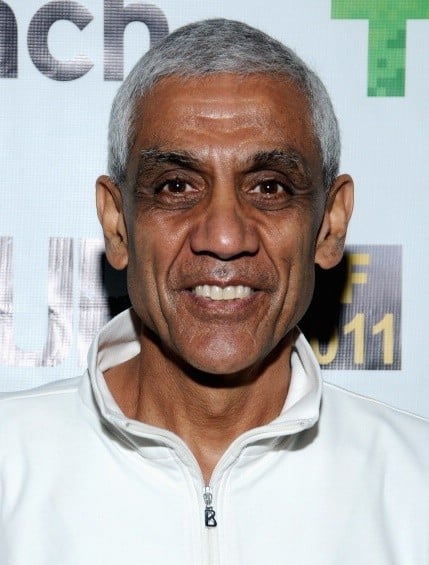
Araya Diaz/Getty Images
Venture Capital Career
In 1986, Vinod became a general partner at the Kleiner Perkins venture capital firm, where he was tasked with managing investments in technologies. During the early years of his career, he also invested in SKS Microfinance, a company that gave small loans to underprivileged women in rural India. In 2004, Khosla went part-time at Kleiner Perkins in order to spend more time with his children, and he eventually left the firm. Later that year, he established Khosla Ventures, which "provides venture assistance and strategic advice to entrepreneurs working on breakthrough technologies." According to the Khosla Ventures website, the firm manages more than $15 billion in assets and focuses on areas such as semiconductors, robotics, and sustainable energy. Khosla Ventures has incubated the companies QuantumScape (solid-state batteries), LanzaTech (carbon recycling technology), and Impossible Foods (plant-based meat products). In 2018, Vinod stated that he wanted to use technology and innovation to "reinvent societal infrastructure," and the following year, he presented the video "Amazing: What KV Founders are Doing" to showcase portfolio companies that were reinventing areas including infrastructure, transportation, health, and artificial intelligence.
49ers Purchase
In 2025, Khosla agreed to purchase a 3.1% minority stake in the San Francisco 49ers at a team valuation of $8.5 billion. Khosla's share of the deal cost roughly $263.5 million. Two other prominent Bay Area investors bought slightly smaller stakes at the same time. It marked Khosla's first foray into professional sports ownership and aligned with a growing trend of Silicon Valley billionaires investing in NFL franchises.
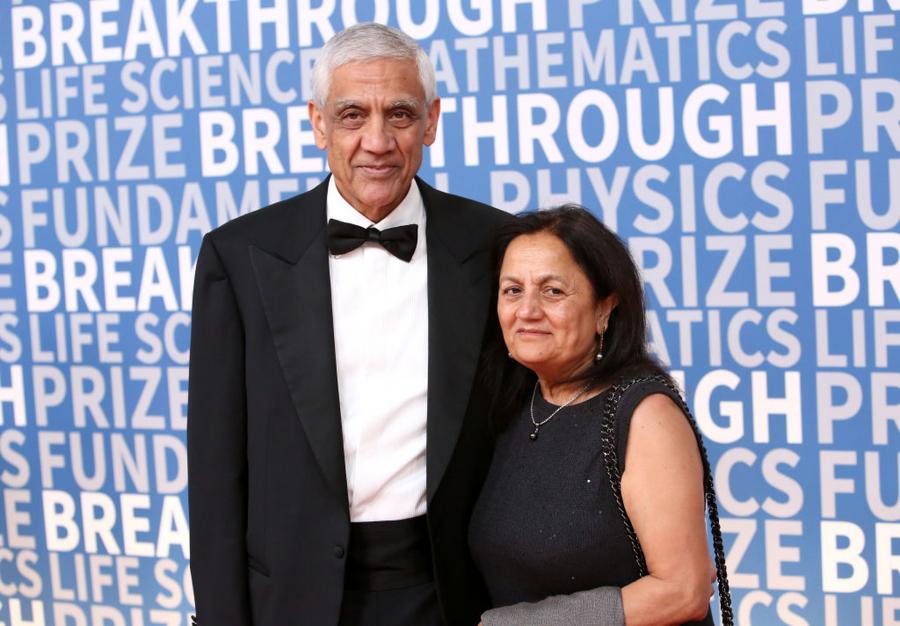
Jesse Grant/Getty Images
Personal Life
Vinod married his childhood sweetheart, Neeru, in 1980, and they have four children: Vani, Nina, Neal, and Anu. Neeru is the co-founder of the non-profit organization CK-12 Foundation, which is dedicated to "increasing access to high-quality K-12 STEM education materials." Khosla was the honorary chair of the advisory board for DonorsChoose in the San Francisco Bay area.
He was honored with the American Academy of Achievement's Golden Plate Award in 2000, and in 2007, he received the EY Entrepreneur of the Year award for Northern California. Vinod has served as an advisor for the website HackerRank and a member of the board of trustees at Carnegie Mellon University and the University of California, Berkeley's Blum Center for Developing Economies.
He co-founded the Silicon Valley non-profit organization The Indus Entrepreneurs (TiE), and he is a member of the Breakthrough Energy Ventures board. In April 2021, in response to the ongoing COVID-19 pandemic, Khosla tweeted, "I'm willing to fund hospitals in India that need funding to import bulk planeloads of oxygen or supplies into India to increase supply." He stated that he would be coordinating grants through the donation platform, the Give India Foundation. In 2008, Vinod and Neeru donated $500,000 to the Wikimedia Foundation. Khosla is a Democrat, and in 2013, he hosted a fundraising dinner for Barack Obama at his Portola Valley home. He endorsed Hillary Clinton in the 2016 presidential election.
/2016/05/GettyImages-180366422.jpg)
/2022/02/andy.jpg)
/2014/06/GettyImages-450492462.jpg)
/2010/07/GettyImages-91756929.jpg)
/2025/05/GettyImages-1964156308.jpg)
/2017/08/GettyImages-455060868.jpg)
/2015/12/GettyImages-167842816.jpg)
/2018/03/GettyImages-821622848.jpg)
/2009/11/George-Clooney.jpg)
/2019/10/denzel-washington-1.jpg)