
/2013/03/Stef-Wertheimer.png)
/2013/05/rahmi.jpg)
/2020/01/Qaboos-bin-Said-Al-Said-of-Oman.png)
/2009/09/Warren-Buffett.jpg)
/2010/11/ajit-jain-1.jpg)
/2020/06/taylor.png)
/2020/02/Angelina-Jolie.png)
/2019/11/GettyImages-1094653148.jpg)
/2017/02/GettyImages-528215436.jpg)
/2020/04/Megan-Fox.jpg)
/2019/10/denzel-washington-1.jpg)
/2018/03/GettyImages-821622848.jpg)
:strip_exif()/2009/09/P-Diddy.jpg)
:strip_exif()/2015/09/GettyImages-476575299.jpg)
/2009/11/George-Clooney.jpg)
/2009/09/Cristiano-Ronaldo.jpg)
/2009/09/Jennifer-Aniston.jpg)
What was Stef Wertheimer's net worth?
Stef Wertheimer was an Israeli industrialist, entrepreneur, philanthropist, and nation-building visionary who had a net worth of $10 billion at the time of his death. That made him one of the richest people in Israel.
Stef Wertheimer's career helped shape the foundation of Israel's manufacturing economy. He founded Iscar Metalworking, a precision cutting tool company that began in a small shack in the Galilee and evolved into one of the most advanced industrial groups in the world. Warren Buffett famously purchased 80% of Iscar for $4 billion after receiving nothing more than a short letter from Stef's son, later acquiring the remaining 20% in a transaction that valued the company at roughly $6 billion. Wertheimer spent decades promoting the transformative power of industry, believing that manufacturing created shared prosperity, reduced tension, and strengthened society. He used his wealth to build industrial parks across Israel's underdeveloped regions and became one of the country's most influential advocates for coexistence through economic opportunity. Beyond business, he served in the Knesset, received the Israel Prize, and published writings that reflected both a builder's mindset and an immigrant's determination. By the time of his death at 98, Wertheimer had become not only one of Israel's wealthiest individuals, but one of its most consequential architects of socioeconomic development.
Early Life
Stef Wertheimer was born on July 16, 1926, in Kippenheim, a town in Germany's Black Forest region. He was the eldest of three children and described himself as a restless and rebellious child. After the passage of the Nuremberg Laws stripped Jews of citizenship, his family fled Germany and immigrated to Palestine in 1937. Wertheimer arrived in Tel Aviv as an 11-year-old who spoke little Hebrew and wore clothing that caused him to be mocked by classmates, an experience that shaped both his toughness and his drive.
He was expelled from junior high school after punching a teacher who had humiliated students. With limited money and little formal education, his parents sent him to work instead of returning him to school. Wertheimer found jobs in optician shops and optics laboratories, where he learned the mechanical skills that became the bedrock of his career. He later trained as a technician with the British Royal Air Force and completed high-school courses at night.
Military Service and Early Technical Work
In 1945, Wertheimer joined the Palmach, the elite strike force of the Haganah. He trained as a pilot, helped manufacture arms, and served as a demolition officer during the final years of the British Mandate. These experiences deepened his appreciation for hands-on production and the importance of technical capability to a nation's survival. After the establishment of the State of Israel, he continued working in mechanical trades, gaining expertise in optics, machining, and repairs. Those skills would lead directly to the project that defined his life.
Founding of Iscar Metalworking
In 1952, Wertheimer opened a small cutting tool workshop in the Galilee. The business began with minimal equipment and almost no outside capital. He named it Iscar, short for Israel Carbides. At a time when Israel's industrial base was extremely limited, Wertheimer believed that a self-reliant manufacturing sector was essential for both economic strength and national security.
Iscar grew steadily by focusing on precision metalworking tools needed by automakers, aerospace firms, and heavy manufacturers around the world. Wertheimer expanded internationally, purchasing factories in countries such as South Korea and Japan. By the early 1980s, Iscar had become one of the world's leaders in advanced cutting technology.
A serious car accident in 1983 led Wertheimer to hand day-to-day control of the company to his son, Eitan, though Stef remained chairman for 15 years. In 2006, Warren Buffett's Berkshire Hathaway purchased 80% of Iscar for $4 billion, marking the conglomerate's first major acquisition outside the United States. Buffett later bought the remaining 20% in 2013 for roughly $2 billion, praising both the company and its founder as extraordinary. Iscar became the largest component of the IMC Group, an umbrella of 15 metalworking companies.
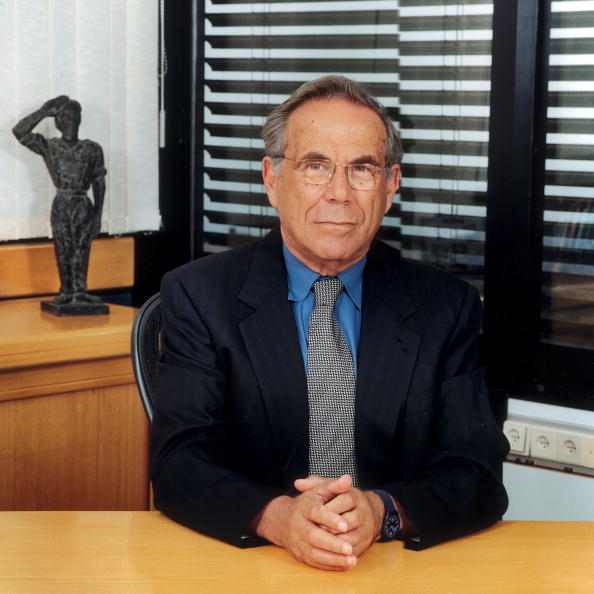
Getty Images
Political Career
Wertheimer briefly entered Israeli politics in the late 1970s. In 1977, he helped found the Democratic Movement for Change and was elected to the Knesset. He spent nearly four years pushing for industrial development policies, but eventually left politics after becoming frustrated with the government's lack of support for manufacturing initiatives. Though his political tenure was short, it reinforced his belief that private enterprise and industrial investment were more effective tools for shaping national progress.
Industrial Parks and Coexistence Efforts
In the 1980s, Wertheimer embarked on what he considered his most important mission: using industry to bridge social and economic divides. He invested roughly $90 million of his own funds to build a series of industrial parks in underserved regions, beginning with Tefen Park in the western Galilee. The parks offered infrastructure, training facilities, and shared resources for manufacturing companies, encouraging job creation in areas with limited opportunities.
He later built parks in the Negev and in Arab-majority regions of northern Israel. Although plans to create twin parks in Israel and the West Bank ultimately faltered during the Palestinian uprising, Wertheimer remained convinced that manufacturing jobs could reduce conflict by providing shared economic incentives. He also partnered with a Turkish business leader to build a park in Turkey, extending his vision beyond Israel's borders.
Awards, Writings, and Public Influence
In 1991, Wertheimer received the Israel Prize, the country's highest civilian honor, recognizing his contributions to industry, employment, and national development. He later published his autobiography, "Man at a Machine," which chronicled his life as a builder and immigrant.
Wertheimer often warned that Israel's focus on technology startups risked overshadowing the importance of manufacturing. In interviews, he emphasized that long-term stability required producing export goods, not only innovating them. His perspective was grounded in decades of hands-on industrial experience and a belief that prosperity must be broad-based.
Personal Life and Death
Wertheimer's private life remained relatively quiet despite his public stature. He was married, had children and grandchildren, and maintained close ties to the northern communities where he built his factories and parks. His son Eitan, who succeeded him at Iscar, died in 2022.
Stef Wertheimer died peacefully in his sleep at 98. He left behind an industrial empire, a model for sustainable economic development, and a legacy defined by action, conviction, and a lifelong belief that nations are strengthened by the people who build things.
/2013/03/Stef-Wertheimer.png)
/2013/05/rahmi.jpg)
/2009/12/King-Hassan-II.png)
/2009/09/Jay-Rockefeller.png)
/2025/02/missing_profile.jpg)
/2025/11/legoland.jpg)
/2014/04/Mo-Ibrahim.jpg)
/2019/04/rr.jpg)
/2009/09/Brad-Pitt.jpg)