
/2015/06/sandy-weil.jpg)
/2010/09/Richard-Fuld.jpg)
/2014/06/Wilma-Tisch.png)
/2014/08/jimmy-cayne.jpg)
/2009/10/Eli-Broad.jpg)
/2010/01/dimon.jpg)
/2009/09/Brad-Pitt.jpg)
/2020/04/Megan-Fox.jpg)
/2020/06/taylor.png)
/2009/09/Cristiano-Ronaldo.jpg)
/2009/11/George-Clooney.jpg)
/2017/02/GettyImages-528215436.jpg)
/2019/10/denzel-washington-1.jpg)
/2018/03/GettyImages-821622848.jpg)
/2009/09/Jennifer-Aniston.jpg)
:strip_exif()/2009/09/P-Diddy.jpg)
/2020/02/Angelina-Jolie.png)
What Is Sandy Weill's Net Worth?
Sandy Weill is an American banker, financier, and philanthropist who has a net worth of $1 billion.
From 1998 to 2003, Sandy Weill was the chief executive at Citigroup, and from 1998 until 2006, he was the chairman of the company.
Weill graduated from Cornell University and got his first job on Wall Street in 1955 with Bear Stearns. After starting out as a runner, he became a licensed broker. In 1960, he co-founded the firm Carter, Berlind, Potoma & Weill, which eventually became Shearson Loeb Rhoades. Sandy sold the company to American Express in 1981 for around $930 million in stock. He served as president of American Express Co. In 1986, he invested $7 million of his own money and became CEO of Commercial Credit. He paid $1.5 billion for Primerica in 1987 and paid $722 million for a 27% share of Travelers Insurance in 1992. As a philanthropist, Weill has donated millions of dollars to education, music, and medicine. In 1997, he received the American Academy of Achievement's Golden Plate Award.
Early Life
Sandy Weill was born Sanford I. Weill on March 16, 1933, in Brooklyn, New York City. He is the son of Polish Jewish immigrants Max and Etta Weill. Sandy attended P.S. 200 for elementary school, followed by Peekskill Military Academy in upstate New York. He later enrolled at Cornell University, where he was a member of the Alpha Epsilon Pi fraternity and the U.S. Air Force ROTC. Weill earned a Bachelor of Arts degree in government in 1955. Sandy has said that his middle initial isn't an abbreviation for anything, stating:
"My mother wanted to name me after somebody whose name started with an 'I,' but she couldn't think of a name she liked. So she gave me the initial with the idea that after I was 21 I could choose whatever middle name I wanted."
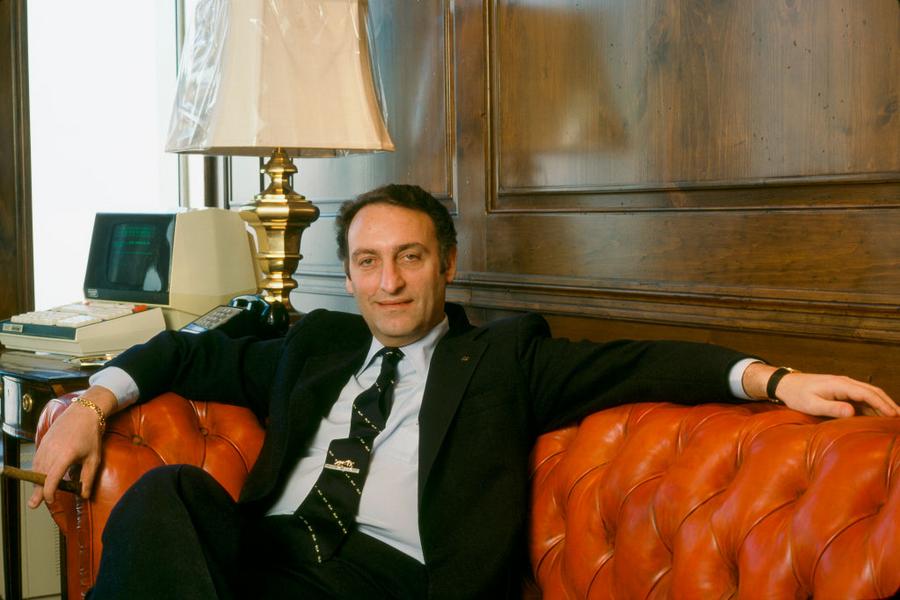
American banker and financier Sanford I. Weill, aka Sandy Weill, 1981. (Photo by Nancy R. Schiff/Getty Images)
Early Wall Street Career
Sandy Weill began his Wall Street career in 1955 as a runner at Bear Stearns. He became a licensed broker the following year, though it quickly became clear that his strengths lay less in sales and more in analyzing financial statements and corporate filings. Early on, his client list was sparse. For a time, his mother was his only customer until his future wife, Joan, persuaded an ex-boyfriend to open an account.
While at Bear Stearns, Weill formed a relationship with Arthur L. Carter, a neighbor who worked at Lehman Brothers. In May 1960, the two teamed up with Peter Potoma and Roger Berlind to launch Carter, Berlind, Potoma & Weill. After regulatory issues forced Potoma's departure, the firm was renamed Carter, Berlind & Weill in 1962. Over the following years, the partnership evolved as new principals joined, eventually becoming Cogan, Berlind, Weill & Levitt after Marshall Cogan and Arthur Levitt came aboard.
Building a Brokerage Empire
From 1965 to 1984, Weill served as chairman of the firm through a period of aggressive growth. During those years, it completed more than 15 acquisitions and grew into the second-largest securities brokerage in the United States. Through successive mergers and rebrandings, the firm operated under names that included CBWL-Hayden, Stone, Hayden Stone, Shearson Hayden Stone, and ultimately Shearson Loeb Rhoades.
In 1981, Weill sold Shearson Loeb Rhoades to American Express for approximately $915 million in stock, marking one of the most lucrative exits of his career and cementing his reputation as a master consolidator in financial services.
American Express and the Insurance Pivot
Following the sale, Weill took on senior leadership roles at American Express. In 1983, he became president of the parent company and the following year assumed the roles of chairman and CEO of Fireman's Fund Insurance, its insurance subsidiary. He resigned from American Express in 1985, setting the stage for his most ambitious chapter yet.
Commercial Credit, Travelers, and Citigroup
In 1986, Weill acquired Commercial Credit, a troubled subsidiary spun off from Control Data Corporation, for just $7 million. He quickly set about rebuilding the business and used it as a platform for a sweeping consolidation strategy. Over the next several years, he acquired Gulf Insurance, Primerica, and the retail brokerage operations of Drexel Burnham Lambert.
In 1992, Weill purchased a 27% stake in Travelers Insurance for $722 million, later gaining full control in a stock transaction and renaming the parent company Travelers Group. He continued assembling pieces of his former empire, buying back Shearson from American Express in 1993 for $1.2 billion.
The culmination came in 1998, when Travelers Group merged with Citicorp in a $76 billion deal to form Citigroup, at the time the largest financial services merger in history. Weill served as CEO during the company's formative years and was named CEO of the Year by "Financial World" in 1998 and by "Chief Executive" in 2002. He also served as a Class A director of the Federal Reserve Bank of New York beginning in 2001.
Later Career and Semi-Retirement
In 2003, Weill sold 5.6 million shares of Citigroup stock for nearly $264 million and entered semi-retirement. He remained on Citigroup's board of directors until 2006, closing out one of the most consequential careers in modern American finance.
Personal Life and Philanthropy
Sandy married Joan Mosher on June 20, 1955, and together they became among the most prolific philanthropists in the United States. Their giving has focused primarily on medicine, education, and the arts. In 1998, Weill endowed the medical school at his alma mater, Cornell University, which was renamed Weill Cornell Medical College. He serves as chairman of its Board of Overseers and is a Cornell trustee emeritus. Collectively, the Weills have donated at least $250 million to Cornell, including major gifts for the Weill Institute for Cell and Molecular Biology and the Weill Cornell Graduate School of Medical Sciences.
Beyond Cornell, Weill has served as a trustee of the Hospital for Special Surgery and NewYork-Presbyterian Hospital and has held leadership roles with University of California at San Francisco Medical Center. In 2016, the Weills pledged $185 million to UCSF to establish the Weill Institute for Neurosciences.
In January 2026, Sandy and Joan Weill announced a $120 million gift to the University of California at Davis School of Veterinary Medicine, one of the largest donations ever made to an animal medicine institution. The gift funded a major campus expansion, supported research in comparative medicine, and led to the school being renamed the UC Davis Weill School of Veterinary Medicine. The donation was inspired in part by the care the school provided to the couple's dog during treatment for lymphoma.
Weill also founded the National Academy Foundation and has long been active in public education initiatives, including the creation of the Academy of Finance in partnership with the New York City Board of Education. His honors include the Baruch Medal for Business and Civic Leadership, multiple honorary degrees, election to the American Academy of Arts and Sciences, and numerous arts and philanthropy awards. He serves as chairman of the Carnegie Hall Board of Trustees, where the Joan and Sanford I. Weill Recital Hall bears the couple's name.
Real Estate
In 2007, Weill and his wife, Joan, purchased a penthouse at 15 Central Park West for $43.7 million. In 2011, they sold it for a then-record $88 million to a company associated with Ekaterina Rybolovleva, daughter of Russian billionaire Dmitry Rybolovlev. The Weills pledged to donate the proceeds to charity. Additionally, in 2014, Weill sold a smaller unit in the same building—originally used as staff quarters—for $5.34 million, more than five times its 2007 purchase price.
In 2010, the Weills acquired a 362-acre estate in Sonoma Valley for approximately $31 million. The property includes a vineyard and a Tuscan-style main house, updated with the help of designer Mica Ertegun. The estate features artworks by Fernand Léger and Will Ryman. The Weills have been active in the local arts scene, donating $12 million to complete the Green Music Center at Sonoma State University.
Weill listed his 16,400-square-foot Greenwich estate for $14 million in 2014. The shingle-style mansion, designed by architect Ira Grandberg, sits on 6.3 acres and includes six bedrooms, nine full baths, a home theater, wine cellar, swimming pool, spa, and fitness room.
Beyond these notable transactions, the Weills have owned other properties, including a 120-acre estate in New York's Adirondacks and a villa in the Bahamas. Their real estate activities often align with their philanthropic endeavors, supporting institutions like Carnegie Hall and Weill Cornell Medical College.
/2015/06/sandy-weil.jpg)
/2010/01/dimon.jpg)
/2015/06/GettyImages-476582865.jpg)
/2009/12/Vikram-Pandit.jpg)
/2010/09/Richard-Fuld.jpg)
/2012/12/fisk.jpg)
/2010/07/hk-e1607290844168.jpg)
/2010/07/Maurice-R.-Greenberg.jpg)
/2020/01/lopez3.jpg)
:strip_exif()/2015/09/GettyImages-476575299.jpg)
/2019/04/rr.jpg)
/2019/11/GettyImages-1094653148.jpg)