
/2013/05/rahmi.jpg)
/2014/03/Ali-Yıldırım.jpg)
/2014/06/Wilma-Tisch.png)
/2014/01/GettyImages-131913470.jpg)
/2009/09/otto2.jpg)
/2020/06/taylor.png)
/2020/01/lopez3.jpg)
:strip_exif()/2015/09/GettyImages-476575299.jpg)
/2019/11/GettyImages-1094653148.jpg)
/2009/09/Brad-Pitt.jpg)
/2020/02/Angelina-Jolie.png)
/2019/10/denzel-washington-1.jpg)
/2017/02/GettyImages-528215436.jpg)
:strip_exif()/2009/09/P-Diddy.jpg)
/2009/09/Cristiano-Ronaldo.jpg)
/2018/03/GettyImages-821622848.jpg)
/2009/09/Jennifer-Aniston.jpg)
What is Rahmi Koç's net worth?
Rahmi M. Koç is a Turkish billionaire industrialist and philanthropist who has a net worth of $2.5 billion. For most of his adult life, Rahmi has been one of the richest people in Turkey.
Rahmi M. Koç is best known for transforming Koç Holding into the dominant private-sector conglomerate in Turkey and one of the most respected family-controlled business groups in the emerging world. As the eldest son of Koç Holding founder Vehbi Koç, Rahmi Koç inherited not just a vast enterprise but the responsibility of modernizing it during a period of enormous economic, political, and technological change. Over a career spanning more than half a century, he oversaw the group's expansion into automotive manufacturing, energy, finance, consumer goods, and heavy industry, while deepening partnerships with global corporations such as Ford and Fiat. Unlike many heirs of large family businesses, Koç earned a reputation as a hands-on operator and institutional builder, helping professionalize management and embed corporate governance practices that allowed the group to scale globally. His influence extends well beyond business, encompassing philanthropy, cultural preservation, and civic leadership, making him one of the most consequential figures in modern Turkish economic history.
Early Life and Education
Rahmi Mustafa Koç was born on February 9, 1930, in Ankara, Turkey. He grew up during the formative years of the Turkish Republic, closely observing his father Vehbi Koç's efforts to build a domestic industrial base in a country still heavily dependent on imports. Koç was educated in Switzerland before attending Johns Hopkins University in the United States, where he studied engineering. He later continued his education at Harvard Business School. This international training exposed him to Western industrial management models that would later influence his leadership style.
Building Koç Holding
Koç joined the family business in the 1950s, initially working in operational roles rather than entering directly into senior leadership. When he assumed greater control of Koç Holding in the 1970s, Turkey was undergoing rapid industrialization amid political instability and economic volatility. Koç responded by accelerating diversification and strengthening international partnerships.
Under his leadership, Koç Holding became Turkey's leading automotive manufacturer through joint ventures with Ford and Fiat, laying the foundation for the country's modern auto industry. He also expanded the group's presence in energy, white goods, banking, and retail, helping Koç Holding become one of the largest employers and exporters in Turkey. Koç emphasized scale, efficiency, and long-term capital investment, positioning the company to withstand economic cycles and currency crises.
Leadership Philosophy
Rahmi Koç is widely regarded as a pragmatic and disciplined executive who believed strongly in institutional continuity. He championed the separation of ownership and management, recruiting professional executives and empowering them to run day-to-day operations. This approach helped Koç Holding evolve from a family-run enterprise into a multinational-style organization while remaining under family control
He also placed heavy emphasis on ethics, compliance, and reputation, viewing trust as a core business asset. Koç frequently spoke about the responsibility of large corporations to contribute to national development, a philosophy that guided both investment decisions and philanthropic initiatives.
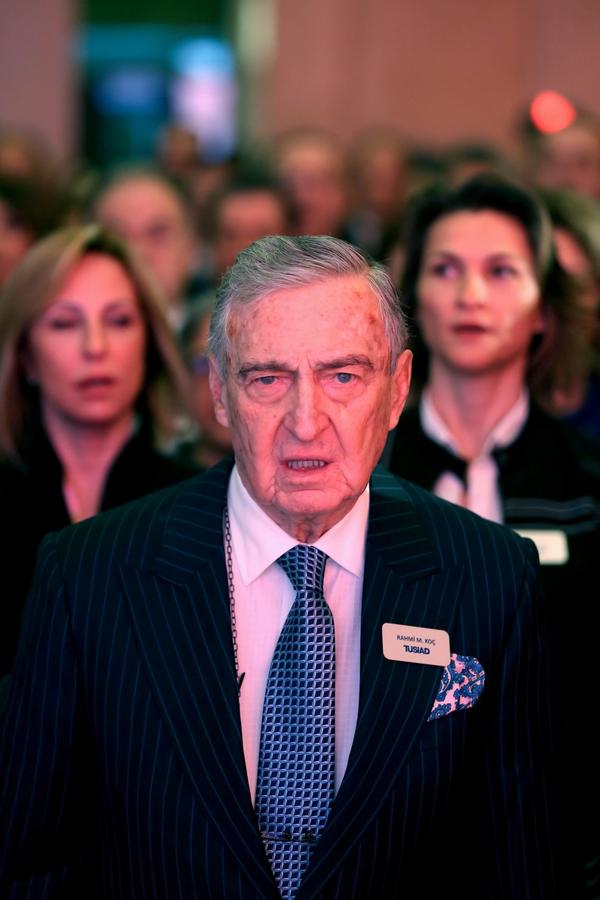
(Photo by Onur Coban/Anadolu Agency/Getty Images)
Philanthropy and Cultural Institutions
Beyond business, Koç has played a major role in Turkish cultural and philanthropic life. He founded the Rahmi M. Koç Museum in Istanbul, one of the country's most prominent museums of industry, transport, and engineering, with additional branches in Ankara and Ayvalık. The museums reflect his lifelong interest in industrial history and technological progress.
Koç also supported education, healthcare, and cultural preservation through the Koç family foundations. He served in leadership roles at institutions such as the Sadberk Hanım Museum, Turkey's first private museum, named in honor of his mother. His philanthropic work helped establish a model in which private wealth plays a visible and structured role in public cultural life.
Legacy
Rahmi Koç's legacy is that of a nation-building industrialist who successfully carried a family enterprise into the modern global economy. He preserved his father Vehbi Koç's founding vision while dramatically expanding its scale, professionalism, and international credibility. Through Koç Holding, he helped shape Turkey's manufacturing base, workforce, and export economy, embedding corporate governance standards that allowed the group to endure across generations. That continuity is reflected most directly in his three sons. The late Mustafa V. Koç served as chairman of Koç Holding until his death in 2016 and was widely viewed as a reform-minded leader poised to guide the group into a new era. Ömer Koç succeeded him as chairman, emphasizing institutional stability, global partnerships, and cultural stewardship. Ali Yıldırım Koç pursued a more public-facing path, combining senior roles within the group with a highly visible presidency of Fenerbahçe Sports Club. Together, their divergent but complementary trajectories underscore Rahmi Koç's most enduring achievement: not merely the accumulation of wealth, but the successful transmission of leadership, values, and institutional responsibility across generations.
/2013/05/rahmi.jpg)
/2014/03/Ali-Yıldırım.jpg)
/2025/02/missing_profile.jpg)
/2014/06/Wilma-Tisch.png)
/2014/01/GettyImages-131913470.jpg)
/2009/09/hans.jpg)
/2009/09/otto2.jpg)
/2019/04/rr.jpg)
/2009/11/George-Clooney.jpg)