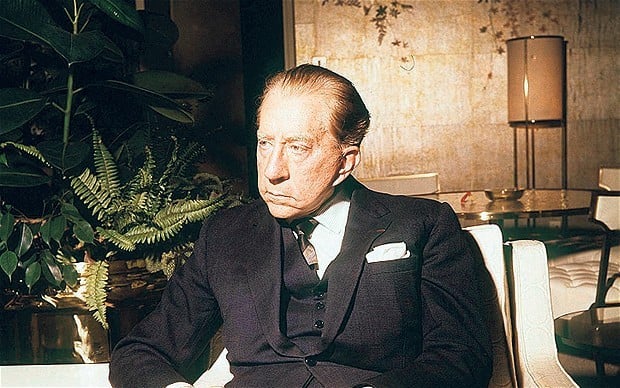
What Was J. Paul Getty's Net Worth?
J. Paul Getty was an American businessman and oil tycoon who had a net worth of at least $2 billion at the time of his death in 1976. That would be the equivalent of roughly $12 billion in today's dollars. Getty built one of the largest private fortunes of the 20th century through oil exploration, acquisitions, real estate, and a willingness to make enormous investments that competitors considered far too risky. In 1957, "Fortune" named him the richest living American, and he subsequently became known as the richest private citizen in the world.
Getty inherited both money and an introduction to the oil industry from his father, but he multiplied the family fortune many times over. His defining business gamble came in 1949, when he acquired an oil concession in the Saudi portion of the Saudi-Kuwaiti Neutral Zone and spent tens of millions of dollars searching for petroleum. After several unsuccessful years, oil was finally struck in 1953, producing a windfall that helped propel Getty into the highest ranks of global wealth.
Getty was also one of the 20th century's most important private art collectors. He established the J. Paul Getty Museum and left the bulk of his personal estate to the institution that eventually became the J. Paul Getty Trust. Meanwhile, Getty Oil remained an enormously valuable company after his death. In 1984, Texaco acquired Getty Oil for roughly $10 billion in what was then the largest corporate takeover in American history.
Despite his extraordinary fortune, Getty became equally famous for his extreme frugality, complicated personal life, and his controversial refusal to immediately pay the ransom after his teenage grandson was kidnapped in Italy in 1973.
Early Life
Jean Paul Getty was born on December 15, 1892, in Minneapolis, Minnesota. His parents were Sarah Catherine McPherson Getty and George Franklin Getty. His father was an attorney who entered the oil business during the Oklahoma oil boom and made the family wealthy.
The Getty family moved to Bartlesville, Oklahoma, when J. Paul was a child and later relocated to Los Angeles. He attended Harvard Military School and Polytechnic High School before briefly studying at the University of California, Berkeley.
Getty subsequently traveled to England and studied economics and political science at the University of Oxford. He developed an unusual aptitude for languages and became fluent in several European languages, an ability that would later prove useful as his business interests expanded internationally.
Making His First Million
Getty began working in his father's Oklahoma oil fields during school vacations and soon became involved in buying and selling oil leases.
In 1914, his father gave him financial backing to begin investing in oil properties of his own. Getty proved to have exceptional instincts for finding undervalued leases. One of his early investments became highly productive, and by 1916, when he was still in his early 20s, Getty had made his first million dollars.
He briefly announced his retirement and moved to Los Angeles to enjoy the life of a wealthy young playboy, but business soon drew him back.
When George Getty died in 1930, he left behind a fortune of around $10 million. J. Paul received only about $500,000 directly. His father had reportedly been concerned about his son's extravagant personal life and succession of romantic relationships.
Much of the remaining family wealth was controlled by Getty's mother, Sarah. J. Paul eventually acquired greater control of the family business, while Sarah's assets were placed into a trust that would later become an important repository of Getty family wealth.
Building An Oil Empire
Getty spent the following decades expanding aggressively.
Rather than simply owning individual wells, he wanted control over as much of the petroleum business as possible. He acquired stakes in oil producers, refiners, distributors, and related companies, allowing his organization to participate in nearly every stage of the business.
Among his most important holdings were Pacific Western Oil, Tidewater Oil, Skelly Oil, and Mission Corporation. These interests ultimately became part of the company known as Getty Oil.
Getty became particularly famous for buying assets during periods when other investors were selling. He believed fortunes were made by accumulating valuable properties when pessimism was greatest and then patiently waiting for their value to become obvious.
That philosophy produced the greatest gamble of his career.
The Saudi-Kuwaiti Neutral Zone Gamble
In 1949, Getty secured a 60-year concession covering the Saudi Arabian portion of the Neutral Zone between Saudi Arabia and Kuwait.
Contrary to a story that has sometimes been repeated about Getty, he did not discover Saudi Arabia's first oil. Commercial oil had already been discovered elsewhere in Saudi Arabia more than a decade earlier.
What Getty did was gamble enormous amounts of his own money on an area where major oil reserves had not yet been proven.
He paid roughly $9.5 million upfront for the concession and committed himself to additional payments. Getty then spent tens of millions more drilling exploratory wells.
For four years, the investment produced little except expenses.
Then, in 1953, oil was discovered.
The concession eventually began producing millions of barrels annually. Getty's decision to spend what would amount to hundreds of millions of dollars in today's money on an unproven desert concession became one of the most successful bets in oil-industry history.
The discovery dramatically increased the value of Getty's petroleum interests and helped make him one of the richest people alive.
World's Richest Private Citizen
By the 1950s, Getty controlled an international network of oil companies along with substantial investments in real estate, hotels, manufacturing, and other businesses.
In 1957, "Fortune" identified Getty as the richest American, estimating his fortune at somewhere around $700 million to $1 billion. His wealth continued growing during the following decade, and by the mid-1960s, he was widely described as the richest private citizen in the world.
Getty himself was famously reluctant to provide a precise figure for his fortune. When asked how much his holdings might be worth if liquidated, he once replied:
"I would hope to realize several billions. But, remember, a billion dollars isn't worth what it used to be."
In 1967, his major petroleum interests were consolidated under the Getty Oil name.

Getty
Sutton Place
Beginning in 1959, Getty lived primarily at Sutton Place, a sprawling Tudor estate near Guildford in Surrey, England.
The centuries-old mansion became Getty's headquarters as he managed business interests stretching from the United States to the Middle East. It also provided a home for part of his increasingly important art collection.
Despite owning one of Britain's great country estates and possessing billions of dollars, Getty developed a legendary reputation for penny-pinching.
The most famous example involved telephones.
After becoming irritated by guests and employees making calls from Sutton Place, Getty installed a pay phone in the mansion. He was also known for washing some of his own clothing, reusing paper, scrutinizing expenses, and negotiating aggressively over even relatively small sums.
His frugality became an inseparable part of his public image.
The Kidnapping Of J. Paul Getty III
Getty's reputation for stinginess reached its peak during one of the most infamous kidnapping cases of the 20th century.
In July 1973, his 16-year-old grandson J. Paul Getty III was abducted in Rome. The kidnappers demanded $17 million.
Getty refused to pay.
He argued that he had 14 other grandchildren and that paying a large ransom would encourage criminals to kidnap them as well. The family initially also questioned whether the kidnapping might have been staged because the younger Getty had previously joked about faking his own abduction to extract money from his wealthy grandfather.
Months passed.
The kidnappers eventually cut off part of Paul Getty III's ear and mailed it to an Italian newspaper along with another ransom demand.
After the demand was negotiated down to around $3 million, Getty finally agreed to provide the money. He supplied approximately $2.2 million himself and loaned the remaining amount to his son, John Paul Getty Jr., at 4% interest.
Paul Getty III was released in December 1973 after more than five months in captivity.
The episode became one of the defining stories of Getty's life and later inspired the film "All the Money in the World" and the television series "Trust."
Art Collection And The Getty Museum
Getty's other great obsession was art.
He began collecting seriously in the 1930s and accumulated European paintings, furniture, decorative objects, manuscripts, and Greek and Roman antiquities. His collection eventually included works by artists such as Titian, Rubens, Gainsborough, Renoir, and other major European masters.
Getty wrote extensively about collecting, including the books "Collector's Choice" and "The Joys of Collecting."
In 1953, he created the J. Paul Getty Museum Trust. The following year, a museum opened at his ranch property in Malibu. Getty later financed construction of the Getty Villa, modeled after an ancient Roman villa buried by the eruption of Mount Vesuvius.
His greatest contribution to the institution came after his death.
Getty left the bulk of his estate to the museum trust, including Getty Oil stock valued at roughly $660 million at the time. Legal proceedings delayed the distribution for several years, and by the time the inheritance was transferred to the Trust in the early 1980s, it was worth around $1.2 billion.
That extraordinary endowment transformed the Getty organization into one of the richest cultural institutions in the world.
The organization eventually expanded beyond the museum to include the Getty Research Institute, Getty Conservation Institute, and Getty Foundation. Getty's fortune also financed the construction of the Getty Center overlooking Los Angeles, which opened in 1997.
What Happened To Getty Oil?
J. Paul Getty died before the company bearing his name reached the end of its independent existence.
After his death, major blocks of Getty Oil stock remained controlled by the Getty family, family trusts, the J. Paul Getty Trust, and other shareholders. Getty's son Gordon Getty became particularly influential in determining the company's future.
By the early 1980s, Getty Oil had attracted takeover interest because the company's oil reserves were considered significantly more valuable than its stock-market valuation suggested.
A complicated bidding battle eventually developed involving Pennzoil and Texaco.
In 1984, Texaco agreed to acquire Getty Oil for approximately $10 billion, or $125 per share. At the time, it was the largest corporate takeover in American history.
The transaction turned enormous Getty family stockholdings into billions of dollars of liquid wealth while ending the family's direct control of the oil empire J. Paul Getty had spent decades assembling.
The deal also triggered a historic lawsuit after Pennzoil argued that it had already reached a binding agreement to acquire Getty Oil. A Texas jury eventually awarded Pennzoil more than $10 billion in damages against Texaco. Texaco later entered bankruptcy protection and settled the dispute for $3 billion.
Personal Life
Getty was married five times and had five sons.
He married Jeanette Dumont in 1923, and they had a son, George Franklin Getty II. After their divorce, Getty married Allene Ashby. That marriage was followed by his marriage to Adolphine Helmle, with whom he had a son, Jean Ronald Getty.
Getty married actress Ann Rork in 1932. They had two sons, John Paul Getty Jr. and Gordon Getty.
His fifth and final marriage was to Louise Dudley Lynch. Their son Timothy was born in 1946. Timothy developed a brain tumor and died at the age of 12. Getty was living in England at the time and did not return to the United States for his son's funeral. His marriage to Louise ended soon afterward.
Getty maintained relationships with numerous women throughout his life and continued entertaining girlfriends and companions at Sutton Place into old age.
For all his financial success, Getty acknowledged that his personal life had been considerably less successful. He once said that he would gladly trade his millions for one lasting marriage.
Death And Legacy
J. Paul Getty died of heart failure on June 6, 1976, at Sutton Place. He was 83 years old. He was buried at the Getty Villa property in Pacific Palisades, California.
Getty's oil company disappeared as an independent business less than a decade after his death, but his fortune proved remarkably durable.
Billions of dollars flowed through Getty family trusts and into subsequent generations after the Texaco sale. His descendants went on to become investors, philanthropists, artists, filmmakers, and businesspeople. His grandson Mark Getty later co-founded Getty Images, creating another global business carrying the family name.
Getty's most enduring financial legacy, however, may be the institution he created to house his art.
The wealth generated by oil fields in Oklahoma and the Middle East ultimately financed museums, research institutes, conservation programs, art acquisitions, and one of the world's great cultural endowments.
It was an unusual ending for the fortune of a man remembered as both one of history's richest entrepreneurs and one of its most famously reluctant spenders.
/2021/01/conrad-hilton2.png)
/2020/04/GettyImages-980225372.jpg)
/2010/05/mohammed-al-amoudi2.png)
/2021/01/jackie.png)
/2014/01/Gordon-Getty-1.jpg)
/2020/04/Megan-Fox.jpg)
/2020/01/lopez3.jpg)
/2009/09/Cristiano-Ronaldo.jpg)
/2019/04/rr.jpg)
/2019/11/GettyImages-1094653148.jpg)
/2020/06/taylor.png)
/2017/02/GettyImages-528215436.jpg)
/2009/09/Jennifer-Aniston.jpg)
:strip_exif()/2015/09/GettyImages-476575299.jpg)
/2009/09/Brad-Pitt.jpg)
/2009/11/George-Clooney.jpg)
/2012/11/getty-house-2_2025918b.jpg)
/2014/01/Gordon-Getty-1.jpg)
/2014/07/GettyImages-3163253.jpg)
/2016/11/Nelson-Bunker-Hunt.jpg)
/2014/05/Herbert-Hunt.jpg)
/2018/01/house-saud.jpg)
/2019/10/denzel-washington-1.jpg)
/2018/03/GettyImages-821622848.jpg)
/2020/02/Angelina-Jolie.png)
:strip_exif()/2009/09/P-Diddy.jpg)