
/2009/10/JR-Simplot.jpg)
/2014/01/fred.jpg)
/2020/06/jb2.jpg)
/2011/01/don-2.jpg)
/2019/04/rr.jpg)
/2020/06/taylor.png)
/2009/11/George-Clooney.jpg)
/2019/10/denzel-washington-1.jpg)
/2020/02/Angelina-Jolie.png)
:strip_exif()/2015/09/GettyImages-476575299.jpg)
/2018/03/GettyImages-821622848.jpg)
:strip_exif()/2009/09/P-Diddy.jpg)
/2020/04/Megan-Fox.jpg)
/2019/11/GettyImages-1094653148.jpg)
/2009/09/Brad-Pitt.jpg)
/2009/09/Cristiano-Ronaldo.jpg)
/2009/09/Jennifer-Aniston.jpg)
What was J. R. Simplot's Net Worth?
J.R. Simplot was an American potato farmer and billionaire who had a net worth of $3.7 billion at the time of his death. He founded the J. R. Simplot Company, an agricultural supplier based in Boise, Idaho. Specializing in potato products, the company made billions of dollars from the commercialization of frozen French fries, and in the 1970s became the primary supplier of French fries to McDonald's. Although Simplot retired as president of his company in 1973, he remained involved for decades afterward.
According to legend, Simplot quit eighth grade after getting into a heated argument with his father and took a job sorting potatoes and raising hogs until he had enough money to purchase his own potato field. By the early 1980s he was worth $500 million thanks largely to a nearly-exclusive contract to supply potatoes to McDonald's. Over time, that deal made Simplot became one of the richest people in the world and one 10 richest people in America. Within a few years he was a billionaire, and at the time of his death his $3.7 billion net worth made him the richest person in Idaho. At the time of his death at the age of 99, J.R. Simplot was named the oldest billionaire in the United States.
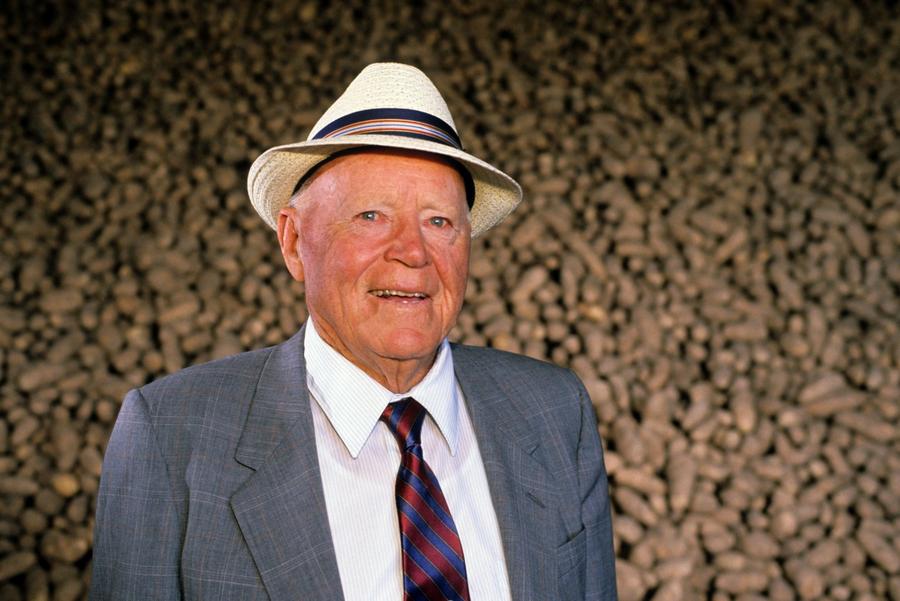
Portrait of J R Simplot (via Alamy)
Early Life
John Richard Simplot was born on January 4, 1909 in Dubuque, Iowa as the third of six children of Dorothy and Charles. The next year, the family moved a thousand miles west to the newly irrigated Magic Valley in Idaho. Simplot went to school until the age of 14, when he dropped out and went to work on a farm near Declo.
J. R. Simplot Company
While doing farm work near Declo, Idaho in 1929, Simplot founded the agribusiness company the J. R. Simplot Company. The company expanded considerably in the 1940s when it provided dehydrated potatoes and onions to the military during World War II. During this time, it also became the largest shipper of fresh potatoes in the United States. The J. R. Simplot Company was eventually incorporated in 1955. It reached the height of its success in the early 1970s when it made billions of dollars from the commercialization of frozen French fries by being the main supplier of the food item to McDonald's. The frozen fry deal with McDonald's led to the expansion of Simplot's potato processing plants. By 2005, the J. R. Simplot Company supplied more than half of all French fries to McDonald's. Beyond food items, the company produces fertilizers for agriculture, which has caused environmental concerns.
Although Simplot retired as president of his company in 1973, he remained involved in its activities for decades afterward. In 1994, he stepped down as chairman of the board, and then held the title of chairman emeritus until his passing in 2008. The J. R. Simplot Company expanded significantly in the 1990s by moving into Australia and acquiring such food brands as Birds Eye and Chiko. Meanwhile, the company contributed to a number of charitable organizations, including Ronald McDonald House, Boys & Girls Clubs of America, Future Farmers of America, and the World Wide Fund for Nature. The J. R. Simplot Company has also donated thousands of pounds of potatoes to the Idaho Foodbank and the Boise Rescue Mission, and has made numerous donations to arts organizations throughout Idaho. In 2009, the company was awarded the Spirit of Treasure Valley by the United Way of Treasure Valley.
Other Ventures
Among his many other business ventures, Simplot financed the Brundage Mountain alpine ski area near McCall, Idaho in 1961. Previously, he had helped the Bogus Basin ski area recover from financial difficulties in the 1950s. Later on, in the early 1980s, Simplot provided startup capital to the nascent Micron Technology, a Boise-based company that manufactures computer memory and computer data storage. By 1994, Simplot owned 20% of the company. Elsewhere, he was a heavy investor in Remington Oil.
Accident
While attending the Fiesta Bowl in Glendale, Arizona on New Year's Day in 2007, Simplot fell from a motorized scooter and sustained a cranial hematoma. He was taken to a hospital in Phoenix, where he ended up spending his 98th birthday. Simplot was able to return to Idaho several days later for further rehabilitation.
Personal Life and Death
In 1931, Simplot wed Ruby Rosevear, whom he had met on a blind date. They had four children together: sons Richard, Don, and Scott, and daughter Gay. The couple remained married until Rosevear abruptly left Simplot for another man, resulting in divorce in 1960. Simplot went on to date former opera singer Esther Becker, whom he met on a business trip in New York City. They married in 1972 and remained together until Simplot's passing. The couple resided in a hilltop home on Boise's north end, which they donated to the state of Idaho in 2004 for use as a governor's mansion. After that, Simplot and Becker lived in the Grove Hotel in downtown Boise.
On May 25, 2008, Simplot died suddenly at his home in Boise following a bout of pneumonia. He was 99 years of age. Simplot was buried at Morris Hill Cemetery in Boise.
/2009/10/JR-Simplot.jpg)
/2014/01/fred.jpg)
/2010/05/CNW-Man.png)
/2016/06/GettyImages-111817488.jpg)
/2012/08/CNW-Man.png)
/2020/03/GettyImages-81032278.jpg)
/2011/01/mars.jpg)
/2023/01/GettyImages-486156422.jpg)
/2020/01/lopez3.jpg)