
/2016/04/GettyImages-459653808.jpg)
/2013/04/nathan-kirsh.png)
/2010/03/Craig-Newmark.jpg)
/2012/08/Jim-davis.png)
/2021/08/dov-charney.jpg)
/2025/02/missing_profile.jpg)
/2020/04/Megan-Fox.jpg)
/2018/03/GettyImages-821622848.jpg)
/2019/10/denzel-washington-1.jpg)
/2019/04/rr.jpg)
/2009/09/Brad-Pitt.jpg)
/2020/02/Angelina-Jolie.png)
:strip_exif()/2015/09/GettyImages-476575299.jpg)
/2009/09/Jennifer-Aniston.jpg)
/2009/11/George-Clooney.jpg)
/2017/02/GettyImages-528215436.jpg)
/2019/11/GettyImages-1094653148.jpg)
What is Hamdi Ulukaya's Net Worth?
Hamdi Ulukaya is a Turkish businessman and philanthropist who has a net worth of $11 billion. Hamdi Ulukaya earned his fortune as the founder of the Chobani yogurt brand. He owns around 70% of the New Berlin, New York-based company.
After immigrating to the United States with limited resources, Ulukaya transformed a struggling upstate New York yogurt plant into a company that reshaped the entire dairy aisle. Under his leadership, Greek yogurt went from a niche product to more than half of all yogurt sales in the U.S., with Chobani emerging as the category's clear leader. The company grew rapidly without traditional advertising, relying instead on grassroots marketing, product quality, and aggressive distribution strategies. Over time, Ulukaya expanded beyond yogurt into oat milk, creamers, and coffee through the acquisition of La Colombe. Chobani has remained privately controlled, allowing Ulukaya to maintain an unusually hands-on leadership style even as the company reached multibillion-dollar revenue levels. Known for combining business success with a strong social mission, he has also become one of the most prominent advocates for refugee employment and inclusive capitalism, while pledging to give away the majority of his fortune.
Early Life and Education
Hamdi Ulukaya was born on October 26, 1972, in Ilic, Turkey, into a Kurdish family that operated a sheep, goat, and dairy farm near the Euphrates River. His upbringing was deeply tied to traditional yogurt and cheese production, which would later influence his business career.
He studied political science at Ankara University before moving to the United States in 1994 to learn English. He initially attended Adelphi University on Long Island and later transferred to the University at Albany, where he took business courses. During this time, he began working on a farm and was encouraged by his father to enter the food business. This led to the creation of a small feta cheese company called Euphrates, which struggled financially but provided critical early experience.
Buying a Failing Yogurt Plant
In 2005, Ulukaya came across an advertisement for a shuttered yogurt factory in New Berlin, New York, that had been put up for sale by a major food company. He secured an $800,000 loan and purchased the facility, despite having limited experience in large-scale manufacturing.
Rather than rushing to market, he spent roughly 18 months refining a recipe with the help of a yogurt maker from Turkey. His goal was to create a thicker, higher-protein product that more closely resembled traditional strained yogurt than the sugary, thin varieties dominating U.S. shelves at the time.
DON EMMERT/Getty Images
Launching Chobani and Early Growth
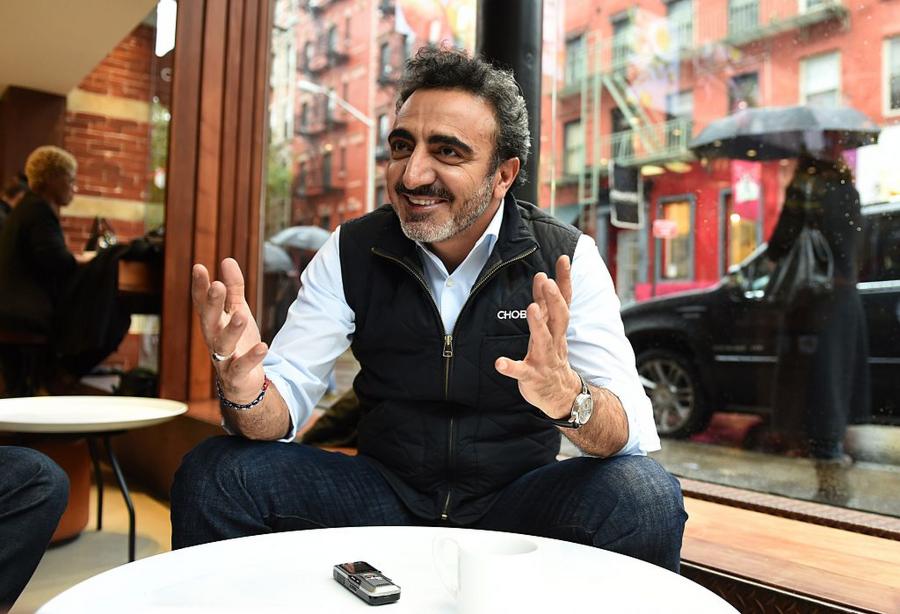
Chobani officially launched in 2007. Without the budget for traditional advertising or the ability to pay standard grocery stocking fees, Ulukaya relied on unconventional tactics. He focused heavily on packaging, direct consumer engagement, and product sampling. One of his more creative efforts included the "CHOmobile," a traveling vehicle that distributed free yogurt samples at events and festivals.
Momentum began building in 2009 when regional grocery chains like Stop & Shop and ShopRite began carrying the product. Sales quickly accelerated, reaching roughly 200,000 cases per week by mid-year. Later that year, warehouse retailers such as Costco and BJ's Wholesale Club added Chobani, helping to double sales again.
Dominating the Greek Yogurt Market
By 2011, Chobani had become the top-selling Greek yogurt brand in the United States. The company's growth coincided with a broader shift in consumer preferences toward higher-protein, lower-sugar foods, and Chobani played a major role in accelerating that trend. Before its rise, Greek yogurt accounted for a tiny fraction of the market. Within a decade, it became the dominant style nationwide.
In 2012, the company surpassed $1 billion in annual sales and opened a massive production facility in Twin Falls, Idaho, widely considered the largest yogurt plant in the world at the time. That same year marked a turning point, as Chobani overtook legacy brands to become the leading yogurt company in the country.
Getty Images
Expansion Beyond Yogurt
As Chobani matured, Ulukaya expanded into adjacent product categories. The company introduced oat milk, dairy creamers, and other natural food products, positioning itself as a broader health-focused brand.
Outside of Chobani, Ulukaya invested in La Colombe Coffee Roasters in 2015 and later brought the company fully under Chobani's umbrella. By the mid-2020s, Chobani had also acquired brands like Daily Harvest and continued investing heavily in manufacturing capacity, including plans for a new billion-dollar production facility in New York.
Despite periodic discussions about going public, Ulukaya chose to keep Chobani private, prioritizing long-term growth and operational control over public market pressures. In recent years, the company has generated billions in annual revenue and is valued at tens of billions of dollars.
Philanthropy and Business Philosophy
Ulukaya is widely known for his philanthropic efforts and progressive approach to capitalism. He signed The Giving Pledge, committing to donate the majority of his wealth during his lifetime.
In 2016, he founded the Tent Partnership for Refugees, an organization that encourages corporations to hire and support displaced people. He has also made significant donations to refugee-focused causes and launched the Hamdi Ulukaya Initiative to support entrepreneurs.
Within his own company, he has emphasized higher wages and employee ownership, with some workers receiving equity stakes. He has frequently spoken about prioritizing people over profits, a philosophy that has shaped both Chobani's culture and his public image.
Personal Life
Ulukaya lives in New Berlin, New York, which is near the Chobani South Edmeston factory and headquarters. In the late 1990s, he married doctor Ayse Giray but they later divorced. In 2012, she sued him for a 53% stake in his company, as she claimed her family had originally lent him half a million dollars to start the company. They later settled the dispute.
In 2015, Ulukaya had a son named Aga with Alida Boer, though the two did not marry; in January of 2018, he married Louise Vongerichten, the president of the Food Dreams Foundation and of a sustainable children's clothing line called Mon Coeur. They had a son, Miran, together in April of 2018. In his free time, Ulukaya enjoys sailing and traveling, as well as spending time with his dogs.
/2016/04/GettyImages-459653808.jpg)
/2025/02/missing_profile.jpg)
/2015/09/Hamdi-Ulukaya.jpg)
/2018/05/GettyImages-136321945.jpg)
/2009/09/ck2.jpg)
/2013/04/nathan-kirsh.png)
/2020/06/taylor.png)
:strip_exif()/2009/09/P-Diddy.jpg)