
/2022/02/John-F.-Kennedy-Jr.png)
/2009/12/GettyImages-455300268.jpg)
/2020/02/rk.png)
/2021/01/John-F.-Kennedy.jpg)
/2021/06/rfk.jpg)
/2021/01/jackie.png)
/2009/09/Jennifer-Aniston.jpg)
/2019/10/denzel-washington-1.jpg)
/2020/01/lopez3.jpg)
/2020/02/Angelina-Jolie.png)
/2020/06/taylor.png)
/2019/04/rr.jpg)
/2020/04/Megan-Fox.jpg)
:strip_exif()/2015/09/GettyImages-476575299.jpg)
:strip_exif()/2009/09/P-Diddy.jpg)
/2019/11/GettyImages-1094653148.jpg)
/2017/02/GettyImages-528215436.jpg)
What Was John F. Kennedy Jr.'s Net Worth?
John F. Kennedy Jr. was an American lawyer, journalist, and magazine publisher who had a net worth of at least $30 million and perhaps as much as $100 million at the time of his death in 1999. That's the same as being worth around $60 – $200 million in today's dollars.
The son of John F. Kennedy and Jacqueline Kennedy Onassis, he grew up under intense national scrutiny and became one of the most recognizable figures of his generation. As a child, he was photographed saluting his father's coffin on his third birthday during the 1963 funeral procession, an image that became one of the most enduring in American history. As an adult, he sought to forge an identity separate from his family's political legacy. After earning a law degree, he worked briefly as a prosecutor before launching "George," a glossy political magazine that aimed to make public affairs accessible to a broader audience. With his charisma, style, and Kennedy name, he became a fixture in New York's media and social circles, often described as American royalty. His life was cut short in 1999 when he died in a plane crash at age 38, ending a chapter in the Kennedy family saga that had captivated the country for decades.
Estate Value and Inheritance
When his will was filed in Manhattan Surrogate's Court, it did not list a specific total value and instead used standard legal language stating that his estate exceeded $1 million, a jurisdictional threshold rather than a true reflection of his wealth. Contemporary reports from sources such as the New York Times and CBS News estimated the actual full value of his estate at $30 – $100 million. The majority of his fortune was held in longstanding Kennedy family trusts established in 1983 and earlier through his father's and grandfather's estates. Those trust assets, which likely included stocks, bonds, and other financial investments, passed outside of probate and therefore were not itemized publicly.
His will directed that his tangible personal property, including his Tribeca apartment and personal effects, would go to his wife, Carolyn Bessette-Kennedy, if she survived him. Because she and her sister Lauren died in the same July 16, 1999 plane crash, those assets instead passed to the three children of his sister, Caroline Kennedy Schlossberg. Those children were Rose (11 at the time), Tatiana (9 at the time), and John (6 at the time).
Specific bequests included a scrimshaw set that had belonged to President John F. Kennedy, which was left to his nephew, John B. Kennedy Schlossberg. Additional beneficiaries of his 1983 trust included longtime family employees, close associates, and two charities, Reaching Up and the John F. Kennedy Library Foundation.
In 2001, just before the two-year statute of limitations expired, the estate reached a reported $15 million wrongful death settlement with Carolyn Bessette-Kennedy's family. Although attorneys did not publicly confirm the amount, the figure was widely reported at the time. The settlement resolved potential litigation arising from the crash, which federal investigators ultimately attributed to pilot error.
Real Estate
In 1994, John paid $700,000 for a 2,600-square-foot penthouse co-op loft at 20 North Moore Street in New York City's Tribeca neighborhood. Adjusted for inflation, that purchase price is equivalent to roughly $1.5 million today. At the time, Tribeca was still in the early stages of its transformation from an industrial warehouse district into one of Manhattan's most desirable residential enclaves. The loft featured high ceilings, exposed brick, and expansive open living space, characteristics that defined the neighborhood's aesthetic.
Following his death in July 1999, the apartment became one of the most closely watched estate assets in Manhattan real estate. Sotheby's International Realty was granted the exclusive listing and marketed the property without a formal asking price, reportedly setting an unofficial floor around $2.5 million. The unit ultimately sold in 2000 for approximately $2 million, reflecting both the strong late-1990s Manhattan market and the intense public interest surrounding the Kennedy name.
In addition to the Tribeca apartment, Kennedy also held a shared ownership interest with his sister in family property on Martha's Vineyard, including Red Gate Farm, a longtime Kennedy retreat originally purchased by Jacqueline Kennedy Onassis. Those interests passed according to the terms of his will and related trusts.
Early Life and Education
John Fitzgerald Kennedy Jr. was born on November 25, 1960, in Washington, D.C., just weeks after his father was elected president of the United States. He spent his earliest years in the White House alongside his older sister, Caroline Kennedy. His childhood unfolded on a public stage, with photographs of him playing in the Oval Office and under his father's desk becoming iconic.
On November 22, 1963, President Kennedy was assassinated in Dallas, Texas. Three days later, on his third birthday, John Jr. saluted his father's casket as it passed during the funeral procession. The image became symbolic of national grief and permanently intertwined his personal story with the country's collective memory.
After the assassination, Jacqueline Kennedy moved her children to New York City, determined to give them as normal a life as possible. John Jr. attended private schools in Manhattan and later studied at Brown University, where he earned a degree in American studies in 1983.
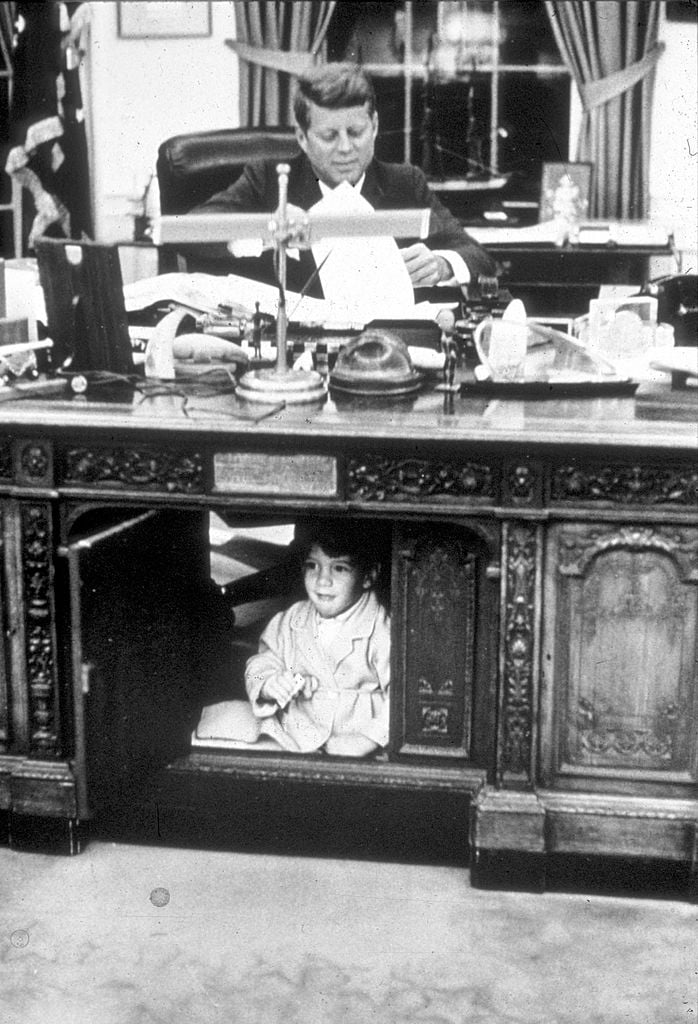
(Photo by Liaison Agency/via Getty)
Education and Legal Career
Following the assassination, Kennedy moved with his family to a luxury apartment on the Upper East Side of Manhattan. There, he attended Saint David's School and then Collegiate School. Later, after Robert F. Kennedy was assassinated in 1968, the family moved outside of the United States to avoid any further harm. Jackie ended up getting remarried to Greek shipping tycoon Aristotle Onassis, with the family living on his private island of Skorpios. John eventually finished his primary education back in the States at Phillips Academy in Massachusetts. He went on to attend Brown University as an American studies major; at the school, he co-founded a student discussion group that talked about such pressing issues as civil rights and gun control. After earning his degree from Brown, Kennedy did some post-graduation work in India at the University of Delhi. In 1989, he obtained his JD degree from the New York University School of Law.
From 1984 to 1986, he worked at the New York City Office of Business Development. In the latter year, he also served as deputy director of the 42nd Street Development Corporation, where he made negotiations with city agencies and developers. Later, in 1988, John worked as a summer associate at the Los Angeles law firm Manatt, Phelps, Rothenberg & Phillips. The following year, he headed the nonprofit Reaching Up, which worked to help people with disabilities.
After earning his JD, Kennedy twice took and twice failed the New York bar exam. He finally passed on his third attempt, after which time he landed a job as a prosecutor at the Manhattan District Attorney's Office. John held this position for close to four years. During this time, he also worked as a journalist.
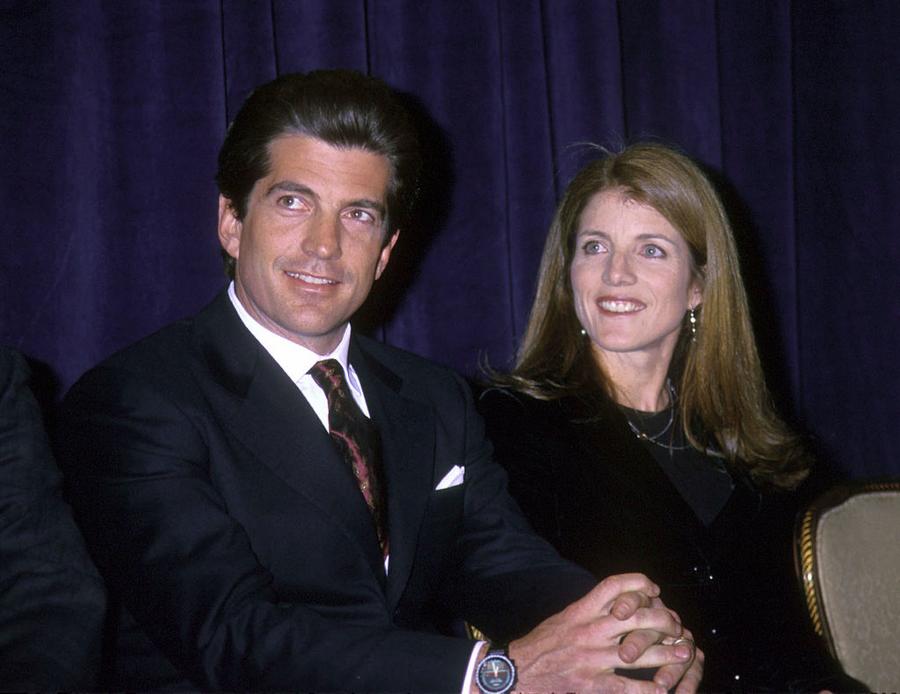
(Photo by Diane Freed/Getty Images)
Magazine Publishing
Along with his friend Michael J. Berman, a businessman, Kennedy founded the magazine George in 1995. A glossy monthly publication, it covered both politics-as-lifestyle and fashion, with each issue featuring interviews written by Kennedy. Memorably, the first issue of George boasted a cover image of Cindy Crawford posing as George Washington, something that garnered a fair amount of criticism in the media. Later notable issues included the July 1997 issue, which profiled then-New York City mayor Rudy Giuliani, and the September 1997 issue, which covered the unscrupulous behavior of two of Kennedy's cousins, Joseph and Michael.
George was already on the rocks by 1997, as Kennedy and Berman got entangled in a power struggle filled with numerous screaming matches. Consequently, Berman sold his company shares, and Kennedy took on all the business responsibilities himself. The damage was done, however, and sales of the magazine dropped precipitously. Following John's death, George was purchased by Hachette; the magazine finally folded in 2001.
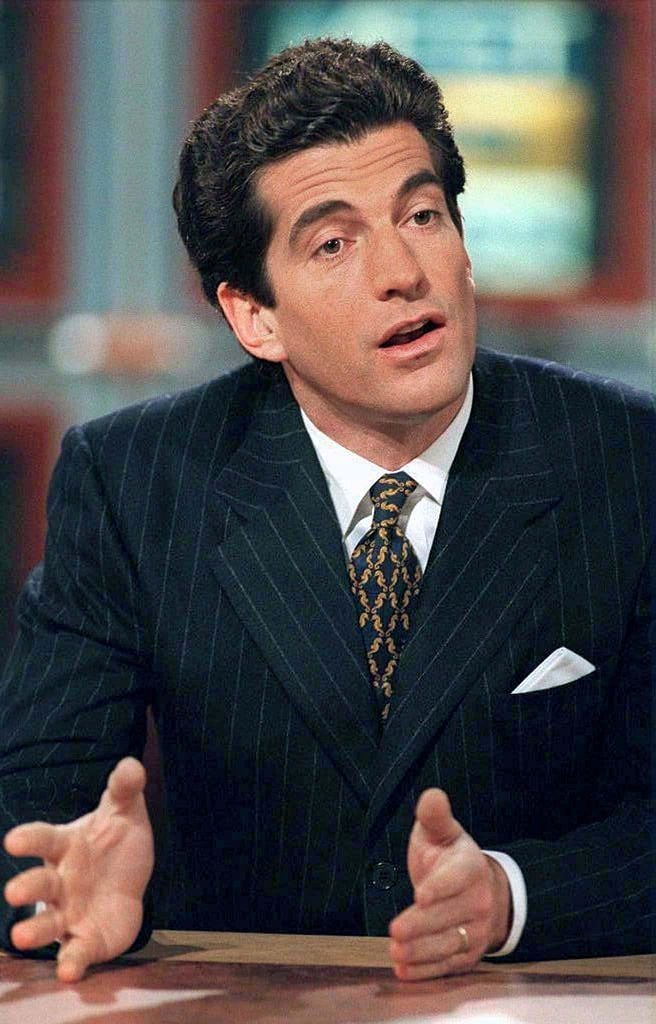
(STF/AFP via Getty Images)
Personal Life and Death
While a student at Brown, John met and began dating Sally Munro. They dated for six years. Among his other romantic relationships, he dated actresses Sarah Jessica Parker and Daryl Hannah, models Julie Baker and Cindy Crawford, and his childhood friend Christina Haag.
In 1996, Kennedy married Carolyn Bessette, a publicist for Calvin Klein. The couple wed in a private ceremony on Cumberland Island, Georgia, in an attempt to shield their relationship from intense media scrutiny.
Their marriage quickly became the subject of relentless tabloid coverage. Photographers tracked their movements throughout New York City, and the couple's fashion choices and social appearances were dissected in gossip columns. Friends described them as deeply in love but under constant pressure from public attention.
Tragic Death
On July 16, 1999, Kennedy piloted a small Piper Saratoga aircraft from New Jersey to Martha's Vineyard, Massachusetts. On board were his wife, Carolyn, and her sister, Lauren Bessette. The plane disappeared over the Atlantic Ocean during nighttime conditions.
After an extensive search, wreckage was located days later off the coast of Martha's Vineyard. All three passengers were found deceased. Investigators later concluded that the probable cause was pilot error due to spatial disorientation.
Kennedy was 38 years old at the time of his death. His passing reignited national mourning and reinforced the perception of tragedy that had long followed the Kennedy family.
Legacy and Cultural Impact
John F. Kennedy Jr.'s life occupied a unique space between politics, celebrity, and journalism. He inherited one of the most storied names in American history but chose not to pursue high office. Instead, he attempted to modernize political discourse through media.
To many Americans, he represented a bridge between the idealism associated with his father's presidency and the media-saturated culture of the late 20th century. His blend of approachability, civic engagement, and style made him a singular public figure.
While "George" magazine did not survive long after his death, Kennedy's broader legacy endures through the enduring public fascination with the Kennedy family and the symbolic power of his childhood image at his father's funeral.
In life, he struggled to balance privacy with inevitability, striving to define himself beyond inherited myth. In death, he became part of that myth, remembered as both a son of Camelot and a man who sought, in his own way, to chart a separate course.
/2022/02/John-F.-Kennedy-Jr.png)
/2009/12/GettyImages-455300268.jpg)
/2026/02/jfk-jr-scaled.jpg)
/2021/01/jackie.png)
/2020/02/rk.png)
/2021/01/John-F.-Kennedy.jpg)
/2021/06/rfk.jpg)
/2018/03/GettyImages-821622848.jpg)
/2009/09/Brad-Pitt.jpg)
/2009/09/Cristiano-Ronaldo.jpg)