
/2010/07/Jack-Roush.jpg)
/2012/07/Brad-Keselowski.jpg)
/2010/07/Matt-Kenseth.jpg)
/2015/10/Josh-Wise.jpg)
/2016/05/GettyImages-531283900.jpg)
/2013/03/Mark-Martin.jpg)
:strip_exif()/2009/09/P-Diddy.jpg)
:strip_exif()/2015/09/GettyImages-476575299.jpg)
/2009/09/Brad-Pitt.jpg)
/2019/10/denzel-washington-1.jpg)
/2020/01/lopez3.jpg)
/2017/02/GettyImages-528215436.jpg)
/2020/02/Angelina-Jolie.png)
/2019/11/GettyImages-1094653148.jpg)
/2018/03/GettyImages-821622848.jpg)
/2020/06/taylor.png)
/2009/09/Jennifer-Aniston.jpg)
What is Jack Roush's Net Worth and Salary?
Jack Roush is an American businessman and CEO who has a net worth of $300 million.
Jack Roush is one of the most influential team owners in the history of American motorsports, a mechanical engineer turned racing visionary who built one of NASCAR's most successful modern dynasties. Over several decades, Roush transformed Roush Racing, later known as Roush Fenway Racing, into a powerhouse organization that produced championships, superstar drivers, and a deep engineering culture that reshaped how stock car teams operated. Under his leadership, the team won championships across NASCAR's top three national series and became especially dominant during the late 1990s and mid-2000s, when its cars were perennial contenders for wins and titles.
Roush was widely respected for his technical rigor, attention to detail, and ability to identify and develop talent, often promoting drivers from grassroots racing into championship-caliber equipment. Beyond NASCAR, he built a parallel business empire in automotive engineering and performance products, applying the same analytical mindset that made his race teams successful. By the time he stepped back from day-to-day competition, Jack Roush had secured a legacy as both a pioneering engineer and one of the most successful owners the sport has ever known.
Earnings
During the years when purse numbers were public (roughly 1988–2015), cars owned by Jack Roush generated over $400 million in total race winnings. The total value today likely exceeds half a billion dollars/
This figure includes the massive career earnings of his flagship drivers during the team's "golden era":
- Mark Martin: Earned over $60 million in purses while driving for Roush.
- Matt Kenseth: Generated over $75 million in purse money.
- Greg Biffle & Carl Edwards: Both generated roughly $75 million each in winnings.
While the total winnings are eye-popping, Jack Roush did not personally pocket the majority of that cash. In NASCAR, the "Owner's Share" is used primarily to run the business rather than as personal profit.
The Standard Split:
- Driver's Share (~40–50%): The drivers typically took home about 40% to 50% of the purse winnings (plus their base salary).
- Team's Share (~50–60%): The remaining 50% to 60% went to the team (Roush Fenway Racing).
Early Life and Education
Jack Roush was born on April 19, 1942, in Covington, Kentucky, and developed an early fascination with machinery and problem-solving. He pursued that interest academically, earning a degree in mathematics and a master's degree in mechanical engineering from Michigan Technological University. Roush's engineering background would become a defining feature of his career, setting him apart from many traditional team owners who came from driving or promotional backgrounds.
After college, Roush worked in the automotive industry, including a stint at Ford Motor Company, where he gained valuable experience in engine development and performance engineering. These early professional years helped him build the technical foundation that would later underpin both his racing success and his broader business ventures.
Founding Roush Racing
Roush entered motorsports in the 1970s, initially focusing on drag racing and road racing. He founded Roush Racing and quickly gained a reputation for technical excellence, particularly in engine development and race preparation. His teams found success in IMSA sports car competition and NHRA drag racing, laying the groundwork for a future expansion into stock car racing.
Roush made the leap into NASCAR in the late 1980s, starting modestly before steadily growing his operation. By the early 1990s, Roush Racing had become a full-fledged NASCAR organization, fielding multiple teams and building a centralized engineering-driven structure that mirrored top-tier professional sports franchises more than traditional race shops.
NASCAR Dominance and Championships
Roush Racing reached its peak during the late 1990s and 2000s, when it regularly fielded some of the most competitive cars in NASCAR. The organization won its first NASCAR Cup Series championship in 2003 with Matt Kenseth, a season defined by remarkable consistency and strategic execution. That title validated Roush's long-term philosophy of building reliable, technically superior cars rather than chasing short-term gains.
Over the following years, Roush Racing became synonymous with depth and internal competition. Drivers such as Greg Biffle, Carl Edwards, Mark Martin, and Kurt Busch all enjoyed significant success under the Roush banner. Biffle won championships in both the Craftsman Truck Series and the Busch Series before becoming a Cup Series star, while Edwards emerged as one of the most formidable competitors of his era. In 2004, Kurt Busch captured the Cup Series championship, giving Roush his second title in two seasons.
At its height, Roush Racing operated as many as five full-time Cup Series teams, a scale that few organizations have ever matched. The team's influence extended across NASCAR's lower divisions as well, where it developed young drivers and consistently competed for championships.
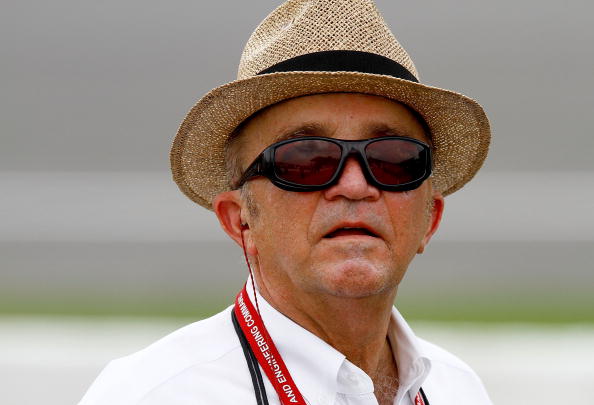
(Jason Smith/Getty Images)
Engineering Philosophy and Business Ventures
Central to Roush's success was his engineering-first approach. He emphasized data, simulation, and controlled experimentation long before such methods became standard in NASCAR. This mindset carried over into his business operations, most notably Roush Performance, which specialized in high-performance automotive components and vehicle modifications, often in partnership with Ford.
Roush's companies applied racing-derived technology to consumer vehicles, reinforcing the link between motorsports innovation and commercial engineering. This dual-track career allowed him to remain influential both on and off the racetrack, blending competition with entrepreneurship.
Later Years and Stepping Back
As NASCAR evolved and competition intensified, Roush gradually reduced the size of his racing operation. In 2007, Fenway Sports Group acquired a stake in the team, leading to its rebranding as Roush Fenway Racing. The partnership helped stabilize the organization during a changing economic and competitive landscape.
In later years, Roush stepped back from daily team management, allowing new leadership to guide the organization. Though results fluctuated compared to the team's peak era, Roush's foundational impact on NASCAR remained unquestioned.
Plane Crashes
Outside of racing and engineering, Roush is known for his passion for aviation. He is a licensed pilot and an avid aviation enthusiast, a hobby that has played a dramatic role in his life. Roush has survived several serious plane crashes over the years, including a highly publicized crash in 2002 in which his aircraft went down during an approach to an airport in Alabama. He suffered significant injuries, including a broken back, but ultimately recovered and returned to active involvement in his racing operations. Eight years later, his jet crashed on approach to a Wisconsin airport. Jack lost an eye in this accident.
/2010/07/Jack-Roush.jpg)
/2013/03/Mark-Martin.jpg)
/2012/07/Brad-Keselowski.jpg)
/2013/04/carl.jpg)
/2015/10/Josh-Wise.jpg)
/2014/11/GettyImages-826991198.jpg)
/2014/05/James-France.jpg)
/2019/10/Denny-Hamlin.jpg)
/2019/04/rr.jpg)
/2009/11/George-Clooney.jpg)
/2009/09/Cristiano-Ronaldo.jpg)