













What Was Henry Ford's Net Worth?
Henry Ford was an American industrialist and entrepreneur who had a peak net worth equal to roughly $200 billion in modern economic-power terms.
Henry Ford founded Ford Motor Company and became one of the richest and most influential businessmen in modern history by transforming the automobile from an expensive novelty into a mass-market product. At his financial peak in the 1920s, Ford controlled more than $1 billion in personal wealth at a time when the entire U.S. economy was only a fraction of its present size. Measured by the share of American economic resources his fortune represented, his wealth was equivalent to roughly $200 billion today, placing him in the same historical wealth class as figures such as John D. Rockefeller and the richest modern entrepreneurs, including Elon Musk and Jeff Bezos.
Ford did not invent the automobile or the assembly line. His breakthrough was combining standardized parts, enormous manufacturing scale, vertical integration, aggressive cost reductions, and a continuously moving assembly line to manufacture reliable cars faster and more cheaply than his competitors. The Model T, introduced in 1908, eventually sold more than 15 million units and fundamentally changed American transportation.
Ford also introduced some of the most consequential employment policies of the early 20th century. In 1914, he stunned the industrial world with a $5 workday, more than doubling the typical wage of many factory employees, and in 1926 Ford adopted a five-day, 40-hour workweek. At the same time, he fiercely opposed labor unions and used an aggressive company security organization to fight attempts to organize his factories.
Henry's legacy is also permanently tarnished by his virulent antisemitism. Through his newspaper, "The Dearborn Independent," Ford promoted conspiracy theories about Jewish people that were collected into "The International Jew," circulated internationally, and praised by Adolf Hitler.
Ford and his immediate family owned essentially all of Ford Motor Company after buying out the remaining outside shareholders in 1919. When a reporter once asked Henry to estimate his enormous fortune, Ford replied: "I don't know, and I don't care!" His estate planning eventually transferred most of the economic value represented by his Ford holdings to the Ford Foundation while preserving voting control for his descendants.
Henry Ford Wealth Milestones
Henry Ford went from earning an engineer's salary to controlling one of the largest private fortunes ever accumulated by an American.
1903 – Ford Motor Company is founded: Ford Motor Company was incorporated on June 16, 1903, with $28,000 supplied by a group of investors. Henry initially owned approximately 25.5% of the business. As Ford became profitable, he acquired additional shares, increasing his stake first to 51% and eventually to approximately 58.5%.
1908 – The Model T changes everything: The Model T transformed Ford Motor Company into an industrial powerhouse. Production soared while manufacturing costs and retail prices fell, allowing Ford to sell automobiles on a scale virtually unprecedented in the young industry.
1919 – The Ford family buys out every outside shareholder: Henry's desire to reinvest Ford's enormous profits brought him into conflict with minority investors, most famously John and Horace Dodge. Henry, his wife Clara, and their son Edsel eventually purchased all remaining outside shares for approximately $105.8 million. After the transaction, the Ford family owned 100% of one of America's most profitable industrial companies, with Henry personally controlling roughly 55% of its shares.
1924 – Ford earns more than $100 million in a year: Ford Motor Company reported assets of more than $644 million and annual profits exceeding $100 million. Those were extraordinary figures at a time when the entire U.S. economy was vastly smaller than it is today.
1925 – Henry Ford becomes a billionaire: Contemporary financial observers valued Ford Motor Company itself at roughly $863 million. Henry also controlled interests in factories, mines, forests, railroads, ships, real estate, and other assets supporting Ford's vertically integrated industrial empire. By the middle of the decade, estimates placed his personal wealth above $1 billion.
1927 – The Ford fortune reaches $1.2 billion: A widely circulated estimate placed the combined wealth of Henry and his son Edsel Ford at $1.2 billion. Because Ford Motor Company remained privately held, there was no public share price that allowed contemporary observers to calculate the family's fortune with the precision possible for a modern public-company founder.
What would Henry Ford's fortune be worth today? CelebrityNetWorth places Henry Ford's peak fortune at the modern equivalent of approximately $200 billion. That is not a simple consumer-price inflation calculation. Instead, it reflects the enormous share of American economic output, corporate assets, industrial capacity, profits, and labor that Ford's wealth commanded at its peak.
A person with $20 billion today would clearly be extraordinarily wealthy, but would control nowhere near the share of American economic resources that Henry Ford did during the 1920s. The roughly $200 billion figure is therefore a more meaningful way to compare Ford's wealth with the fortunes of today's richest entrepreneurs.
1947 – The Ford Foundation inherits most of the economic value: By the time Henry died, decades of estate planning had reshaped ownership of the family fortune. His estate transferred an enormous block of nonvoting Ford Motor Company shares to the Ford Foundation while voting shares remained with his descendants. The arrangement created one of the world's richest philanthropic organizations while preserving Ford family influence over the automaker.

Evening Standard/Getty Images
Early Life
Henry Ford was born on July 30, 1863, on a farm in Springwells Township, Michigan, an area that later became part of Dearborn. His parents were William Ford and Mary Litogot Ford. Henry grew up performing farm work but developed an early fascination with machinery, particularly watches, which he learned to disassemble and repair.
After his mother died in 1876, Ford became increasingly determined not to spend his life farming. At age 16, he left home for Detroit and became an apprentice machinist, working first for James F. Flower & Bros. and later for the Detroit Dry Dock Company. He subsequently returned to the family farm and became skilled at operating and repairing Westinghouse portable steam engines.
Edison Illuminating Company and the Quadricycle
In 1891, Ford joined the Edison Illuminating Company of Detroit as an engineer and was promoted to chief engineer in 1893. The job provided both additional income and enough free time for him to experiment with gasoline-powered engines.
In 1896, Ford completed the Quadricycle, a lightweight gasoline-powered vehicle mounted on four bicycle wheels. That same year, he met Thomas Edison at a company gathering and described his automobile experiments. Edison encouraged Ford to continue pursuing the idea.
Ford completed another vehicle in 1898 and eventually left Edison Illuminating to pursue automobile manufacturing full-time.
Early Automobile Companies
Ford's first attempts at creating a successful automobile company failed. In 1899, he helped establish the Detroit Automobile Company, which produced vehicles Ford believed were too expensive and complicated. The business was dissolved in 1901.
He subsequently became involved in the Henry Ford Company but left after disputes with investors. The remaining company was reorganized under engineer Henry Leland and eventually became Cadillac.
Ford then turned to automobile racing as a way to demonstrate his engineering abilities and attract investors. His success against established racing driver Alexander Winton and the publicity generated by race cars including "999" helped give Ford another opportunity to start a company.
Ford Motor Company
On June 16, 1903, Ford Motor Company was incorporated with $28,000 in capital. Early shareholders included coal dealer Alexander Malcomson and brothers John and Horace Dodge, whose machine shop supplied engines, transmissions, and other components.
Ford's business philosophy differed from many early automakers. While automobiles were generally expensive products for wealthy buyers, Henry wanted to build a durable car inexpensive enough for ordinary middle-class families. The company produced a succession of models before finding the product that transformed both Ford and the automobile industry.
Model T
Ford Motor Company introduced the Model T on October 1, 1908. The original vehicle sold for roughly $825, substantially less than many competing automobiles, and was relatively light, durable, easy to operate, and suited to America's primitive rural roads.
Demand exploded. As Ford improved manufacturing efficiency, he repeatedly reduced the Model T's price, with later versions selling for less than $300. By 1918, roughly half of all automobiles in the United States were Model Ts.
Ford ultimately manufactured more than 15 million Model Ts before production ended in 1927. Millions of Americans learned to drive in one.
Ford is also closely associated with the famous statement, "Any customer can have a car painted any color that he wants so long as it is black." Model Ts had been available in multiple colors early in production, but black dominated from 1914 through much of the 1920s because it fit Ford's relentless pursuit of manufacturing efficiency.
The Moving Assembly Line
Contrary to popular belief, Ford did not invent the assembly line. Manufacturers had used sequential production techniques long before Ford Motor Company.
Ford's achievement was developing an extraordinarily efficient continuously moving automobile assembly system. His employees studied manufacturing methods used in other industries, including meatpacking plants, and essentially reversed the process: rather than workers disassembling a product as it moved past them, Ford workers added standardized components.
Experiments began at Ford's Highland Park plant in 1913. Before the moving assembly line, completing a Model T chassis could require more than 12 hours. Ford eventually reduced the process to roughly 93 minutes, allowing the company to manufacture vastly more automobiles while cutting prices.
The $5 Workday
Ford's assembly-line system also created serious employee-retention problems. The work could be physically exhausting and monotonous, producing extraordinary turnover.
On January 5, 1914, Ford announced a $5 workday for qualifying workers. Many employees had previously earned approximately $2.34 for a nine-hour shift, so the new policy more than doubled potential daily compensation while reducing the workday to eight hours.
The announcement made headlines around the world and attracted enormous numbers of job applicants. It also helped create a class of industrial workers who could afford more of the products being generated by America's growing mass-production economy.
The policy came with strings attached. Ford's Sociological Department investigated employees' drinking habits, finances, living conditions, and personal behavior before deciding who qualified for the full compensation package. Those intrusive requirements were eventually relaxed.
Dodge v. Ford and Complete Family Ownership
Henry's determination to reinvest Ford Motor Company's profits eventually brought him into conflict with minority shareholders. John and Horace Dodge, who had become wealthy through their early Ford investment while simultaneously building their own automobile company, objected when Henry sought to withhold special dividends and spend heavily on expansion.
The Dodge brothers sued. In the landmark 1919 case "Dodge v. Ford Motor Co.," the Michigan Supreme Court upheld an order requiring Ford to distribute a special dividend.
Henry responded by buying everyone out. That year, Henry, Clara, and Edsel Ford acquired all remaining minority shares for approximately $105.8 million, making Ford Motor Company entirely family-owned.
River Rouge and Vertical Integration
Ford wanted to control virtually every step required to manufacture an automobile. The ultimate expression of that philosophy was the enormous River Rouge industrial complex in Dearborn.
The Rouge encompassed steel mills, glass production, foundries, power generation, railroad lines, docks, and automobile assembly across hundreds of acres. Raw materials could enter one end of the system and emerge as completed vehicles.
Ford also acquired or controlled forests, coal mines, iron ore deposits, railroads, ships, and other resources. Vertical integration reduced his dependence on outside suppliers and helped Ford control costs on a scale unmatched by most competitors.
Lincoln, Model A, and the V8
Ford acquired Lincoln Motor Company in 1922 for approximately $8 million, giving the company a luxury brand. Lincoln became particularly important to Henry's son Edsel, whose sophisticated tastes in automobile design differed sharply from his father's obsession with simplicity and manufacturing efficiency.
Henry's resistance to replacing the Model T eventually became a major competitive problem. General Motors offered buyers multiple brands, colors, financing plans, and regularly updated products while Ford stubbornly continued producing essentially the same car.
Model T production finally ended in 1927. Ford shut down significant portions of its manufacturing operation to prepare the Model A, which became another commercial success. In 1932, Ford introduced its flathead V8, bringing eight-cylinder performance to a relatively affordable mass-market automobile.
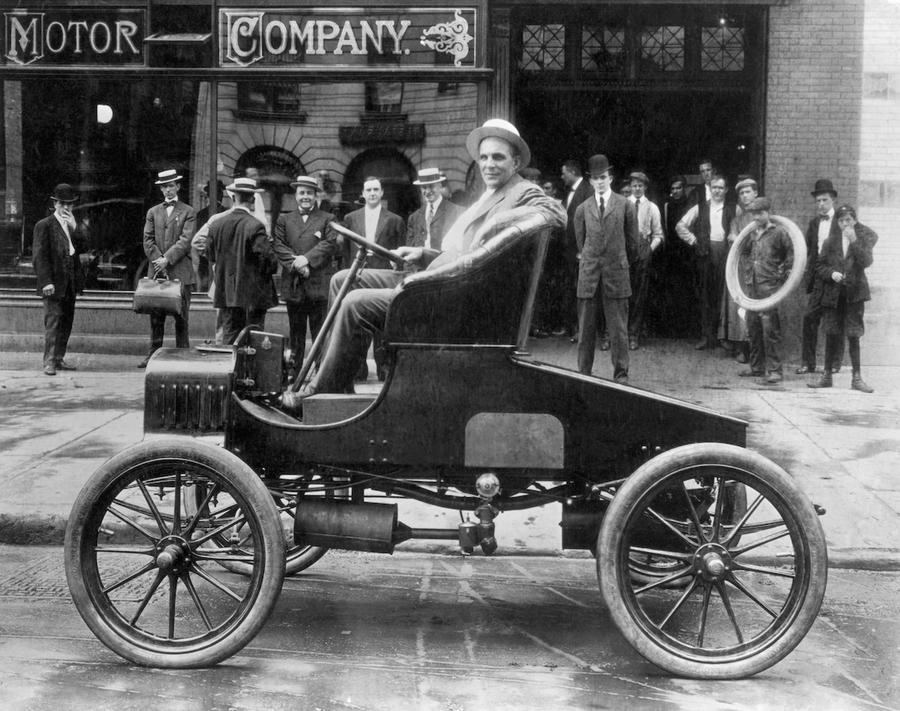
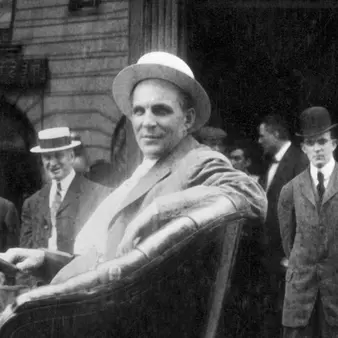
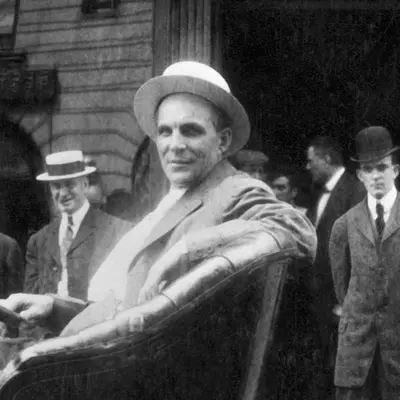
Henry Ford during the early 1900s (via Getty)
Five-Day Workweek
Ford made another influential employment decision in 1926 when the company adopted a five-day, 40-hour workweek for factory employees without reducing weekly pay. Office workers later received the same schedule.
Ford did not invent the five-day workweek, but its adoption by one of America's largest manufacturers helped accelerate the idea's acceptance. Henry argued that workers needed leisure time both to enjoy their lives and to participate in a mass-consumption economy.
Anti-Union Campaign
Ford's relatively high wages did not translate into support for organized labor. Henry fiercely resisted the United Auto Workers long after General Motors and Chrysler had recognized the union.
Ford's Service Department, controlled by former boxer Harry Bennett, employed an aggressive internal security force that monitored workers and fought union activity. The conflict culminated in the notorious 1937 "Battle of the Overpass," when Ford security personnel attacked UAW organizers, including Walter Reuther, as they attempted to distribute literature outside the River Rouge plant.
Photographs of the beating appeared across the country and badly damaged Ford Motor Company's reputation. Henry nevertheless continued resisting unionization until a major strike in 1941. Under pressure from his wife Clara, his son Edsel, and federal officials, Ford finally agreed to recognize the UAW.
Ford Aviation
Ford also became an important figure in early aviation. During World War I, the company manufactured Liberty aircraft engines, and in the 1920s Ford acquired the Stout Metal Airplane Company.
The Ford Trimotor became one of the best-known early commercial passenger and freight aircraft. Nearly 200 were built between 1926 and 1933.
During World War II, Ford's Willow Run plant became an extraordinary example of American wartime manufacturing. The factory mass-produced B-24 Liberator bombers using techniques adapted from automobile production and eventually reached a production rate approaching one completed bomber per hour.
Ferrari and Le Mans
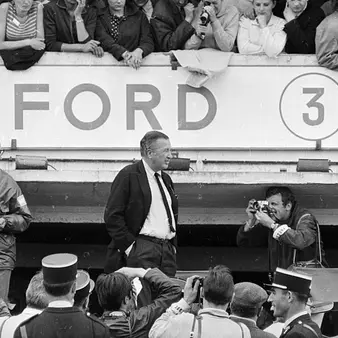
One of the most famous episodes associated with the Ford empire began when the company attempted to acquire Ferrari in 1963. Henry had died 16 years earlier, so the confrontation was led by his grandson Henry Ford II, but the battle that followed became an important extension of the industrial and competitive culture Henry had created.
Ford spent months negotiating with Enzo Ferrari before the transaction collapsed over control of Ferrari's racing operation. Ford responded by pouring enormous resources into developing a car capable of beating Ferrari at the 24 Hours of Le Mans.
The resulting Ford GT40 eventually dominated the race. With major contributions from figures including Carroll Shelby, Ford swept the top three positions at Le Mans in 1966 and won the race four consecutive times from 1966 through 1969. The story later became the basis of the film "Ford v Ferrari."
Political Activities
Ford's fame drew him into politics and international affairs. An outspoken pacifist during the early years of World War I, he financed a 1915 expedition to Europe aboard a vessel quickly nicknamed the "Peace Ship," hoping private citizens could help negotiate an end to the conflict.
The effort became a public embarrassment and accomplished little. After the United States entered the war, Ford Motor Company nevertheless became an important military supplier.
In 1918, Henry ran for the U.S. Senate from Michigan as a Democrat at the urging of President Woodrow Wilson. He narrowly lost the election.
Antisemitism
Henry Ford's antisemitism represents one of the darkest aspects of his legacy. In 1918, he acquired "The Dearborn Independent," a local newspaper that he transformed into a nationally distributed publication.
Beginning in 1920, the newspaper published a long series of antisemitic articles promoting conspiracy theories about supposed Jewish control of finance, media, politics, and culture. The articles were subsequently collected in four volumes under the title "The International Jew."
Although Ford did not personally write most of the material, the articles were produced by an organization he financed, published under his ownership, and distributed through his business network. The writings spread internationally and became particularly influential among antisemites in Germany.
Adolf Hitler praised Ford in "Mein Kampf," and Ford was the only American mentioned positively by name in the book. In 1938, Nazi Germany awarded Ford the Grand Cross of the German Eagle, the regime's highest decoration for a foreigner.
Ford eventually faced intense public criticism and a libel lawsuit over the newspaper. In 1927, he issued an apology and shut down "The Dearborn Independent," claiming he had not been aware of everything that had been published in his name.
Ford Foundation
The Ford Foundation was established in 1936 by Henry's son Edsel with an initial contribution of $25,000. It began as a relatively modest Michigan charitable organization.
That changed dramatically after the deaths of Edsel in 1943 and Henry in 1947. Their estate plans transferred enormous holdings of nonvoting Ford Motor Company stock to the foundation while preserving voting stock for family members.
The transfers transformed the Ford Foundation into one of the richest philanthropic institutions in the world. The organization later diversified away from Ford Motor Company stock and became institutionally independent of both the company and the Ford family.
Clara and Edsel Ford
Henry married Clara Jane Bryant in 1888. They had one child, Edsel Bryant Ford, who was born in 1893.
Edsel became president of Ford Motor Company in 1919, although Henry continued exercising enormous authority over major decisions. Their personalities and business instincts differed sharply. Edsel was heavily interested in automobile styling, design, architecture, and Ford's luxury operations, while Henry remained focused on manufacturing efficiency and low-cost transportation.
Edsel died from cancer in 1943 at just 49 years old. His death devastated the family and created a serious succession crisis at Ford Motor Company.
Later Years and the Next Ford Generations
After Edsel's death, Henry reassumed the presidency of Ford Motor Company despite being nearly 80 years old and in declining health. He had suffered strokes and increasingly relied on Harry Bennett, whose influence concerned other members of the Ford family.
Edsel's eldest son, Henry Ford II, returned from military service and joined Ford management. Clara Ford and Edsel's widow, Eleanor, eventually pressured Henry to surrender control to his grandson. Henry Ford II became company president in September 1945 at just 28 years old and quickly began transforming Ford into a professionally managed global corporation.
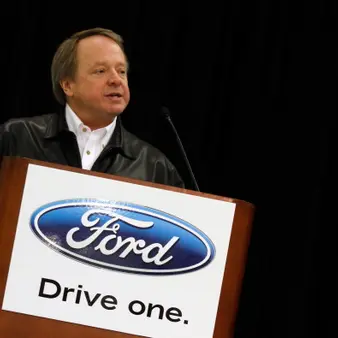
Henry's youngest grandson, William Clay Ford, later served on Ford's board for nearly six decades and became the longtime owner of the Detroit Lions. Subsequent generations maintained the family's role at Ford Motor Company, including Henry Ford II's son Edsel Ford II, who served on Ford's board for more than three decades.
Death
Henry Ford died from a cerebral hemorrhage on April 7, 1947, at Fair Lane, his estate in Dearborn, Michigan. He was 83 years old.
By the time Ford died, the automobile had transformed almost every aspect of American life. Cars altered where people could live and work, accelerated suburban development, created enormous new industries, reshaped cities and roads, and gave ordinary families a degree of mobility that would have been unimaginable when Henry was born.
His manufacturing methods were equally influential. High-volume factories, standardized products, relatively high industrial wages, falling consumer prices, and mass consumption became defining characteristics of 20th-century American capitalism.
Henry's estate planning created an unusual financial legacy. Most of the economic value represented by his Ford Motor Company holdings ultimately passed to the Ford Foundation, while voting control remained within the family.
At his peak, Henry Ford's personal fortune exceeded $1 billion at a time when billionaire fortunes were almost nonexistent. Measured according to the share of the American economy and economic resources his wealth represented, his fortune was equivalent to roughly $200 billion today, securing his place among the wealthiest individuals in modern history.