
/2010/03/Clive-Davis.jpg)
/2009/12/LA.jpg)
/2009/11/Whitney-Houston.jpg)
/2009/10/Bruce-Springsteen-1.jpg)
/2020/02/toni-braxton-1.jpg)
/2022/05/Patti-Smith.jpg)
/2022/01/mary-lou.jpg)
/2021/05/gary.jpg)
/2013/07/GettyImages-800836002.jpg)
/2015/03/GettyImages-98102880.jpg)
/2013/07/GettyImages-504405760.jpg)
/2011/07/Drake-Bell-1.jpg)
/2020/04/Eddie-Vedder.jpg)
/2012/12/Brooke-Mueller.jpg)
/2016/01/Kirk-Cousins.jpg)
/2013/09/Sean-Duffy.jpg)
/2021/03/Morgan-Wallen2.jpg)
What is Clive Davis's Net Worth and Salary?
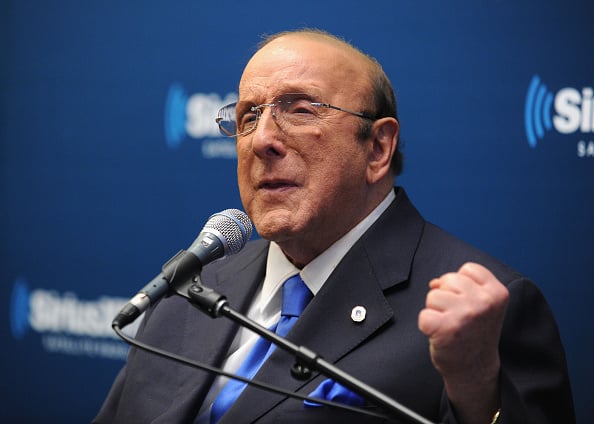
Clive Davis is an American record producer and music industry executive who has a net worth of $850 million. Clive Davis is known for heading such labels as Columbia Records, Arista Records, and J Records. Over the course of his decades-long career in the music industry, he signed such major artists as Janis Joplin, Bruce Springsteen, Billy Joel, and Sly and the Family Stone. Additionally, Davis is credited with helping to launch the careers of Whitney Houston and Barry Manilow. Five-time Grammy-winner Clive Davis is also a member of the Rock and Roll Hall of Fame as a non-performer.
Early Life and Education
Clive Davis was born on April 4, 1932 in the Brooklyn borough of New York City to Jewish parents Herman and Florence. He was raised in the Crown Heights neighborhood. When Davis was a teenager, he lost both of his parents within a two-year span; he subsequently lived with his married sister in Queens. For his higher education, he attended New York University, from which he graduated magna cum laude in 1953 with a degree in political science. Davis went on to attend Harvard Law School on a full scholarship; he graduated in 1956.
Legal Career
After graduating from Harvard Law, Davis practiced at a small firm in New York. Following two years there, he moved to the firm of Rosenman, Colin, Kaye, Petschek, and Freund. Notably, partner Ralph Colin had CBS as a client, leading to Davis's hiring as an assistant counsel for the CBS subsidiary Columbia Records. Eventually, he moved up to the position of general counsel.
Columbia Records
While Davis was serving as general counsel at Columbia Records, the company underwent a reorganization. As a result, in 1965, Davis was made administrative vice president and general manager of Columbia. The year after that, CBS formed the Columbia-CBS Group, which in turn yielded the new music operations arm CBS Records. Davis became the head of that new unit, and within a year was appointed president. Looking to capitalize on the fledgling generation of rock and folk rock artists, he signed British singer-songwriter and musician Donovan early on. Additionally, Davis hired singer Tony Orlando as general manager of the Columbia publishing subsidiary April-Blackwood Music. Later, Orlando became vice president of CBS Music.
After attending the Monterey Pop Festival in the summer of 1967, Davis immediately signed Janis Joplin and her group Big Brother and the Holding Company. He went on to sign a number of other successful artists to Columbia, including Santana, Bruce Springsteen, Chicago, Billy Joel, and Loggins and Messina. In the early 70s, Davis had major gets by signing Earth, Wind & Fire and Aerosmith. Meanwhile, one of the most commercially successful albums during his Columbia tenure was Lynn Anderson's "Rose Garden," which spawned the worldwide hit single of the same name. In 1973, Davis was fired from Columbia/CBS for allegedly taking company funds to bankroll his son's bar mitzvah.
Arista Records
In 1974, Davis founded Arista Records. At the label, which he headed until 2000, he signed a plethora of hugely successful artists, including but not limited to: Barry Manilow, Whitney Houston, Dionne Warwick, Aretha Franklin, Patti Smith, Ace of Base, Air Supply, Taylor Dayne, and Alicia Keys. In 1989, Davis co-founded Arista Nashville with Tim DuBois, and subsequently signed such country artists as Pam Tillis, Brad Paisley, and Brooks & Dunn. Davis was later fired from Arista and its parent company BMG in 2000 due to an age restriction policy. In 2011, Arista was dissolved during the restructuring of RCA.
LaFace Records
In 1989, Clive co-founded LaFace Records with L.A. Reid and Kenneth "Babyface" Edmonds. LaFace Records would become enormously successful in the late 90s and early 2000s thanks to acts like TLC (75 million records sold), Toni Braxton (65 million) and Usher (65 million).
J Records, RCA, and Sony
After leaving Arista, Davis launched the label J Records, which was distributed through the RCA Music Group. A couple years later, he became president and CEO of RCA. In 2004, BMG merged with Sony Music Entertainment to form Sony BMG, and in 2008 Davis left RCA to become Sony BMG's chief creative officer. He was soon promoted to chief creative officer of Sony Music Entertainment.
Andrew Toth/Getty Images
Bad Boy Records
In 1993, Sean Combs was a recently-fired talent executive at Uptown Records looking for a home. He landed a meeting with Clive, who was famously not a fan of rap music at the time. Later Clive would explain:
"I didn't even know that much about Puffy. I did take the meeting, and it was no question that he had the vision, that a hip-hop revolution was coming. He needed my expertise to "conquer" Top 40, I was skeptical. So I asked Puffy, what music do you have? He played me "Flava In Ya Ear" by Craig Mack. That sold me."
Clive gave Puffy a distribution deal and $15 million to launch Bad Boy Records. Through Bad Boy, Clive would have enormous success from artists like Mase, 112, The Notorious B.I.G. and Faith Evans.
Davis created J Records in 2000 and now serves as the chief creative officer for Sony Music. He has five Grammy awards and is a member of the Rock & Roll Hall of Fame.
Personal Life
Davis wed his first wife, Helen Cohen, in 1956; they eventually divorced in 1965. He was subsequently married to Janet Adelberg from 1965 until their divorce in 1985. Davis has a total of four children: Fred and Lauren from his first marriage and Mitchell and Doug from his second. In his 2013 autobiography "The Soundtrack of My Life," he publicly revealed his bisexuality.
Real Estate
Clive Davis owns a number of properties in New York City. He owns at least five units in a single Manhattan building located at 465 Park Avenue. In 2017 he listed one of his units in the building for $7.8 million. He eventually reduced the price to as low as $6.2 million before taking it off the market in 2019. That one unit alone comes with a monthly $11,700 HOA fee!
He also owns a luxurious compound in Westchester County, New York where he frequently entertains guests on weekends. The home, which he bought in 1991 after his second divorce, has a 30-seat home theater and an 8,000 square-foot main house in addition to a 6,000 square-foot guest house.
Awards
Davis has won five Grammy Awards as a producer. His first was in 1994 for Album of the Year for Whitney Houston's soundtrack to the movie "The Bodyguard." Davis next won Best Rock Album and Album of the Year for Santana's "Supernatural." His other Grammy Awards are for Best Pop Vocal Album, for Kelly Clarkson's "Breakaway," and Best R&B Album, for Jennifer Hudson's self-titled debut. In other honors, Davis won the Golden Plate Award from the American Academy of Achievement in 2000.
Art Collection
Clive's art collection might be worth $100 million on its own. The collection includes pieces from Picasso, Damien Hirst, Dale Chihuli, Adolph Gottlieb, Andy Warhol and more.
/2010/03/Clive-Davis.jpg)
/2009/11/Whitney-Houston.jpg)
/2009/11/alicia.jpg)
/2020/05/babyface-2.jpg)
/2020/01/tommy.jpg)
/2024/05/craig-mack.png)
/2021/08/mariah.jpg)