
/2017/12/Whitney-Wolfe-Herd.jpg)
/2020/07/jm-1.jpg)
/2020/06/jb2.jpg)
/2010/11/Evan-Williams-1.jpg)
/2011/04/se.jpg)
/2012/03/Sara-Blakely-1.jpg)
/2009/11/George-Clooney.jpg)
/2017/02/GettyImages-528215436.jpg)
/2009/09/Cristiano-Ronaldo.jpg)
/2019/11/GettyImages-1094653148.jpg)
/2019/04/rr.jpg)
/2009/09/Brad-Pitt.jpg)
/2018/03/GettyImages-821622848.jpg)
:strip_exif()/2015/09/GettyImages-476575299.jpg)
/2020/06/taylor.png)
/2009/09/Jennifer-Aniston.jpg)
/2019/10/denzel-washington-1.jpg)
What is Whitney Wolfe Herd's net worth and salary?
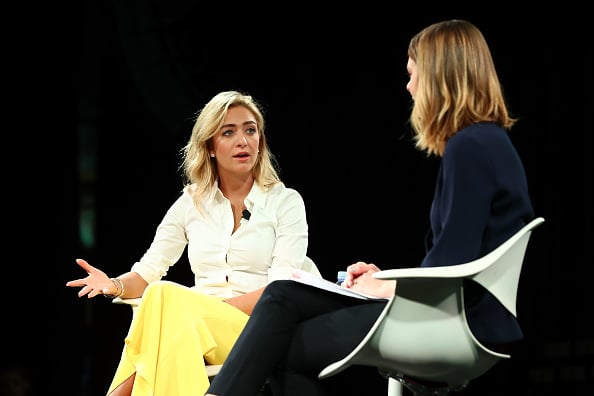
Whitney Wolfe Herd is an American entrepreneur who has a net worth of $100 million. Whitney Wolfe Herd is best known as the founder and executive chair of Bumble, one of the world's leading dating and social networking apps. She first rose to prominence as a co-founder and early executive at Tinder, where she played a central role in the app's initial marketing and launch strategy. Wolfe Herd helped establish Tinder's presence on college campuses, which drove its viral early growth. However, her time at the company ended in 2014 after a highly publicized sexual harassment and discrimination lawsuit, which she settled out of court for just over $1 million.
That same year, Wolfe Herd founded Bumble with backing from Russian billionaire Andrey Andreev, who had previously launched the dating service Badoo. Unlike traditional dating apps, Bumble introduced a women-first approach in which only women could initiate conversations after a match. The concept differentiated the platform in a crowded market and quickly attracted millions of users, especially among younger women seeking a safer, more empowering online dating experience. Bumble expanded beyond dating to include Bumble BFF and Bumble Bizz, broadening its reach into friendship and professional networking.
Wolfe Herd became one of the most visible female leaders in the tech industry. In February 2021, she took Bumble public on the NASDAQ, with the company valued at over $13 billion at its debut. At age 31, she became the youngest woman in the U.S. to take a company public and briefly held billionaire status from her stake in the firm.
Bumble Ownership
When Bumble went public on February 11, 2021, Whitney's net worth officially topped $1.5 billion. At that point, she owned 21.5 million shares, equal to roughly 11.6% of the company's outstanding equity. Whitney was the youngest CEO ever to take a company to an IPO, accomplishing the feat at 31.
Prior to the IPO, she had privately sold about $100 million worth of shares as part of the 2019–2020 Blackstone acquisition and restructuring.
Over the next several years, her ownership stake steadily declined through a combination of planned secondary offerings and open-market sales. In 2023, she sold approximately 1.75 million shares in a secondary offering connected to Blackstone's sell-down. In 2025, she sold another 1.36 million shares through her holding entities for roughly $8.5 million. Smaller disposals were also made to cover tax obligations tied to vested stock awards.
Unfortunately, just ten months after the IPO, in November 2021, Whitney lost her billionaire status as Bumble's share price began a prolonged collapse. Bumble's market cap at IPO was roughly $8 billion. By November 2025, the company's valuation had plunged to about $400 million, a decline of approximately 95% from its public-market debut.
According to the most recent SEC filings, Whitney now owns about 1.7 million Bumble shares, equal to roughly 1.5% of the company. At a $400 million market cap, those shares are worth approximately $6 million.
Early Life and Education
Whitney Wolfe Herd was born on July 5, 1989, in Salt Lake City, Utah, to Kelly and Michael Wolfe. She grew up in a close-knit family and attended Judge Memorial Catholic High School, where she was known for her interest in social issues and international culture. After graduating, she enrolled at Southern Methodist University in Texas, majoring in international studies. During her time at SMU, she became increasingly interested in global humanitarian work and entrepreneurship, passions that would later influence her career. Her college years also provided the environment where she first experimented with business-building, brand development, and social-impact ventures.
Career Beginnings
Wolfe Herd's entrepreneurial instincts surfaced while she was still in college. After the 2010 BP oil spill, she launched a small business selling bamboo tote bags to raise funds for communities affected by the disaster. She partnered with celebrity stylist Patrick Aufdenkamp to design the bags, and national attention followed when stars like Nicole Richie and Rachel Zoe were photographed carrying them. Encouraged by the response, Wolfe Herd and Aufdenkamp created a second project — a limited clothing line built around raising awareness of human trafficking and encouraging fair-trade labor practices.
After graduating from SMU, Wolfe Herd spent time working with orphanages and aid programs in Southeast Asia. This period reinforced her interest in empowering vulnerable communities, a theme that later shaped the mission and brand identity behind Bumble.
Tinder
In 2012, Wolfe Herd joined Sean Rad's startup Cardify, a loyalty rewards app incubated inside Hatch Labs. As Cardify wound down, Rad, Wolfe Herd, Justin Mateen, Jonathan Badeen, and engineer Joe Munoz shifted their energy toward a new dating concept known internally as MatchBox. Wolfe Herd ultimately suggested the name "Tinder," inspired by the material used to spark a flame — an idea meant to reflect quick, frictionless connections.
She became Tinder's vice president of marketing and was instrumental in its early strategy, particularly its now-famous push onto college campuses. By framing Tinder as a fun, social discovery tool for young adults, she helped ignite the viral spread that turned it into one of the fastest-growing apps of the decade.
However, her time at the company ended abruptly in 2014 following a deterioration of her working relationship with other executives. She resigned and soon filed a sexual harassment and discrimination lawsuit against Tinder and its parent company. The dispute was widely covered in the media and concluded with Wolfe Herd receiving more than $1 million plus stock as part of a confidential settlement.
Joe Scarnici/Getty Images
Bumble
After leaving Tinder — and enduring a wave of online harassment in the process — Wolfe Herd began exploring ideas for a women-centered social platform. Her original concept, a compliment-based networking app called Merci, eventually evolved into something broader. She partnered with tech entrepreneur Andrey Andreev, founder of Badoo, to build a new kind of dating app designed to give women more control over their online interactions. The working name was Moxie, but when that name proved unavailable, the pair settled on "Bumble."
Wolfe Herd moved to Austin in late 2014 and launched Bumble shortly thereafter. Its defining feature was simple but transformative: in heterosexual matches, only women could make the first move. The approach was pitched as a safer, more respectful alternative to traditional dating apps. By the end of 2015, Bumble users had exchanged over 15 million conversations and logged 80 million matches. Two years later, the platform surpassed 22 million registered users.
In 2019, Blackstone acquired a majority stake in MagicLab, the parent company overseeing Bumble and Badoo. As part of the transaction, Wolfe Herd became CEO of MagicLab. In 2020, Bumble was reorganized as the primary parent brand, and by then the app had grown to more than 100 million users worldwide. In early 2021, she took Bumble public on the Nasdaq, becoming the youngest woman in U.S. history to lead a company to an IPO. The surge in Bumble's stock price briefly made her the world's youngest self-made female billionaire.
Although the IPO was a major milestone, the years that followed were far more turbulent. After an initial spike above its $43 offering price, Bumble's stock began slipping in late 2021 as revenue growth slowed and competition in the dating-app market intensified. Within ten months of the IPO, the share price had fallen far enough for Wolfe Herd to lose her billionaire status. The decline accelerated through 2022, 2023, and 2024 as the company issued softer revenue guidance, undertook layoffs, and struggled to meet investor expectations. By 2025, Bumble's stock had lost roughly 95% of its value compared to its debut, and the company's market capitalization had contracted from approximately $8 billion at IPO to around $400 million. Wolfe Herd stepped back from the CEO role in 2024 to become executive chair, and later returned to the CEO position in 2025 as part of an effort to stabilize the business and refocus the product.

Bennett Raglin/Getty Images
Chappy
Outside of Bumble, Wolfe Herd helped fund Chappy, a UK-based dating app designed specifically for gay men. Founded by Ollie Locke, Jack Rogers, and Max Cheremkin, the app emphasized user safety and authenticity. Chappy allowed users to choose between searching for "Mr. Right" or "Mr. Right Now," and used Facebook verification to ensure accurate profile photos. The app mirrored many of Bumble's values around respectful, positive online interactions.
Personal Life
In 2017, Wolfe Herd married Texas oil and gas heir Michael Herd, whom she first met during a 2013 ski trip in Aspen. The pair welcomed their first child, a son, in December 2019. Between Bumble's rapid rise and the demands of parenthood, Wolfe Herd has often spoken about navigating the balance between building a high-growth tech company and maintaining a grounded family life.

Vivien Killilea/Getty Images
Real Estate
Whitney Wolfe Herd and her husband, Michael Herd, have owned several notable luxury properties in both Texas and California. Their primary base has long been Austin, where Michael's family developed a sprawling 6.5-acre Lake Austin compound featuring three residences, a private movie theater, multiple boat docks, a helipad, extensive entertaining spaces, and more than 500 feet of waterfront. The property was listed for sale at $28.5 million in 2020, reflecting both its size and its status as one of Austin's premier lakefront holdings.
In early 2023, Whitney and Michael expanded to California with the purchase of Rancho San Leandro, a historic Montecito estate previously owned twice by Ellen DeGeneres and Portia de Rossi. The Herds paid $21 million for the romantic, 19th-century adobe property, which sits on several lush acres in the gated Ennisbrook community. Wolfe Herd described the hacienda as a peaceful retreat from the intensity of her tech career, noting its old-world architecture, horse facilities, courtyards, and mountain views. After roughly two years of ownership, the couple quietly sold the property in 2025 for about $22.8 million in an off-market deal.
/2017/12/Whitney-Wolfe-Herd.jpg)
/2020/07/jm-1.jpg)
/2018/08/GettyImages-135181389.jpg)
/2020/06/jb2.jpg)
/2010/11/Evan-Williams-1.jpg)
/2018/08/GettyImages-625496334.jpg)
/2014/08/sp2.jpg)
/2020/02/Angelina-Jolie.png)
/2020/04/Megan-Fox.jpg)
:strip_exif()/2009/09/P-Diddy.jpg)