
/2016/03/joe-kennedy.png)
/2020/02/rk.png)
/2021/01/John-F.-Kennedy.jpg)
/2010/01/michael2.jpg)
/2020/03/john-d-rockefeller-1.jpg)
/2009/09/Ted-Kennedy.jpg)
/2020/01/lopez3.jpg)
:strip_exif()/2009/09/P-Diddy.jpg)
/2009/09/Cristiano-Ronaldo.jpg)
/2019/04/rr.jpg)
/2009/11/George-Clooney.jpg)
/2020/02/Angelina-Jolie.png)
/2020/06/taylor.png)
:strip_exif()/2015/09/GettyImages-476575299.jpg)
/2019/10/denzel-washington-1.jpg)
/2018/03/GettyImages-821622848.jpg)
/2020/04/Megan-Fox.jpg)
What was Joseph Kennedy's net worth?
Joseph Kennedy was an American businessman, politician, and investor who had a net worth of $400 million at the time of his death in 1969. That's the same as roughly $3.2 billion today after adjusting for inflation. In 1957, Fortune Magazine estimated Kennedy's net worth at $200 – $400 million. That level of wealth made him one of the 15 richest people in the country.
Joseph Kennedy was born in Boston, Massachusetts, in September 1888 and passed away on November 18, 1969, at 81 years old. He was married to Rose Kennedy and was the father of President John F. Kennedy, Senator and Attorney General Robert F. Kennedy, and Senator Ted Kennedy.
Joseph Kennedy's life was marked by extraordinary achievements and immense wealth. Contrary to popular legend, Kennedy did not accumulate his fortune through bootlegging. His wealth was actually derived primarily from stock market investments, real estate, and financing Hollywood films. He did have large investments in the legal liquor importing and distribution business after prohibition was lifted. As the patriarch of the influential Kennedy family, Joseph played a significant role in shaping the political landscape of the United States in the 20th century.
Business Empire & Peak Wealth
After graduating from Harvard in 1912, Kennedy went to work for the Columbia Trust Bank. When the bank was facing a financial crisis, Joseph borrowed $45,000 from friends and family (roughly $1.1 million today) to buy a controlling interest in the bank. He quickly proved himself to be a talented entrepreneur. Kennedy became a millionaire for the first time thanks to the 1920s bull market. He then took many short positions in 1929, right before the market crashed. He would later claim that he knew it was time to get out of the highly-hyped stock market when he started receiving tips from his shoe-shine boy. During the depression, Kennedy bought vast amounts of real estate at extremely low prices. In 1929, his net worth was estimated at $4 million (roughly $60 million today). Within six years, his net worth was believed to be around $180 million (roughly $3 billion today). In his later career, Kennedy made huge profits investing in Hollywood film studios.
Early Life
Joseph Patrick Kennedy was born on September 6, 1888, in East Boston, Massachusetts. He was the son of Patrick Joseph Kennedy, a successful saloon owner, businessman, and Democratic political figure, and Mary Augusta Hickey. The family was upwardly mobile but not wealthy by national standards.
Kennedy attended Boston Latin School before graduating from Harvard College in 1912. Even at a young age, he demonstrated ambition and financial instinct. Unlike many members of Boston's Brahmin elite, Kennedy was not born into established wealth. He built it.
In 1914, he married Rose Fitzgerald, the daughter of Boston mayor John "Honey Fitz" Fitzgerald. The marriage united two ambitious Irish-American political families and laid the foundation for the Kennedy dynasty.
Early Business Career
After graduating from Harvard, Kennedy briefly worked in banking. When Columbia Trust Company encountered financial difficulties, the 25-year-old Kennedy borrowed $45,000 from friends and family, roughly $1.1 million today, to purchase a controlling stake. He became one of the youngest bank presidents in the country.
This early move demonstrated two hallmarks of his career: leverage and control.
He soon transitioned fully to investment activity, operating in stock pools and securities syndicates during the roaring 1920s. Kennedy was not reckless, but he was opportunistic. He understood speculation better than most of his peers.
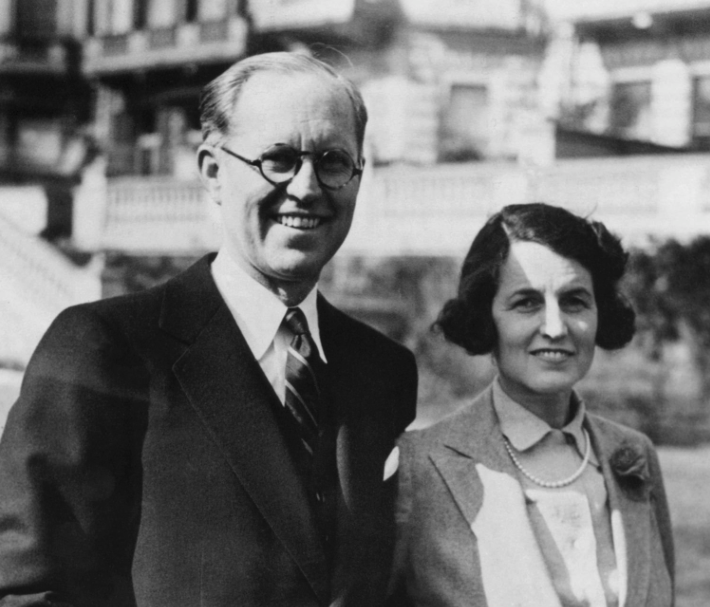
Getty
Stock Market Success and the 1929 Crash
Kennedy's first major fortune came during the 1920s bull market. Unlike many contemporaries, he exited before the crash. By his own account, he began liquidating his stock holdings when market speculation became so widespread that even his shoe-shine boy was offering stock tips.
Whether embellished or not, the anecdote captured his philosophy: when euphoria becomes universal, it is time to leave.
By 1929, his net worth was estimated at roughly $4 million, equivalent to about $60 million today. Within several years, as markets collapsed and assets were liquidated at distressed prices, Kennedy deployed capital aggressively. By the mid-1930s, estimates of his wealth ranged dramatically higher, with some later placing it north of $100 million.
Hollywood and RKO
In the late 1920s, Kennedy entered the motion picture industry. In 1926, he acquired a controlling interest in Film Booking Offices of America (FBO). He later merged FBO with Pathe Exchange and Keith-Albee-Orpheum theaters, forming RKO Radio Pictures.
RKO would go on to produce major films, including "King Kong" and later "Citizen Kane."
Kennedy did not remain a studio executive long-term. True to form, he built value, consolidated, and exited. His Hollywood investments were enormously profitable and significantly expanded his capital base.
Real Estate Investments
Real estate was the single most important pillar of Joseph P. Kennedy Sr.'s fortune and the long-term financial backbone of the Kennedy dynasty.
By the late 1940s, Kennedy had largely moved away from high-risk speculation and toward capital preservation. With his sons entering politics, stability mattered more than aggressive expansion. Income-producing commercial real estate, particularly in major urban centers, offered exactly what he wanted: predictable cash flow, long-term appreciation, and insulation from public scrutiny.
Manhattan became a central focus. Through holding companies such as Ken Industries and the Park Agency, Kennedy accumulated a portfolio of high-quality New York properties. He bought at distressed prices during the Depression and held patiently. Over time, those assets appreciated substantially. Unlike industrial magnates tied to a single operating company, Kennedy's wealth became decentralized, diversified, and difficult to publicly track.
But the crown jewel of the real estate portfolio — and arguably the most important asset in the Kennedy empire — was Chicago's Merchandise Mart.
In 1945, Kennedy purchased the massive commercial complex for just under $13 million. At the time, the property was considered oversized and financially cumbersome. Kennedy saw something different: scale, location, and steady rental income. Under family ownership, the Mart became an extraordinary cash-flow machine. By the late 1960s, it was valued at approximately $75 million and represented the largest single building block of Kennedy wealth.
More importantly, it generated reliable annual income for decades. That income funded trusts, foundations, family households, and indirectly supported the political ambitions of multiple Kennedy sons. The Merchandise Mart was not just an investment. It was the financial engine that powered a dynasty.
Then, in 1998 — nearly 30 years after Joe Kennedy's death — the family made a move that crystallized the success of his long-term strategy.
The Kennedys sold the Merchandise Mart and related properties to Vornado Realty Trust in a deal widely reported at approximately $625–$680 million. The exact structure involved a mix of cash and securities, but the headline number placed the transaction in the high hundreds of millions.
Liquor and Oil
Contrary to popular myth, there is no credible evidence that Kennedy built his fortune through illegal bootlegging. However, after Prohibition ended in 1933, he made substantial legal investments in liquor importing and distribution, securing early import rights for brands such as Dewar's Scotch.
In the late 1940s, he also invested in oil, partly to take advantage of favorable tax treatment under the oil depletion allowance. These investments were not massive relative to his real estate holdings, but they added diversification and tax efficiency.
Peak Fortune
By the late 1930s, Joseph Kennedy's various ventures had made him one of the wealthiest men in the United States, with an estimated net worth of $400 million. He used his fortune and influence to support the political ambitions of his sons, John F. Kennedy, Robert F. Kennedy, and Edward M. Kennedy, all of whom went on to have successful careers in public service.
Death
Joe Kennedy suffered a stroke in 1961. As a result, he developed aphasia and lost his ability to speak. Joseph P. Kennedy passed away on November 18, 1969 at 81 years old.
/2016/03/joe-kennedy.png)
/2009/09/Ted-Kennedy.jpg)
/2020/02/rk.png)
/2026/02/jfk-jr-scaled.jpg)
/2026/03/jack-schlossberg.jpg)
/2018/02/gw.jpg)
/2021/01/John-F.-Kennedy.jpg)
/2010/01/michael2.jpg)
/2017/02/GettyImages-528215436.jpg)
/2009/09/Brad-Pitt.jpg)
/2009/09/Jennifer-Aniston.jpg)