
/2014/06/butcher.jpg)
/2019/05/harley-race.png)
/2014/06/rick-1.jpg)
/2016/02/GettyImages-484967365.jpg)
/2013/09/Nattie-Neidhart.jpg)
/2014/07/terry-funk.jpg)
/2009/09/Jennifer-Aniston.jpg)
/2020/01/lopez3.jpg)
/2009/09/Brad-Pitt.jpg)
/2020/02/Angelina-Jolie.png)
/2009/09/Cristiano-Ronaldo.jpg)
/2019/10/denzel-washington-1.jpg)
/2017/02/GettyImages-528215436.jpg)
/2019/04/rr.jpg)
/2020/06/taylor.png)
/2019/11/GettyImages-1094653148.jpg)
:strip_exif()/2009/09/P-Diddy.jpg)
What is Abdullah the Butcher's net worth?
Abdullah the Butcher is a semi-retired Canadian wrestler who has a net worth of $500 thousand. Known for his wild brawling style, violent matches, and a terrifying persona that earned him nicknames like "The Madman from Sudan," Abdullah became one of the most infamous and feared wrestlers in history. Standing over six feet tall and weighing more than 360 pounds at his peak, he carved out a decades-long career across Japan, the United States, Puerto Rico, and Canada, becoming synonymous with hardcore wrestling before the term existed. Abdullah was never a mainstream television star in the sense of WWE champions, but his influence on the development of extreme wrestling is undeniable. With his signature forehead scars and brutal in-ring tactics involving forks, spikes, and chairs, he became a global wrestling legend whose matches drew massive crowds throughout the 1970s, 1980s, and 1990s.
Early Life
Lawrence Robert Shreve was born on January 11, 1941, in Windsor, Ontario, Canada. Growing up in a working-class family, he developed an interest in martial arts and athletics early on, training in judo and karate before entering the world of professional wrestling. Shreve's martial arts background later influenced his ring persona, as he often incorporated karate stances and gestures into his character. Early in his career, he crafted the "Abdullah the Butcher" gimmick — an unpredictable, silent, bloodthirsty wildman allegedly from Sudan — that would define his entire wrestling identity.
Wrestling Career
Abdullah debuted professionally in the late 1950s and gained notoriety throughout the 1960s in regional territories, including the NWA and Stampede Wrestling in Calgary. He quickly stood out for his violent style, which contrasted with the more technical wrestling of the era. His character rarely spoke, instead relying on his menacing presence and the chaos he brought into matches. His signature weapons included forks and foreign objects, often used to "carve" opponents in the ring, creating shocking visuals that became his trademark.
During the 1970s and 1980s, Abdullah became a major attraction in Japan, particularly with All Japan Pro Wrestling and New Japan Pro Wrestling, where his matches against legends like Giant Baba, Antonio Inoki, and Terry Funk became cult classics. His feuds in Puerto Rico's World Wrestling Council (WWC), especially with Carlos Colón, are remembered as some of the bloodiest rivalries in wrestling history. Their brutal brawls filled stadiums and helped make WWC a dominant promotion in the Caribbean.
Although Abdullah never competed extensively in the WWE (then WWF), his reputation preceded him, and he was inducted into the WWE Hall of Fame in 2011 for his contributions to the business and influence on future generations of hardcore wrestlers.
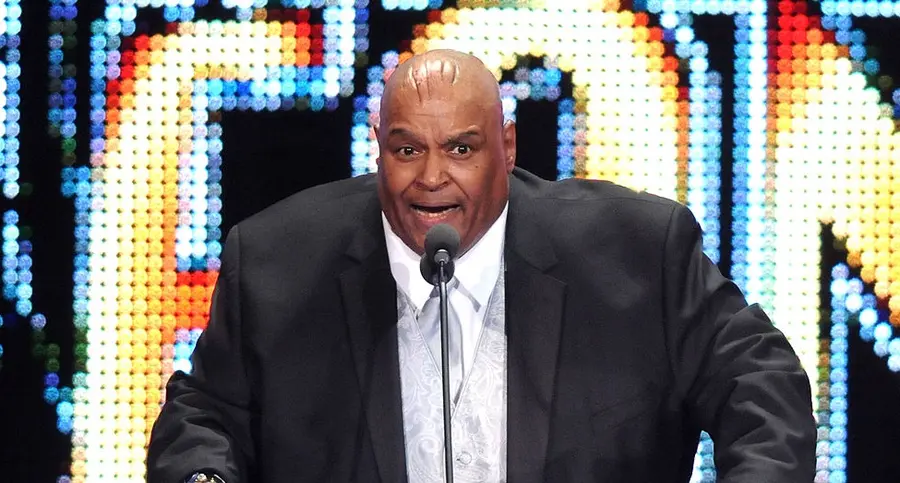
(Photo by George Napolitano/FilmMagic)
Legacy and Influence
Abdullah the Butcher's influence on the wrestling world is enormous. He helped define the "hardcore" or "death match" style that later became popular through promotions like ECW and Japan's Frontier Martial-Arts Wrestling (FMW). Wrestlers such as Mick Foley, Sabu, and The Sheik have all cited him as a major influence. His willingness to absorb and inflict punishment, combined with his ability to terrify audiences, made him a one-of-a-kind performer. He was also among the first wrestlers to achieve true international superstardom without needing a major American TV platform.
Outside of wrestling, Abdullah opened a soul food restaurant in Atlanta, Georgia, called "Abdullah the Butcher's House of Ribs and Chinese Food," which became a popular local spot for both wrestling fans and celebrities for many years. He also made a handful of appearances in film and television, always playing off his infamous in-ring persona.
Later Years and Controversies
In his later years, Abdullah's career became the subject of controversy. In 2014, he was sued by fellow wrestler Devon Nicholson (Hannibal) for allegedly infecting him with hepatitis C during a match, leading to a court ruling against Abdullah. The judgment damaged his public reputation, and his health began to decline in the years that followed. In 2024, reports surfaced that he had been placed in a care facility, prompting widespread concern among wrestling fans and fellow performers.
Despite the controversies, Abdullah the Butcher remains one of the most iconic and polarizing figures in wrestling history. His legacy endures as a pioneer of hardcore wrestling, a global attraction who helped shape the industry's violent spectacle, and a performer whose influence can still be felt in every chair shot, blood feud, and death match that followed.
/2014/06/butcher.jpg)
/2014/07/terry-funk.jpg)
/2019/05/harley-race.png)
/2019/09/CNW-Man-4.png)
/2014/06/rick-1.jpg)
/2013/06/rob.jpg)
/2014/12/Colt-Cabana.jpg)
/2020/04/Megan-Fox.jpg)
/2018/03/GettyImages-821622848.jpg)
:strip_exif()/2015/09/GettyImages-476575299.jpg)
/2009/11/George-Clooney.jpg)