
/2009/11/ron.jpg)
/2020/01/ronaldinho.jpg)
:strip_exif()/2010/04/Lionel-Messi-1-e1588467513958.jpg)
/2017/05/GettyImages-835653576.jpg)
/2010/05/Karim-Benzema.jpg)
/2014/05/Neymar.jpg)
/2009/09/Cristiano-Ronaldo.jpg)
/2019/11/GettyImages-1094653148.jpg)
:strip_exif()/2015/09/GettyImages-476575299.jpg)
/2019/04/rr.jpg)
:strip_exif()/2009/09/P-Diddy.jpg)
/2020/01/lopez3.jpg)
/2009/09/Brad-Pitt.jpg)
/2009/09/Jennifer-Aniston.jpg)
/2018/03/GettyImages-821622848.jpg)
/2020/04/Megan-Fox.jpg)
/2017/02/GettyImages-528215436.jpg)
What is Ronaldo's Net Worth and Salary?
Ronaldo is a retired Brazilian football player who has a net worth of $160 million. Also known as "R9" or "O Fenomeno" (The Phenomenon), Ronaldo made a massive impact (and a massive amount of money) on the game of football despite a relatively short time in the spotlight. He was a goalscoring machine who led Brazil to a memorable World Cup title in 2002. He is also credited with reinventing the way strikers play football. At his peak, Ronaldo was considered the best player in the world. He is currently considered one of the best players of all time.
He won the FIFA World Player of the Year award three times, and he has received the Balon d'Or award twice. To this day, he is the youngest ever player to receive the Balon d'Or, having first won it at the age of 21. He was also the youngest person to ever win the FIFA World Player of the Year award at age 20. Professional clubs were willing to pay exorbitant sums to have Ronaldo on their teams, and he twice broke the world record signing fee.
In terms of goal-scoring ability, he is one of the highest-scoring players of all time. He scored 62 goals for Brazil, and only Pele has scored more for his country. At age 23, he had scored 200 goals for club and country. However, Ronaldo's career faded abruptly with a sudden onset of serious injuries. In what seemed like a blink of an eye, Ronaldo disappeared from the game of football as quickly as he had appeared.
After leaving the game, Ronaldo became closely involved with philanthropic work, becoming a United Nations Development Programme Goodwill Ambassador. He also served as an ambassador for the 2014 FIFA World Cup. In 2018, Ronaldo purchased a team in the Spanish La Liga called Real Valladolid, and in 2021, a controlling stake in Cruzeiro.
Early Life
Ronaldo Luiz Nazario de Lima was born on September 18th, 1976, in Rio de Janeiro, Brazil. Raised alongside two siblings, Ronaldo played soccer in the streets of Rio from a young age. Shortly after his parents divorced when he was 11, Ronaldo dropped out of school to pursue a career as a professional soccer player. He began his career as a futsal player (indoor soccer), joining a youth league and quickly becoming the lead scorer in the entire city's league. In his first season alone, he scored 166 goals. Futsal was an important part of Ronaldo's development, helping him learn technical skills and close ball control that would become his key strengths in his later playing career. Ronaldo was quickly signed by sports agents.
Career
Ronaldo made his professional debut for the Brazilian side Cruzeiro in 1993. While still a 16-year-old, he scored five goals in one match and started to attract international attention. After scoring 44 goals in 47 games during his first season, Ronaldo joined the Brazilian World Cup squad in 1994, but only as an unused substitute.
After the World Cup, Ronaldo joined Dutch side PSV Eindhoven. After scoring 30 goals in his first season, some were already wondering whether Ronaldo had what it took to be the best player of all time despite being just 18. His second season at PSV was marred by a knee injury. Before the 1996-1997 season, Ronaldo joined Barcelona for a then-world-record fee of $19.5 million. During his first season, he scored an unbelievable 47 goals in all competitions and ended 1996 with a FIFA World Player of the Year Award.
Ronaldo spent just one season at Barcelona before moving to Inter Milan, again breaking the world record with a signing fee of $27 million. Although he had to adapt to the Italian style of play during the first season, he eventually became a more complete striker during his time at Inter and won his first Ballon d'Or.
In 1998, Ronaldo entered the FIFA World Cup as a starting striker for Brazil, and many considered him to be the best player on the planet. He scored continuously throughout the tournament before a convulsive fit threatened to take him out of the final. He miraculously recovered just hours before kickoff, but he seemed dazed, and Brazil lost the final to France. Later, a neurologist determined that Ronaldo should not have been allowed to play while feeling the aftereffects of a seizure.
In the years that followed, Ronaldo began to have serious issues with his knees. In 2000, he suffered a complete rupture of his kneecap tendons. This caused Ronaldo to miss almost three years of professional sport, although he returned in 2002 to help Brazil win the World Cup. That year, he also signed with Real Madrid for 46 million Euros. He was one of Real's key players, but Ronaldo suffered from continuous injury and weight issues during his time in Madrid.
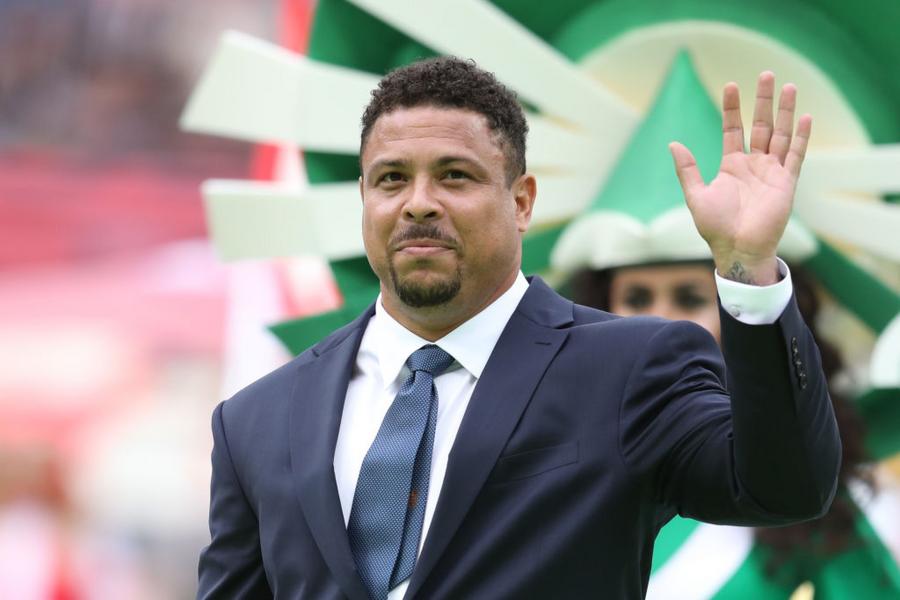
(Photo by Catherine Ivill/Getty Images)
After playing one last time for Brazil in the 2006 World Cup, Ronaldo transferred to A.C. Milan in 2007 for 8.05 million Euros. In 2008, he suffered another serious knee injury and joined the Brazilian club Corinthians shortly thereafter. In 2011, he officially retired, revealing for the first time that he suffered from hyperthyroidism – which explained his weight gain issues. In addition, he admitted that his body simply couldn't continue after suffering so many injuries, even though mentally, he wanted to keep going. His entire footballing career lasted 18 years.
Nike Contract
Nike was quick to sign Ronaldo to a lucrative contract. In 1996, he signed a 10-year contract and lifetime brand endorsement deal with Nike for $180 million. Shortly after the contract was signed, Nike designed the now-famous Mercurial R9 soccer boot for him. He wore the boots at the 1998 FIFA World Cup, and ever since then, they have become some of Nike's most successful boots. In the years that passed, similar Mercurial boots were designed for players like Cristiano Ronaldo and Kylian Mbappe. Ronaldo also appeared in a range of Nike commercials over the years.
Other Brand Endorsements
Outside of his commitment to Nike, Ronaldo has appeared in a range of other commercials over the years. Some of his most notable appearances were in Snickers and Pirelli commercials, and he is also a regular feature in EA's "FIFA" video game franchise.
Club Ownership
In 2018, it was announced that Ronaldo had purchased a controlling stake in the La Liga club Real Valladolid. He paid approximately 30 million Euros for a 51% stake in the team, making him the majority owner. After the acquisition, Ronaldo announced that he was approaching his new managerial role with the utmost seriousness, stating that he wanted to build "the best team possible."
In December 2021, he purchased a controlling stake in Cruzeiro, his boyhood club, for 400 million reais ($70 million at the time).
Personal Life
Ronaldo met Brazilian model and actress Susana Werner in 1997, and the couple held a longterm relationship and lived together in Milan until 1999. In December 1999, he married Brazilian footballer Milene Domingues, who was pregnant with his first son, and they divorced four years later. In 2005, Ronaldo became engaged to Brazilian model and MTV VJ Daniela Cicarelli, but the relationship lasted only three months. In 2008, he got engaged to Maria Beatriz Antony, and they had two daughters together. In December 2010, a paternity test confirmed that Ronaldo was the father of a boy named Alexander, who was born after a brief relationship with a Brazilian waitress named Michele Umezu. Ronaldo first met Umezu in Tokyo in 2002. After confirmation of a fourth child, Ronaldo had a vasectomy.
/2009/11/ron.jpg)
/2010/04/Lionel-Messi-1-e1588467513958.jpg)
/2016/12/ronaldo.jpg)
/2026/03/GettyImages-2265322555.jpg)
/2009/09/Cristiano-Ronaldo.jpg)
/2015/02/GettyImages-455987296.jpg)
/2020/06/GettyImages-1199531911.jpg)
/2023/01/GettyImages-1325105287.jpg)
/2019/10/denzel-washington-1.jpg)
/2009/11/George-Clooney.jpg)